






11.27.11
Posted by Ryan at 5:00AM

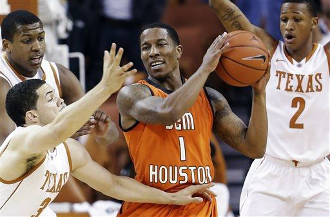
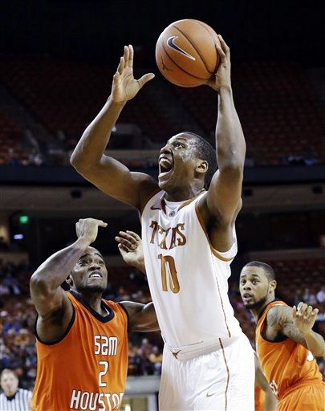
Texas Longhorns 56, Sam Houston State Bearkats 40

It certainly wasn’t pretty, but the Texas Longhorns put a stop to their losing streak on Saturday night, grinding out a 56-40 win over Sam Houston State at the Erwin Center. Despite taking nearly six minutes to make their first bucket and shooting less than 32% from the field, the Longhorns were able to pull away in the final minutes to push their record back above the .500 mark.

What looked good

There was hardly anything that looked good in this one, but there were some bright spots for Texas. Most importantly, the Longhorns were able to come out on top of the rebounding battle, something they have struggled with all season. It should be noted that Sam Houston State went with a small lineup all night, oftentimes running four guards at a time. But when winning the battle on the glass is as tough as it has been for Texas this season, you have to take the victories when you can get them.

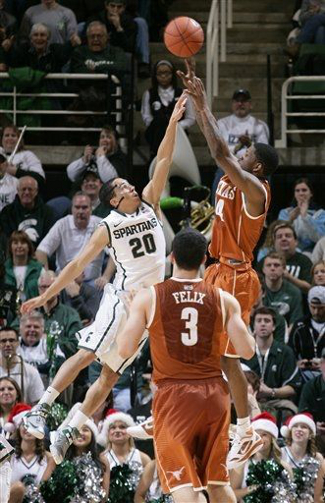
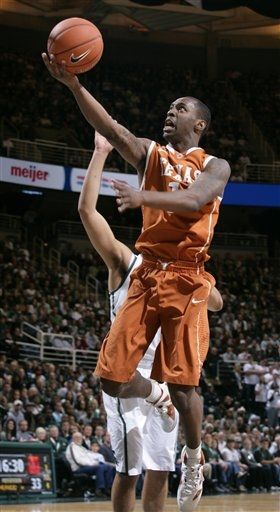
Alexis Wangmene scored a career-high 13 points
(Photo credit: Michael Thomas/Associated Press)

The Longhorns were able to reclaim more than 40% of their missed shots, only the second time they’ve done so this season. They also reached that mark in the loss to Oregon State, with their numbers in the three other games all mired in the mid-30 percent range. Defensively, they held the Bearkats to just a 30.6% offensive rebounding mark, but allowed those second chances to turn into 10 extra points.

Individually, the biggest breakthrough came from Alexis Wangmene, who scored seven of his 13 points in the final 7:28 to help Texas stretch their lead. Alexis was able to capitalize on his good looks inside, something that had proved difficult for the big man in the past, and he held onto rebounds and loose balls instead of fumbling them away. He logged eight boards in his 27 minutes.

The only player to outscore Wangmene was Jonathan Holmes, who also fought hard for his points inside and even tested his three-point range. Although the freshman was just one of three from behind the arc, getting that long-range shot on tape will give opposing defenses one more thing to consider while game-planning for the Horns. Holmes was just one rebound shy of a double-double, and could have had even more points if not for some point-blank misses.

It was also nice to see Wangmene and Clint Chapman getting extended minutes at the same time, and actually being successful while doing so. They certainly got some help from facing a the smaller Bearkat lineup, but when the pair was faced with defensive situations in the post, they performed admirably. On one particular occasion, Wangmene went to the floor trying to draw a charge, leaving his man isolated on a Texas guard. Chapman slid across the lane and blocked the shot, saving an easy bucket.

What needed work

Other than those bright spots, there wasn’t much else to get excited about for Texas. Although J’Covan Brown cracked double-digits in scoring, he did so by shooting just 26% from the field. He also continued to drive baseline against a Bearkat defense that had shown it would double along the boundary and cut off both driving and passing lanes. Julien Lewis also had a tough day at the office, missing all three of his three-point attempts and going just 1-for-7 from the field in his 26 minutes of work.

Texas struggled the most in the early stages of the game, allowing Sam Houston State to build a lead as large as 12 just eight minutes into it. While the Longhorns missed a few good looks early, they clearly started to press on the offensive end, taking quick shots instead of being patient with their possessions. Late in the first half, the team made a brief commitment to scoring in transition and working the ball in low, and that is when they found the most success.

Myck Kabongo had a rough night for Texas
(Photo credit: Michael Thomas/Associated Press)

It was also troubling to see the Longhorns struggle at the line late in the game. Texas was 8-for-9 from the stripe in the first half, but made just 8-of-17 in the second. Myck Kabongo missed three of four in the final 15 seconds, while Wangmene missed two opportunities to complete three-point plays down the stretch. When Texas finds itself in close games later this season, a repeat of this charity-stripe performance will surely end in defeat.

Not only did Kabongo struggle at the line in the final minutes, but he once again had a rough day from the floor. McClellan mentioned in the post-game interview that the Longhorns were overthinking on the offensive end, passing up good looks for fear of repeating their poor shot selection from earlier in the game. Kabongo certainly looked like he lacked confidence in this one, and he missed his first five shots before finally draining a last-minute three.

The freshman has had trouble finishing inside this season, so adding in these problems with the jump shot only makes him easier to defend. Without a shot to keep opponents honest, it’s going to be hard for Kabongo to find cracks, create, and dish out the assists.

Up next: vs. North Texas (1-2); Tuesday, 7 P.M. CT

11.22.11
Posted by Ryan at 8:05AM

North Carolina State Wolfpack 77, Texas Longhorns 74

The consistent storyline this season has been the youth of the Texas Longhorns. How quickly would this young team produce, and how soon would the freshmen mature? On Monday night in New Jersey, it turned out to be the team’s junior leader who had a costly moment of immaturity.

The Longhorns built a lead as large as 18 points against N.C. State in the second half. The Wolfpack had clawed back to within 13 points with just 8:25 to play. That’s when J’Covan Brown and the Longhorns unraveled. Whistled for his fourth foul, Brown said it was “bullshit” on his way to the bench and was tagged with a technical foul, which was also his fifth personal. His night was over, and so were the hopes for a Longhorn victory.

J’Covan Brown’s technical had Rick Barnes seeing red
(Photo credit: Bill Kostroun/Associated Press)

North Carolina State seized the momentum and stormed back, turning the remaining 13-point deficit into an eight-point lead in less than six minutes. The Texas offense stalled out, earning just two points during the meltdown, with both coming at the free throw line.

The Longhorns managed to wake up and stay competitive in the final minutes, but it was too late. A potential game-tying three pointer from Julien Lewis was slapped away as time expired. Although the ball was on its downward flight when it was blocked, it was well short and already below the iron, sending Texas home with an 0-2 record in New Jersey.

What looked good

For the first thirty minutes, the Longhorn offense was clicking. Early on, the freshmen were the ones lighting up the scoreboard, as Brown took more than 12 minutes to log his first bucket. Jonathan Holmes was aggressive from the start, scoring the team’s first seven points. He was confident with the ball and tenacious on the glass, finishing the night with 16 points and eight boards.

Texas’ early success was built on smart basketball, with the first five buckets all coming after an assist. The Longhorns moved the ball well, kept N.C. State on its heels, and looked for the open teammates for easy finishes. Although Brown’s early exit limited him to just 28 minutes on the floor, the junior was again the major facilitator, dishing out seven dimes to go with his 17 points.

Sheldon McClellan also had another solid game for Texas, consistently putting the ball on the floor and driving to the paint. His aggressive play earned him seven trips to the line, and he knocked down five freebies, finishing with 16 points. The freshman logged 28 points and eight rebounds in his two games in East Rutherford and was named to the All-Tournament Team.

Perhaps the biggest thing for the Longhorns was that they won the rebounding battle for a second straight game. Even more importantly, they did their best job on the defensive glass all season, allowing a very talented N.C. State frontcourt to win just 27.6% of their offensive rebounding chances. In the first three games, Texas had not held an opponent below 41% on the offensive glass.

The Longhorns also continued their success at the free-throw line, knocking down 76% of their attempts. Unfortunately, the team missed three out of five in the minutes following Brown’s foul-out, including the front end of a one-and-one. With the offense struggling so much during the N.C. State run, missing the freebies only made things worse.

It was also encouraging to see solid defensive efforts from the Texas big men early on. Alexis Wangmene and Clint Chapman both blocked a shot in the first few minutes of the game, and Wangmene frustrated the Wolfpack’s Richard Howell, setting the tone early with sound post defense.

What needed work

Obviously the most glaring issue in this one was a lack of maturity by Brown. He claimed after the game that his words weren’t directed at the referee and were said when he was almost to the bench. Regardless of the where or why, he cannot even put himself in a situation where he could be misunderstood. The simple fact of the matter is that he has to know better.

His coach said as much in his post-game comments. “That’s where he’s gotta grow up,” Barnes told the media. “This happens too much. Sooner or later he’s going to have to figure it out. It’s a team game. It’s not about him.”

Unfortunately, Myck Kabongo and the rest of the Longhorns went into their turtle shells after Brown left the game. The Texas offense deteriorated into weak attempts at dribble penetration, followed by taking the air out of the ball at the perimeter when those drives were turned away. Earlier in the season, Kabongo was able to put the ball on the floor and create offense. After Brown’s departure, it looked like the freshman point guard had completely forgotten how.

That disappearing act by the Kabongo coupled with the frightened play of Sterling Gibbs against Oregon State is huge cause for concern. If Texas has no other guards to step up in Brown’s absence, any foul trouble for the junior will spell disaster for the Longhorns. It wouldn’t even be that surprising to see future opponents get a little chirpy in Brown’s ear in an effort to set him off and eliminate Texas’ leadership.

In addition to Brown’s maturity issues, the Longhorns have to be concerned with how careless the team was with the ball early. Texas turned it over seven times in the first 12 minutes of play, but still managed to hold a five-point lead. Most frustrating was the fact that many of the turnovers were simple miscommunications or lazy passes when the Wolfpack had little or no pressure on the ball. Fortunately, Texas was able to calm down and only turn it over six more times the rest of the game, but their miscues still led to 21 points for the opposition.

Texas also continued to have difficulties with foul trouble. Every Longhorn outside of Gibbs picked up at least three fouls, and the team drew 28 whistles in total. The team’s defensive free throw rate was an improbable 100%, meaning that the Wolfpack took as many shots at the line as it did from the field.

The Texas defense has Rick Barnes looking for answers
(Photo credit: Bill Kostroun/Associated Press)

There’s something to be said about the fact that N.C. State was in the bonus before the first media timeout of the second half. But at the same time, the Longhorns have to be cognizant of the fact that they have a short bench and they must play defense with their feet rather than their hands. We saw quite a bit of zone from Texas in New Jersey when foul trouble began to build, and there might be a lot more of that in the future if the Horns cannot play man-to-man defense without drawing whistles.

The big picture

While losing two second half leads to drop two consecutive games is annoying in its own right, these defeats are even more frustrating when considered in a larger context. The Longhorns have a tough round-robin schedule awaiting them in conference play, and precede that with road trips to UCLA and UNC. Quality wins are going to be tough to come by, and for a team that is likely going to be on bubble watch all season long, these two losses are squandered opportunities.

N.C. State and Oregon State are both teams that will likely surprise people in their conferences. The Pac-12 appears to be wide open outside of a strong Cal squad, while the ACC is top heavy with North Carolina, Duke, and Florida State leading the charge. A win in either game this weekend would have looked very good come March. Now, Texas will have to wait to build its résumé.

Next up: vs. Sam Houston State (1-2); Saturday, 7 P.M. CT

11.20.11
Posted by Ryan at 9:52AM

Oregon State Beavers 100, Texas Longhorns 95 (OT)

The Longhorns had a fresh-faced 23-year old on the bench Saturday night. He sat with graduate assistants Connor Atchley, Royal Ivey, and Chris Mihm. He listened in from the back of team huddles. He even pulled freshman point guard Myck Kabongo aside for a few quick pointers. About the only thing Kevin Durant didn’t do at the IZOD Center last night was check into the ballgame. Coach Rick Barnes probably wishes that the NBA superstar could have.

Kevin Durant watched the Longhorns give up a late lead
(Photo credit: Bill Kostroun/Associated Press)

With the most famous face of the Texas basketball program looking on, this year’s young batch of Longhorns surrendered a late lead and lost to Oregon State in overtime, 100-95, in the semifinals of the TicketCity Legends Classic. It was a script that likely seemed all too familiar for Durant, as his 2006-07 Texas squad lost their own November tournament semifinal to Michigan State on a last-second shot from Drew Neitzel.

For this year’s team, the well-known weaknesses of depth and rebounding came home to roost. Five Longhorns fouled out in the game, forcing little-used walk-on Andrew Dick to check in for action in the final seconds of action.

Unfortunately, it never had to come to that point. The Longhorns had the game in hand with less than 30 seconds left. Up by two points, J’Covan Brown missed a three as the shot clock expired and managed to race across the top of the key to secure his own rebound. But as he dribbled towards the left wing to await the inevitable foul, Oregon State’s Jared Cunningham stripped him from behind and flipped the ball to a teammate as he fell out of bounds.

Cunningham knocked down three of four from the line in the game’s final 18 seconds, while Kabongo made one of two and had his potential game-winning layup blocked at the regulation buzzer. The Longhorns would take an early lead in overtime, but the ensuing 9-0 push from the Beavers proved to be the difference in the game.

Wilting under the pressure of the final few minutes underscores the youth of this team. Players are still defining their roles, and no one seemed prepared to step up and be the leader in the clutch. Fortunately the season is a long one, and the Longhorns have many months to grow.

What looked good

In the first half, the Texas offense was humming. They moved the ball crisply around the perimeter and on kickouts off of the drive. The Longhorns were 6-for-12 from behind the arc in the first half, but strayed from the long ball after half. Texas shot just three three-pointers in the second half as Oregon State whittled away the five-point Texas lead.

J’Covan Brown led Texas with 25 points
(Photo credit: Bill Kostroun/Associated Press)

Brown was again the star for Texas, just missing a double-double with 25 points and nine assists. He created shots for himself and for teammates with penetration, piling up the dimes with easy drop offs to the bigs underneath when the defense collapsed on him. There were still times that the junior guard tried to force things and play one-on-five, but Texas fans have to be happy with Brown’s commitment to finding his open teammates this season.

Brown was not the only one creating shots. Sheldon McClellan looked very confident with the ball, proving that he can put it on the floor and knife through the defense for good looks. Despite coming off the bench, McClellan scored 12 points on 56% shooting and grabbed five rebounds.

Jonathan Holmes also did a good job on the boards, snagging five in his 21 minutes of play. Unfortunately, his playing time was limited by foul trouble, an issue that dogged the entire Texas lineup all night.

The Longhorns also continued their success at the free throw line, knocking down 73.3% of their attempts. Texas will likely find themselves in a lot of close games this season, and every single point will be huge. Some fans might point to the eight missed free throws in this game and bemoan missed opportunity, but the overall trend is much more important than dwelling a few single shots. These new-look Longhorns are more than 11 percentage points better at the line than last year’s squad.

Fans can also take solace in the fact that Texas actually won the rebounding battle and did a solid job on the offensive glass. The Longhorns reclaimed 47.5% of their misses, a massive improvement over their first two games. The offense has been highly efficient through three games, and if they can build on this success on the glass and continue to extend possessions, it will only make them even tougher to stop.

What needed work

While the offensive rebounding was solid, Texas still had a terrible time on the defensive glass. They allowed the Beavers to grab 43% of their missed shots, leading to 26 second-chance points. Time and again the Longhorns let balls come off the weak side and fall into the hands of a waiting Oregon State player for an easy putback.

Most troubling about the continued issues on the defensive glass is that Texas struggles regardless of the opponent. The Beavers were a very average offensive rebounding team in their first three games, but absolutely obliterated their previous season high with their performance against Texas.

A big reason for Oregon State’s success was that Alexis Wangmene and Clint Chapman were practically non-existant on the glass, combining for only six rebounds in 42 minutes on the floor. Although they were the beneficiaries of the Texas drive-and-dish attack, scoring 17 combined points, they absolutely have to show up on the glass if Texas wants to find success this season. With games against intimidating frontlines like UCLA and North Carolina still to come, the Longhorn bigs have their work cut out for them.

Texas also looked wild and out of control at many points in the game. The Longhorns have proven to be a run-and-gun team so far this season, but didn’t have any issues handling the ball in their first two wins. Against the Beavers, however, they coughed it up 23 times, which equated to miscues on 28% of their possessions. Kabongo actually turned it over five times against just three assists.

Freshman Sterling Gibbs had the most trouble hanging on to the basketball. He absolutely froze against the Oregon State pressure, twice dribbling himself right into traps. He turned it over three times in just three minutes of play, including an inexplicable one in the final seconds of the game where he simply dribbled it out of bounds. Gibbs did have a couple of key buckets during the team’s late comeback bid in overtime, but he’s going to spend much of the year on the bench if he can’t hang on to the ball.

Jaylen Bond also had a rough night, and it all stemmed from problems on defense. He couldn’t seem to keep any of the Beavers in front of him, and was constantly drawing whistles by hacking from behind the play. He only played 22 minutes and still managed to foul out.

Rick Barnes will have a lot to go over in practice
(Photo credit: Bill Kostroun/Associated Press)

Cunningham played out of his mind for Oregon State, and Texas could do little to stop him. He scored 37 points, earning 20 of them in 23 trips to the line. Unfortunately, Texas is going to have trouble with strong, slashing players like him all season long. The guards and wings were picking up tons of whistles trying to contain Cunningham, and UT actually switched to a zone defense to limit the foul trouble. That led to too many open looks for their shooters — who fortunately made only two threes in the second half — as Texas’ closeouts weren’t very quick.

It’s also concerning that while Brown played with fire and intensity early, he disappeared for the second half and overtime. He had only eight points in the final 25 minutes of the game, and was clearly frustrated as the game came down the stretch. He yelled at McClellan for not passing the ball on one possession and had to be calmed down by Kabongo. Brown and Kabongo also appeared to squabble over who should be handling the ball on a later possession. With such a young team, Brown is going to need to be a leader, so he cannot afford to be petulant when he’s struggling.

All told, it was a tough loss to swallow, as the Longhorns were just seconds away from victory and have an even tougher task awaiting them in the form of NC State on Monday. There were a lot of teachable moments in the game and Coach Barnes will certainly take full advantage of building on them. But teams can learn from close wins just as much as they can from close losses, and for a team that might be sweating the bubble in March, this November win would have been huge.

11.16.11
Posted by Ryan at 5:18AM

Texas Longhorns 100, Rhode Island Rams 90

When six freshmen make up the majority of your roster, you’re bound to have some growing pains. Texas coach Rick Barnes might not have expected them to happen so soon, however. His Longhorns made it interesting against Rhode Island yesterday afternoon, building and then conceding a 17-point lead before finally finishing off the Rams, 100-90.

Texas fans were able to see brief glimpses of their team’s problem areas in a thoroughly dominating win over Boston University on Sunday, but the flaws came out in full force as the Horns slowly gave up their double-digit lead against Rhode Island. Poor rebounding, failure to control the ball, and a cold spell from long range allowed Rhode Island to erase that 17-point deficit and briefly claim a 59-58 lead early in the second half. Fortunately, the backcourt of J’Covan Brown and Myck Kabongo took charge and attacked a pesky Rhode Island defense, guiding Texas to the win.

J’Covan Brown scored a career-high 35 points
(Photo credit: Eric Gay/Associated Press

What looked good

After tying his career high with 28 points against Boston, Brown upped the ante with an impressive 35-point performance against the Rams. He was 5-of-10 from behind the arc and earned 10 points at the line by pressuring the aggressive Rhode Island D with dribble penetration.

But while his epic scoring totals are impressive, Brown’s assist numbers are just as important. J’Covan dished out six assists, giving him 14 on the season. Opponents are going to be keying on the junior guard this season, so it’s a good sign that he is already looking for and finding his open teammates. When other teams start throwing double teams at Brown, he’ll have to make them pay with timely passes.

The Longhorns also found a spark in freshman Jaylen Bond. When the team was having difficulties on the glass, he simply went out and got the basketball. Bond showed nice hops and ripped his rebounds out of the air, not allowing the ball bounce to around like many of his teammates have been. In just 17 minutes on the floor, the freshman secured six rebounds, four of them on the defensive end.

The team leader in rebounding was Clint Chapman, who grabbed eight boards on the afternoon. He also showed a little more agility with the ball than fans have seen in past seasons, unveiling a few nice face-up offensive moves. He finished with seven points, which is really all that Texas can expect at this point from the big man. While he still was beat for some rebounds that he should have controlled, overall it was a satisfactory performance.

On the perimeter, Julien Lewis picked up right where he left off, knocking down a triple to open the scoring for Texas. He took one ill-advised three early in the first half and was promptly removed and talked to by Barnes, but he learned from the mistake and stuck to open looks the rest of the way. Lewis finished 3-for-7 from long range, giving him a cool 50% success rate for the season.

Texas also found success at the free-throw stripe, a welcome sight for fans used to seeing the team struggle there in recent years. The team earned a whopping 44 free throw attempts and missed only nine of them. Bond and Jonathan Holmes, who didn’t make any trips to the line in the season opener, combined to go 9-for-10.

Not only are Horns knocking down 78.6% of their free throws so far this year, they showed great awareness in getting there against Rhode Island. With the refs calling a very tight game and the Rams playing even tighter defense, the guards put the ball on the floor and drew a hefty share of fouls all the way out on the perimeter. As a result, Texas’ free-throw rate — measured as free throw attempts per field goal attempts — was a ridiculous 74.6%. For comparison, last year’s national leaders at Northwestern State posted a 50.6% FTR.

What needed work

Unfortunately, Texas made this game much closer than it ever needed to be. The Horns were sloppy in the transition game, costing them a lot of points on turnovers and bad shots. They often careened right into the defense on the break, forcing up challenged looks or getting into positions where their only option was to throw a terrible pass at the last minute.

Kevin Durant was on hand to watch his former team
(Photo credit: Eric Gay/Associated Press

Kabongo was one player who especially had issues with this, and it underscored the fact that he isn’t quite the inside finisher that former point guard D.J. Augustin was. If Myck isn’t strong enough yet to score amongst the trees in the paint, he will have to be more under control on his drives. Flying headlong into good interior D with no passing options to bail him out simply won’t work.

Texas also had trouble with the transition game on the defensive end. As Rhode Island put together their late first-half run, their speedy guards were able to get deep into the defense and often all the way to the rim without a single Horn trying to stop the ball. When Texas did manage to turn away dribble penetration, often someone else failed to pick up an assignment coming down the court, leading to mismatches and open threes.

The Rams also utilized a ton of full-court pressure during their comeback, and the Longhorns had quite a few issues against it. Rather than beating it with the pass, their only solution was to wait for Brown or Kabongo to beat the press with their dribble. Once Texas can learn to move the ball quickly with smart passes, they can score a lot of easy points against aggressive defenses like this one.

While Chapman had a generally positive game, Alexis Wangmene struggled early and saw his playing time diminish. Early on, he had a rough time keeping up with the quicker Orion Outerbridge when the forward played face-up against him, and Barnes elected to go with Chapman and Holmes instead. Wangmene also continued to have issues hanging on to the ball on passes, rebounds, and loose ball situations. Fortunately, he did do quite a few little things right, taking a charge, setting some good screens, and sinking the midrange baseline J he took late in the game.

Finally, it is also worth mentioning that different players had defensive lapses at different times throughout the game, which is to be expected with such a young team. Barnes was liberal with the hook and took advantage of the teaching opportunities, talking over the mistakes with each player as they came off the court. Even though these Longhorns are going to have to run-and-gun to beat quite a few teams, Barnes is still very focused on teaching sound defense.

Up next: vs. Oregon State (2-0) in East Rutherford, NJ; Saturday, 8 P.M. CT

11.14.11
Posted by Ryan at 6:14AM

Texas Longhorns 82, Boston Terriers 46

It was only one game, but the future certainly looks bright for the Texas Longhorns.

Led by junior J’Covan Brown, Rick Barnes’ freshman-laden roster settled down after some early adversity and cruised to an easy, 36-point win in front of a home crowd on Sunday night. Brown tied a career-high with 28 points and added eight assists, despite enjoying the final five minutes of the blowout from the bench.

J’Covan Brown dropped 28 points on Boston
(Photo: Alberto Martinez/American-Statesman)

What looked good

Brown’s scoring outburst gives Texas fans a lot to be optimistic about, as there is no doubt that he will have to be the team’s leader this season. He scored in a variety of ways, knocking down three triples, earning his way to the line for five points, and repeatedly sinking a soft pull-up floater. Texas also found success multiple times on backdoor cuts for the junior, giving him easy finishes at the rim.

Perhaps most importantly, Brown finished the night with eight assists. One of the most consistent complaints about his game last season was his troubling habit of dominating the ball to the detriment of the team. Against Boston, he was willing to give up the rock when his teammates were in a position to score. Although Brown took a few bad shots early in the game, most of them came on possessions where the entire team was standing idly in the half-court set.

In addition to Brown’s career night, the team’s defense was another reason for excitement for Longhorn fans. Texas made the Terriers uncomfortable all night, forcing turnovers on a whopping 34.2% of Boston’s possessions. The Longhorns utilized ball pressure well past the perimeter, often making it difficult for the Terriers to even get into their offense.

The active hands of freshmen Sheldon McClellan and Jonathan Holmes earned them each a pair of steals. Both used their lengthy wingspans to simply reach around the ballhandler or disrupt passing lanes on multiple ocassions.

In the post, Alexis Wangmene gave a solid defensive effort to kick off his senior campaign. He did an excellent job standing tall and forcing players to take bad shots, and even blocked five in just 26 minutes on the court. A few of those swats came when he was the help defender, bringing to mind the excellent team defense of last season’s squad.

The only knock on Wangmene’s defensive performance was that on a few instances, it was a little too easy for his man to back him down to the blocks. Fortunately, even on those plays, he typically stiffened up the D at that point and made the Terriers earn their points.

The senior also impressed with his off-the-ball play on offense. He had a few good seals as his teammates were driving to the hoop, giving them easy access to the rim, and he set some stout high screens to free up the guards. While Texas will likely need a little more than his four point output on some nights, fans have to be very happy with his seven-rebound, five-block performance.

Senior Clint Chapman is the other half of the big-man puzzle for Texas, and while he didn’t land on any All-American lists last night, he showed that he might be a serviceable option this season. Chapman utilized some nice face-up skills late in the game, lumbering baseline for an easy dunk and taking another defender to the hole for a layup.

Myck Kabongo and the Horns played lockdown D
(Photo credit: Alberto Martinez/American-Statesman)

Freshman phenom Myck Kabongo lived up to his billing as point-guard extraordinaire, logging seven assists in just 22 minutes. While he didn’t have any highlight-reel assists, he did showcase excellent court vision on some really nice interior feeds in the second half. Kabongo also added a three pointer and a pair of steals to his stat line.

Guard Julien Lewis was one of three freshmen in the starting lineup, and he unveiled a great catch-and-shoot ability behind the arc. His Longhorn teammates constantly found him open from long range, where he knocked down 4-of-7. Seeing the team repeatedly find Lewis in the flow of the offense was a very welcome sight for Texas fans who have watched some recent teams force things from long range. Lewis also added some easy layups to score 18 in his debut.

Fellow freshman Sterling Gibbs didn’t do anything exceptionally flashy in his 20 minutes off the bench, but he knocked down his one open look from behind the arc and notched three assists.

One of the most exciting developments of the night was at the free throw line. After a season in which the Horns shot just 65.4% at the line, the team’s 75% mark in last night’s game seemed downright unbelievable. Although Brown missed his first attempt — breaking the streak of 28-consecutive makes he began in last season’s Big 12 title game — he knocked down his other five. Kabongo and McClellan were the only other Horns to make it to the line, so only time will tell if Holmes, Bond, or Lewis are comfortable at the stripe.

What needed work

The number one concern for this team heading into this season was its weakness in the frontcourt, and that problem manifested itself in a poor rebounding effort against the Terriers. Although Boston was a smaller team and had just been worked on the glass by Northeastern on Friday night, the Terriers claimed a 43-35 edge on the boards.

Some of the rebounding problems were a result of Wangmene and Chapman still struggling to control the ball when it came to them. There was also a surprising number of long rebounds that would fall loose around the free throw line or perimeter, with nothing but red jerseys around to claim it. The Longhorns allowed Boston to reclaim 43% of their missed shots, a number that is going to be absolutely deadly when replicated against a team that makes those second chances count.

There were also stretches of play where the Texas offense seemed to lack any direction or flow. For much of the first half, the Longhorn offense turned stagnant, as players stood around or half-heartedly made weak cuts along the baseline. Oftentimes, those possessions ended with Brown trying to take control and being forced into bad looks.

At halftime, the team seemed to make adjustments, coming out of the locker room with lots of motion in the half-court set and excellent interior passing to the bigs or guards cutting along the baseline. But as the Texas lead expanded, the Horns once again became complacent, jacking up an inordinate amount of threes down the stretch. Hopefully this lack of focus was simply a result of the lopsided score, and not an indication that the youngsters might camp out on the perimeter this season rather than run an offense.

As always, it’s important not to put too much stock into the results of one game, and it’s especially important not to do so after a season opener. But for Texas fans who had a multitude of concerns about this year’s team, it’s a relief to see the team play as well as they did last night.

While the frontcourt will have its share of issues against deeper, more-experienced units this season, the play of Wangmene and Chapman gives fans hope that they can hold down the fort and let the backcourt carry the team. And although the youthful Longhorns will certainly have growing pains as they face tougher teams down the road, all of the freshmen looked confident in Sunday night’s debut.

Next up: vs. Rhode Island (0-1); Tuesday, 3 P.M. CT

3.21.11
Posted by Ryan at 11:52PM

[5] Arizona Wildcats 70, [4] Texas Longhorns 69

In 2002, ESPN’s Bill Simmons penned an epic column titled “The Levels of Losing.” In it, he outlined thirteen different types of losses suffered by teams and — more importantly — their fans. A 2007 update expanded the list out to 16 different levels of losing, ranking them from the pedestrian “Princeton Principle” to the most gut-wrenching level, saved only for Game 6 of the 1986 World Series.

Derrick Williams won the game with a three-point play
(Photo credit: Charlie Riedel/Associated Press)

Not far behind Bill Buckner’s gaffe is The Sports Guy’s third most-excruciating level of losing — “The Stomach Punch.” Simmons describes it as “any roller-coaster game that ends with (A) an opponent making a pivotal (sometimes improbable) play or (B) one of your guys failing in the clutch…Usually ends with fans filing out after the game in stunned disbelief, if they can even move at all.”

Sound familiar, Texas fans?

Sunday’s loss to Arizona in the third round of the NCAA Tournament fit every letter of that description. From Derrick Williams’ improbable no-look and-1 bucket that gave Arizona the final lead, to numerous failures by Longhorn stars in the clutch, Longhorn Nation experienced a massive, unrelenting series of gut punches. We even have the stunned disbelief covered, as your intrepid travelers spent a good portion of the eight-hour drive back to Austin in that very state.

There have been a million words written and spoken about the five-second call that gave Arizona the ball for the winning possession. If you watched the game on television, you likely saw the studio discussions and 8,923 video replays. If you didn’t, feel free to use Google or YouTube — I won’t rehash the debate here. Right or wrong, that call isn’t the only reason Texas lost. As had happened multiple times this season, there was a glaring lack of basketball IQ when the game hung in the balance.

First, the entire five-count sequence was set up by Jordan Hamilton’s inexplicable timeout with 14 seconds left. The Longhorns had a two-point lead when Tristan Thompson blocked a potential game-tying shot from Williams. Hamilton grabbed the loose ball, and the game seemed to be in the bag. All Hamilton had to do was wait for the Arizona foul.

Jordan was a 77.9% free throw shooter this season. Against the Wildcats on Sunday, he was 1-for-2 from the line. If Jordan waits for the foul in that situation, more time ticks off the clock and he then has two opportunities to make it a three-point Longhorn lead. Make both of those, and it’s a two-possession ballgame. Instead, Texas had to inbound the ball against full-court pressure and an unthinkable chain of events was set in motion.

Even after the five-second violation, the Longhorns were still leading by two with 14 seconds to go. The fear in every Texas fan’s mind was that the Wildcats — who had hit 8-of-14 from behind the arc — would drill another three and win the game. But once Williams started driving to the basket, there seemed to be no way Texas could lose in regulation. Until, of course, Hamilton tried to take a charge.

Hamilton and the ‘Horns came up just short in Tulsa
(Photo credit: Charlie Riedel/Associated Press)

If Hamilton defends the shot straight up and it goes in, the game is tied, but Texas still has the ball and some time to win it. If you want to contest the shot in that situation, you have to make sure you don’t foul, or make sure your foul counts.

Williams was 8-for-14 from the line at that point, so a hard foul not only would have prevented the game-tying basket, but also probably meant that Williams would not have tied it at the line, either. In trying to draw a charge, Hamilton not only let Williams get off a shot, but left the worst-case scenario on the table. That, of course, is exactly what occurred.

After the three-point play, the Longhorns were still left with about nine seconds to try to save a win despite their series of errors. But instead of pushing the ball up the floor, J’Covan Brown calmly walked it up the court, wasting close to five seconds just getting across the timeline. He drove to the right side of the lane, threw up a floater in traffic, and time expired as Gary Johnson fought for a putback.

If Brown races up the floor, the Arizona defense has less time to get set, plus the Longhorns have time to try for a rebound and game-winning putback. Instead, they were left wandering the floor after the final buzzer, arms raised in question as the officials huddled and decided whether or not a foul occurred.

It was a heartbreaking way to end the season, especially after the gritty way the Longhorns had fought back in the second half to finally reclaim the lead. But putting the loss solely at the feet of the officials is a shortsighted conclusion. As was the case in many tense situations this season, the Longhorns failed to make the right decisions. Unfortunately, it finally caught up with them.

3.19.11
Posted by Ryan at 9:50AM

[4] Texas Longhorns 85, [13] Oakland Golden Grizzlies 81

After last year’s disappointing collapse and ignominious exit in the first round of the NCAA tournament, Texas fans were understandably skittish about embracing this year’s team. Even after a torrid 11-0 start to conference play, Longhorn Nation was still waiting for the other shoe to drop. It finally did, in the form of three losses in the team’s last five conference games and a slide to second in the conference standings.

Oakland gave Texas a fight to the final whistle
(Photo credit: Charlie Riedel/Associated Press)

Selection Sunday stung the spurned Longhorn fans even more. Texas dropped from a No. 2 or a No. 3 seed to a No. 4 seed, and drew a terribly tough match-up in an Oakland team that was probably under-seeded with its placement on the 13 line. Despite the tough draw, the Longhorns took a step towards erasing the demons of their past, hanging on to an 85-81 win against a feisty Oakland club on Friday afternoon.

While the win is just one small step in a much larger goal, it came as a relief to those Longhorn fans still skeptical after last year. Arizona will provide yet another tough test on Sunday in the NCAA Third Round, but at least for one day, Texas fans can finally breathe a little easier.

What looked good

The Longhorns did an excellent job forcing Oakland to settle for three-pointers. The Grizzlies averaged just 35% of their shots from behind the arc coming into the game, but took 39% of their attempts from long range on Friday. Texas was able to contest most of those looks, locking down sharpshooter Travis Bader and limiting him to a 2-for-11 performance from long range. Coming into the game, the freshman was drilling nearly 46% of his three-point attempts.

Star senior guard Reggie Hamilton found it just as tough to score from outside. He was just 2-of-9 against the Texas defense, and both of those threes came on stepback shots with a Longhorn defender just inches away from him. Texas couldn’t do anything better to defend those shots, and you simply have to tip your cap to Hamilton for sticking those looks.

Tristan Thompson blocked seven shots on Friday
(Photo credit: Associated Press)

Inside, Texas freshman Tristan Thompson did a fantastic job against Oakland’s Keith Benson. Thompson broke the school record for blocks in an NCAA game by swatting seven Oakland attempts, and four of those blocks came against Benson.

Oakland’s big man is a guaranteed NBA player, and might even be a lottery pick in the next NBA draft. Despite that intimidating match-up, Thompson set the tone early by taking it at Benson and forced Oakland to change their defensive approach to protect their star from foul trouble. Tristan finished with a double-double, scoring 17 points to go with 10 boards.

Jordan Hamilton also posted a double-double for Texas by scoring 19 points and grabbing 10 rebounds. He drove the lane consistently against Oakland, eschewing his usual flurry of three-point attempts. Hamilton took only three shots from behind the arc, the fewest attempts he’s had in a game since the team’s win against Kansas in Lawrence on January 22nd.

Against Oakland, Jordan made eight of his 14 attempts from inside the arc, simply because he put the ball on the floor and attacked the seams in the defense. If Hamilton will continue to attack defenses as the Longhorns move forward in the tournament, it will make the offense look much more like the well-oiled machine we saw in January and not the painfully stagnant mess we watched in late February.

Gary Johnson also had a solid game for Texas, which was a relief after how the last few weeks had gone for the senior. Johnson was just 26.7% from the field in the team’s last five games, including a 21.7% mark at the Big 12 tournament which included three missed dunks. Against Oakland, he was 4-of-6 from the field — including a made dunk — and was able to consistently knock down his patented mid-range jumper.

Off the bench, J’Covan Brown provided another solid game. He led the team with 21 points, twelve of them coming at the free throw line, where he was perfect on the day. While he had a tough time scoring inside against the physical Oakland frontcourt, Brown was able to manufacture points for his team by getting to the line. J’Covan also added three assists and six boards, and had an incredible block on a closeout against Bader on a three-point attempt.

It’s also worth noting that the rest of the team did fairly well at the free throw line, too. Hamilton and Cory Joseph were both 3-of-4 at the line, with all of Joseph’s attempts coming in the final minute of the game. Thompson was just 3-of-6 at the stripe, but at this point, 50% from the big man is a minor victory. With his season average sitting at 48.6%, Longhorn fans are simply hoping Thompson can sink one out of every two.

What needed work

Texas had just 10 turnovers in 71 possessions, but when the Longhorns did make mistakes with the basketball, it led to runs for Oakland. With Texas up 12 late in the first half, three straight turnovers and a missed three allowed the Grizzlies to slice the lead to just five points.

At the end of the game, Texas again made some poor decisions with the ball. With just five minutes left, Texas led by 15, but had three turnovers down the stretch to aid a furious Oakland comeback bid. The most egregious mistake was when Gary Johnson tried to single-handedly break the Oakland press, dribbling it three-quarters of the court before having it stolen. Oakland drilled a three on the ensuing possession, and Texas’ lead had shrunk to five.

Will Hudson and Oakland piled up points in the paint
(Photo credit: Tom Pennington/Getty Images)

Games are going to be close for the rest of the season, so the Longhorns must make better decisions in the clutch. The ball simply has to be passed to the best shooters on the floor. Rick Barnes was furious with Hamilton for passing to a poor free-throw shooter in crunch time against Kansas in Lawrence, so you have to be concerned that this could be a deadly trend in March.

Finally, it should be noted that the Longhorns had some major issues shutting down the slashing attack of Oakland inside. While Texas did a great job contesting Oakland’s long-range shots, it was often far too easy for the Grizzlies to score inside. The Longhorns allowed 1.148 points per possession, which was just under Oakland’s season average coming into the game.

A big part of Oakland’s excellent offensive efficiency was the 38 points they scored in the paint. with Benson limited to 12 points from the field, most of those points in the paint came on layups from the slashing guards and wings. If the Longhorns are going to continue to advance in the tournament, they will have to make sure the defense shuts down driving lanes as well as it shuts down the perimeter.

Next up: vs. Arizona (28-7) in Tulsa, OK; 5:10 P.M. CT, Sunday

3.13.11
Posted by Ryan at 10:21AM

No time for a full-fledged post-game, as we still have nine hours of interstate ahead of us and want to be somewhere at 5 P.M. where we can catch the Selection Show. The vast wasteland between OKC and Denton really makes that hard to do, so we’ll keep this brief.

We’ve known all season that frontcourt depth was going to be an issue, but last night was certainly an extreme example of it. Tristan Thompson played just 21 minutes thanks to foul trouble, while Gary Johnson was going through his fifth-straight rough game on the offensive end. Johnson was just 1-of-9 from the floor, giving him a 5-for-24 line during the Big 12 Tournament that included three missed dunks. In the team’s last five games, Gary is shooting just 26%.

Thompson’s foul trouble also underscored his importance to the offense even when he isn’t scoring. The team managed to grab just 25.9% of their offensive rebounding opportunities, well off their 37.9% season average. In the first half, the Longhorns only secured 20% of their offensive boards, limiting them to numerous one-and-done possessions while the Jayhawks were building a massive lead on the strength of a ridiculous 58% shooting mark. Texas was able to grab more offensive rebounds when the Morris twins were in second-half foul trouble, and Texas was able to chip away at the lead as a result.

In a tournament where one bad game can end your season, the Longhorns are going to have to hope for a draw with less physical frontcourts than the one the Jayhawks sport. Texas has competed in the past against similar teams, and even beat Kansas in Lawrence. But the chances are good that Thompson could run into the same foul trouble as he did yesterday, and then the Longhorns will likely be sunk.

Texas also made the mistake of making far too many light fouls inside. That wasn’t the difference in this game, as there was simply no beating Kansas on Saturday afternoon. But the Longhorns gave up so many and-one opportunities that it’s a troubling trend going forward. The last time Texas and Kansas played, Matt Hill did a great job making his fouls count and ensuring that the Jayhawks would have to earn both points at the line. Last night, the Longhorns not only allowed the buckets, but compounded the issue by piling up fouls and giving Kansas extra points from the charity stripe.

All the credit in the world has to go to Tyshawn Taylor. He broke down the defense off the dribble, time after time. When he wasn’t finishing at the rack, he was drawing enough defensive attention to get Thomas Robinson or the Brothers Morrii wide open dunks and layups. Taylor played his best game in ages, scoring 20 points while dishing out five dimes.

Kansas executed so well on Saturday afternoon, it’s hard to imagine a team that could have beat them. They broke down the Texas defense, moved the ball extremely well, and shut down the driving lanes on defense. If Penn State does the unthinkable this afternoon and knocks off Ohio State, there’s no question that the Jayhawks are your overall No. 1 seed in the NCAAs. After yesterday’s performance, they still have an argument even if Ohio State does win.

We’ll be checking in again via Twitter during the Selection Show. At this point, Texas is practically assured a first-weekend trip to Tulsa. They are likely a 2-seed, but there is still the chance they could slip down to the top of the 3-seed line. That wouldn’t be a result of losing to Kansas, but rather just upward trends from teams currently slotted behind the Longhorns.

The big question for LRT is where the Longhorns head for the second weekend. Texas is essentially locked out of San Antonio now that Kansas will likely be there, with Pitt in New Orleans. But with Newark being one of the four regional sites this season, we ask that for our sake, you keep all of your fingers crossed that Texas lands in Anaheim or New Orleans.

3.12.11
Posted by Ryan at 9:46AM

[2] Texas Longhorns 70, [3] Texas A&M Aggies 58

On Thursday, the Longhorns finished off a three-game sweep of their rivals from Oklahoma. A night later, Texas repeated the feat against their most-hated in-state foes. The Longhorns scrapped their way to a 70-58 win over Texas A&M in last night’s Big 12 semifinal, earning their first three-game sweep of the Aggies since the 1991-92 season, when both schools were still in the Southwest Conference.

An upset was just out of reach for the Aggies
(Photo credit: Rich Sugg/Kansas City Star)

Unlike the first two games between these two teams, this one was never a laugher. There were four ties and ten lead changes, and neither team led by more than seven points until midway through the second half. Even then, the Aggies were able to trim the margin back down to four points with just five minutes to play. A 10-2 run by the Longhorns finally put the game out of reach, with Gary Johnson icing it at the free-throw line in the final two minutes.

Although this game had the exact same number of possessions as the first game in Austin, it felt completely different. A&M’s defense did an excellent job turning back the drivers and trapping Tristan Thompson when he caught the entry pass a few feet off the block. Texas turned it over on 20.9% of its possessions and missed a handful of easy finishes at the rim in the first half. Despite all of that, the Longhorns had one of their most efficient offensive performances of the season.

The key was another strong performance on the glass. On top of an excellent 49% shooting percentage for the game, the Longhorns also grabbed 52.4% of their missed shots. That number was so good, in fact, that it was the team’s third-best performance of the season, behind only their drubbings of Coppin State and Texas State. With the Longhorns making nearly half of their shots and adding 20 second-chance points, Texas A&M’s upset hopes were dashed.

On defense, the Longhorns allowed a respectable 1.01 points per possession. The Aggies managed that level of efficiency largely by drawing fouls and getting to the line. Texas A&M had a free-throw rate of 56.3% — the second-highest allowed by Texas all year — and they converted on 21 of their 27 attempts.

That strategy of manufacturing points obscured the fact that Texas did an excellent job defending in the half-court. After falling behind 14-7 just seven minutes into the game, the Longhorn defense held the Aggies to just one field goal over the next eight minutes, allowing Texas to reclaim the lead. For the game, the Horns limited A&M to just 35.4% from the field and 27.3% behind the arc, just one night after the Aggies had shot 57.8% against Missouri and made 50% of their threes.

Jordan Hamilton led Texas with 17 points
(Photo credit: Shane Keyser/Kansas City Star)

Jordan Hamilton had his second-straight solid performance, scoring 17 points on 7-of-13 shooting. After making just 31.4% of his shots in the team’s final six regular season games, Hamilton has a field-goal percentage of 51.6% in the two Big 12 tournament games, including a 40% success rate behind the arc. Having a more-efficient Hamilton was Texas’ number-one concern heading into March. So far, things are looking up, but the true test will come for him today against Kansas.

Once again, Hamilton’s strong effort was matched by freshman Tristan Thompson. The big Canadian posted his third double-double in the team’s last four games, scoring 14 points to go with 13 rebounds. Of those, nine of Thompson’s boards came on the offensive glass. His individual offensive rebounding percentage was a whopping 32.8% for the game.

The biggest concern in the win was questionable play from the other big men. Johnson had a painful game until his six points in the final few minutes. He struggled with foul trouble most of the way, and missed his first six shots from the field, including a dunk attempt. Off the bench, Alexis Wangmene never got into the flow of the game, and only showed up in the box score thanks to his three fouls in six minutes.

Fortunately, J’Covan Brown played well off the bench, scoring 15 points on an efficient 5-of-8 shooting night. He knocked down three triples, including two in a row midway through the second half that helped the Longhorns pull away momentarily. Like Hamilton, Brown’s resurgance is coming at just the right time. He’s shooting 62.5% in the Big 12 tournament after making just 31.3% of his shots in the team’s last eight conference games.

Next up: vs. Kansas (31-2); 5 P.M. CT, Saturday

3.11.11
Posted by Ryan at 11:53AM

[2] Texas Longhorns 74, [10] Oklahoma Sooners 54

The Texas Longhorns badly needed a shot in the arm. After storming through conference play with an 11-0 mark and a efficiency differential of greater than 0.20 points per possession, Texas looked nearly unstoppable. But in their final five games of the season, the Longhorn offense stalled out at the exact time that their impenetrable defense began to lose its luster.

After holding 10 of their first 11 conference opponents to less than 0.80 points per possession, the Longhorn defense turned into a sieve during the final three weeks of the season. In losses to Nebraska, Colorado, and Kansas State, Texas allowed an average of 1.174 points per defensive possession.

The Sooners couldn’t find space against the Texas D
(Photo credit: Shane Keyser/Kansas City Star)

It was a stroke of luck, then, that the Longhorns and Sooners were matched up in last night’s quarterfinal. In the first two meetings between the teams, Texas held Oklahoma to just .797 points per possession and an effective field goal percentage of only 38.3%, while winning by an average of 12.5 points.

It was more of the same last night, as Texas built upon their strong defensive showing in the regular-season finale against Baylor. The Longhorn defense held Oklahoma to just six points in the first 10-plus minutes of the game, and jumped out to another early lead that they would never relinquish. Texas put it on auto-pilot at halftime, coasting to a 74-54 win, their third victory of the season over the Sooners.

A night after the Oklahoma offense had run roughshod over Baylor, Texas completely shut down the Sooner attack. Oklahoma shot 50% from behind the arc against Baylor in the first round game, but were just 0-5 from long range in the first half against Texas. While OU did manage to knock down half of their two-point attempts in the first half, their inability to reclaim any of the misses doomed them to failure.

Texas held the Sooners to just three offensive rebounds in the entire game, with two of them coming in the final 62 seconds. The absolute clinic on the glass gave the Longhorns a defensive rebounding percentage of 89.5%, their best mark of the season by far. The only game that saw Texas come anywhere close to that level of dominance was the season opener against Navy, in which the Horns grabbed 84.3% of the Midshipmen’s misses.

On offense, the Longhorns looked more crisp than they had in weeks. J’Covan Brown and Jordan Hamilton drove baseline from the wings time and again, resulting in layups and wide-open interior passes for the bigs. Brown had a season-high five assists, while Hamilton added a pair of his own. The unselfish play was a team-wide attitude, as Texas logged 18 assists on 29 baskets.

Jai Lucas had his best game of the season
(Photo credit: Shane Keyser/Kansas City Star)

The biggest surprise of the day came from Jai Lucas, who gave 20 minutes off the bench and gave the Longhorns an early spark with his eight points. Lucas had a very tough outing against Oklahoma in the home game on January 15th, playing just six minutes thanks to poor defense against OU’s Carl Blair. In this one, he kept the speedy guard in front of him, knocked down both of his three-point attempts, and logged three assists.

While Lucas is not going to be playing that many minutes against better opponents, the key takeaway from this one is that it appears his confidence has improved dramatically. In the last three games, Lucas shot 57% from the field, 3-of-4 behind the arc, and logged four steals. In the first 29 games of the year, he was 33.6% from the field, 20.5% from three-point range, and had three total steals.

Where Lucas was once just a spot-up shooter, he now has the confidence to drive for pull-up jumpers, and he finally seems capable on the defensive end. If Texas can just get at least 10 minutes of quality bench play from Lucas in tournament games, the team’s depth issues become less of a factor.

Inside, Tristan Thompson abused the Sooner frontcourt. He posted his eighth double-double of the season, grabbing 11 rebounds to go with his 13 points. In his last five games, Thompson is averaging 18.2 points, 11.2 boards, and 2.4 blocks per game. Without a doubt, the freshman has chosen the best time of the year to become an unstoppable force.

The most reassuring thing about the victory was the resurgence of sophomore star Jordan Hamilton. After shooting just 31.4% from the field over the team’s final five regular season games, Hamilton played a fantastic game against the Sooners. He was 9-of-18 from the field, with three of those misses coming on one particularly physical sequence inside. Hamilton seemed more willing to attack inside, wasn’t primarily focused on shooting, and used his teammates screens to come open for mid-range jumpers. If this is the Hamilton that shows up against better teams — instead of the one that dribbled the air out of the ball in recent weeks — Texas is once again a scary team.

Next up: vs. Texas A&M (24-7); Friday, 8:30 P.M. CT

« Previous PageNext Page »