






11.17.14
Posted by Ryan Clark at 8:39AM

#10/10 Texas Longhorns 85, Alcorn State Braves 53

For the second straight game, the Texas Longhorns dominated an over-matched opponent, throttling Alcorn State in the Regional Round of the 2K Sports Classic, 85-53. The Longhorns jumped out to a 15-0 lead to open the game, and didn’t allow the Braves to score their first field goal for more than 10 minutes. Texas comfortably cruised the entire way, enjoying their largest lead of 37 points with less than two minutes left in the game.

Since this should be one of the two worst teams Texas faces all season — the other being Rice — it’s important to not draw too many conclusions from such a one-sided affair. Undoubtedly, Texas fans will know much more about their team after games against Iowa and either Cal or Syracuse later this week. With those words advising cautious optimism still fresh in your mind, let’s take a look at eight notes and observations from last night’s win:

1. Texas controlled the half-court

It’s fair to say that the Longhorn half-court offense has been tough to watch at times over the last few seasons. As the team would endure lengthy scoring droughts, most possessions were long, drawn out affairs with little motion, and they typically resulted in a poor, challenged shot. Last night, those memories seemed miles away, as the Longhorns made good cuts without the ball and moved the ball quickly.

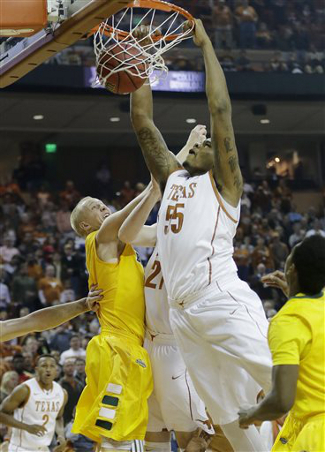
On the night, Texas finished with 24 assists on 32 baskets. The Horns constantly shifted the defense with good passing, and they played unselfish basketball, repeatedly passing up good looks to get teammates even better ones. This was exemplified in one play midway through the second half, when Prince Ibeh found himself double-teamed on the baseline. Jordan Barnett crashed to the rim from the opposite corner, and when Ibeh found him for an outlet, Barnett barely touched the ball before dumping it to Myles Turner in the lane for a dunk.

2. Improved three-point shooting continued

While good cuts and unselfish play are going to be key to finding holes against defenses that will likely sag off against Texas, good outside shooting will be just as important. With the Longhorns making only 32.7% of their threes last year and 30.1% the year before that, long-range shooting was a huge concern coming into the year. Without an outside threat, defenses can pack it in against a massive Texas frontcourt, forcing the guards to shoot over the top.

In the first game, Texas was actually below last season’s average, making just 32% of their attempts, although three of the team’s misses came while the four walk-ons were on the court. Most importantly, however, Isaiah Taylor and Demarcus Holland made 3-of-4 against North Dakota State. The two guards continued that success against Alcorn State, as did the rest of the Longhorns. Taylor and Holland again made 3-of-4, while Texas sank 12-of-25, with two of those misses coming from the walk-ons.

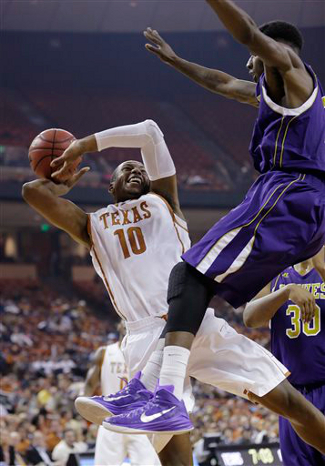
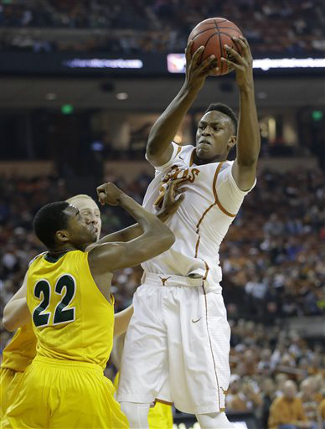
Fouling was the only way to slow down Jonathan Holmes
(Photo credit: Eric Gay/Associated Press)

To further underscore the level of improvement we’re seeing, consider these two stats: Last year, Taylor and Holland combined to make just 28.4% of their threes, with the point guard making just five all season. Through two games, Taylor already has four makes, and the pair has nailed 75% of their attempts. While the long-range looks might not be as open in conference play as they were last night, it’s a very promising sign in an area that appeared to be a major concern heading into the year.

3. Jonathan Holmes still incredibly efficient

Against the Braves, Holmes needed just 21 minutes to post a nine-point, nine-rebound performance. He was a perfect 3-for-3 from the field, including two three-point makes, pushing his season totals to 8-of-9 from the field and 4-for-5 from behind the arc. In just 36 total minutes, he has logged 24 points and 15 boards, and his offensive rating is a sky-high 174.5, putting him in the Top 50 nationally.

4. Connor Lammert stretches the floor

Between his freshman and sophomore seasons, Lammert worked on his three-point stroke, which paid off in a 34% success rate last year. With the big man often used in the high post to set ball screens, he was a constant threat on the pick-and-pop. Through two games, his three-point shooting has continued to impress, as he’s knocked down 3-of-6 from behind the arc.

Last night, Lammert showed off another skill that we’ve only seen flashes of in previous years. The big man logged seven assists on the night, picking up six of them in just the first twelve minutes of action. With Lammert already spreading the floor thanks to his three-point threat, his quality passing will certainly help to pick apart defenses once they are stretched out.

5. Isaiah Taylor set the tone early

Alcorn State’s transition defense was clearly ripe a problem in their season-opening loss to Cal, and Taylor took full advantage of that from the opening tip on Sunday night. He charged at the Braves repeatedly in the opening minutes, leaving them on their heels and scrambling. Taylor scored four of the team’s first eight points with his aggressive play, and his ability to easily attack the gaps of the Alcorn State defense also helped him dish out five assists.

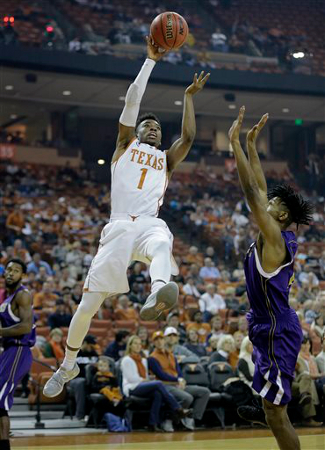
Isaiah Taylor scored 12 against Alcorn State
(Photo credit: Eric Gay/Associated Press)

If the aforementioned improvement in Taylor’s three-point shooting continues as the competition improves, it will only serve to open up more driving lanes for the sophomore guard, and force defenses to choose between trying to stop him and trying to stop the Texas bigs.

6. Foul trouble didn’t slow down Turner

Although early fouls limited the freshman phenom to just five minutes in the first half, he made a big impact after the break. Turner scored 10 points on the night, eight of them coming in the second half, and added seven points and six blocks. It’s clear that Turner’s presence in the paint is going to give opposing offenses nightmares, so Myles just needs to ensure that he can provide stifling defense without picking up fouls that limit his minutes.

7. Lapses in focus were quickly rectified

One of the overlooked benefits of having such a deep bench is the ability to easily swap out players who aren’t playing smart basketball. It’s always tough to maintain focus and execute with a huge lead, something that showed up on the defensive end in Texas’ opening night win against North Dakota State, and cropped up again last night.

Rick Barnes didn’t like what he was seeing from his team at the start of the second half, and he utilized a line change almost immediately. Within the first thirty-five seconds of the second half, Barnes had subbed out four of his starters. The second unit turned up the defensive intensity, and with that renewed focus, the Longhorns were able to extend their lead throughout the second half. Barnes has always been a coach who will sub out a player to give him some extra coaching, but now he has the depth to help ensure his team stays focused.

8. Free-throw shooting regressed to the mean

The Longhorns surprised fans on Friday night by sinking over 85% of their free throws. Even Demarcus Holland and Ibeh combined to make 5-of-7 against NDSU, an absolute shock after they combined to shoot 53.6% from the line in their first two seasons.

Last night, the free-throw percentage plummeted back to normal, with those two players struggling at the line once again. The pair made 4-of-10 at the line, with Ibeh completely airballing on one of his attempts, and barely scraping iron on another.

Ibeh has earned solid minutes in these first two games, thanks to his defensive presence and his improved hands in the post. However, if he is still completely unreliable at the line, his effectiveness and minutes will be severely limited in close games.

Holland has the ability to quickly slash to the rim, something that will be even more dangerous if he continues to hit threes. Like Ibeh, if Holland can’t covert on his free-throw opportunities, there’s no reason for opponents to not foul him hard once he gets near the paint.

Up next: vs. Iowa at Madison Square Garden; Thursday, 6 P.M. CT (ESPN2)

11.16.14
Posted by Ryan Clark at 12:37PM

Alcorn State Braves (0-1) at #10/10 Texas Longhorns (1-0)
Frank Erwin Center | Austin, TX | Tip: 7 P.M. CT
TV: ESPNU | Vegas: Texas -28.5

The Texas Longhorns return to action tonight, finishing out the Regional Round of the 2K Classic with a game against Alcorn State. As with all November tournaments, the Longhorns will “advance” to New York City on Thursday regardless of the result tonight, and will take on Iowa, followed by either Cal or Syracuse.

Even if the Longhorns needed a win tonight to reach Madison Square Garden, there would not be much cause for concern. The Braves have languished at the bottom of the SWAC for all three years of Luther Riley’s tenure, and based on their performance in Berkeley on Friday night, Alcorn State may be in for another long year.

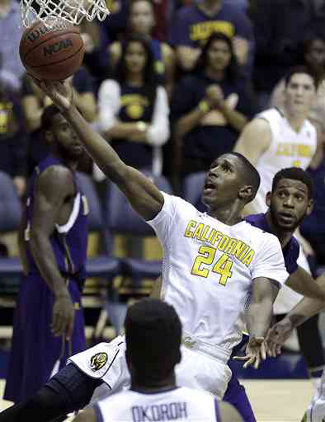
Alcorn State repeatedly let Cal get to the rack
(Photo credit: Ben Margot/Associated Press)

By the numbers

With just one game on the books, the stats don’t look pretty for the Braves. Alcorn State fell behind by double-digits to Cal almost immediately, and ultimately lost by a 91-57 tally. Their adjusted offensive and defensive efficiency numbers currently rank 323rd and 304th out of 351 Division I teams, according to number cruncher Ken Pomeroy.

On a more granular level, there still wasn’t much the Braves did right against the Bears. Their effective field goal percentage was just 34.2%, while they allowed Cal a 59.2% mark and were crushed on the defensive glass. About the only statistical positives for Alcorn State in the opener were the fact that they didn’t turn it over very often, and they didn’t send Cal to the line with much frequency. Of course, the matador defense played by Alcorn State had something to do with the latter, but we’re trying to stay positive here.

Meet the Braves

The lineup situation for Alcorn State is incredibly confusing at the moment, so I’m not even sure who will be on the bench for them tonight. Big man Octavious Brown didn’t make the trip to Berkeley, and his status for the game in Austin is unknown. Players also switched jersey numbers, resulting in an administrative technical at one point in the game, because an Alcorn State player was wearing a different number than what had been provided to the official scorer before the game.

The team’s best player is Leantwan Luckett (No. 1), who is listed as No. 15, but decided to wear No. 1 against the Bears. Who knows what he’ll be wearing tonight, but you’ll be able to quickly pick him out, since he’ll be the one chucking up shots early and often. Luckett took nearly a third of his team’s shots on Friday night, even though he was only on the floor for 30 minutes, and despite connecting on just 27.8% of his attempts.

Luckett is quick and can get to the rim, but as his field-goal percentage might have told you, he has quite a bit of trouble finishing. Since he had issues against a Cal team that really only has a pair of true post options, he will certainly have even more problems against the size of Texas.

That inability to finish once getting to the rack also plagued Marquis Vance (No. 30). The 6’7″ sophomore forward has the ability to face up and drive to the bucket, but doesn’t have much in the way of quickness or tight handles. Vance was also a sizable portion of the Alcorn State offense on Friday, taking 21% of their shots, while posting 17 points. He also easily led the team with nine rebounds on a night where few other Braves were able to earn second chances.

Tyrel Hunt (No. 0) is the team’s other dynamic scoring threat, but like Luckett, he also had some issues finishing against size. He did utilize a nice floater to score some buckets in the lane, so his midrange game might be the team’s best option against a big Texas team tonight.

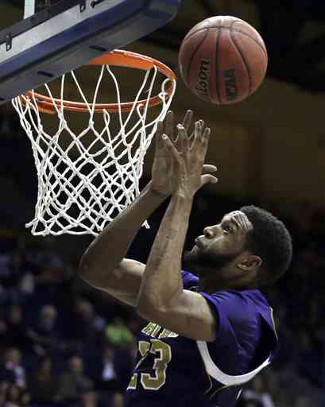
Kenyan Pittman missed both of his attempts against Cal
(Photo credit: Ben Margot/Associated Press)

The starting five on Friday was rounded out with Tamarcio Wilson (No. 3) and Kenyan Pittman (No. 23), who combined for just four points in 57 minutes on the court. Key reserves for Alcorn State were Reginald Johnson, Jr. (No. 24), a freshman who was tabbed as Mr. Basketball in Louisiana last year, and George Thomas (No. 2), a 6’6″ junior who did not score in his limited action against Cal, but did snag four rebounds.

Keys to the game

Let us pretend for a moment that the only key to this game for Texas is not “just show up with five players in uniform.” Instead, let’s take a look at a few areas that Texas can exploit in the matchup with Alcorn State.

1) Run the floor in transition — Although Alcorn State didn’t turn the ball over very often, they did a terrible job early in the loss to Cal at stopping the ball in transition, leading to uncontested layups. The Braves also had very questionable shot selection, which set up the Bears nicely for numerous fast break points. The Longhorns have already shown their ability to add easy points on the break, and with big men that know how to run the floor in transition, they should easily take advantage of this weakness tonight.

2) Provide quick help on D — The Braves only logged assists on four of their 18 baskets, instead preferring to have one of their three stars isolate and try to get to the rim. Even when Cal offered help inside, the Braves were more content to force up a shot than look for an open teammate. If Texas is able to quickly help inside when they allow dribble penetration, they likely won’t fall victim to a timely assist, and should be able to force a ton of bad looks.

3) Attack with the bounce — When Cal didn’t manage to score on a fast break, they still found it easy to slice through the Alcorn State D with dribble penetration, and rotations by the Braves were horribly slow. Isaiah Taylor will likely have a field day against this defense, and should be able to pad his line with quite a few buckets and assists. We’ve heard a lot about Jordan Barnett‘s ability to finish with a nasty dunk, so perhaps he’ll even add a highlight or two on cuts from the wing.

11.15.14
Posted by Ryan Clark at 4:58PM

#10/10 Texas Longhorns 85, North Dakota State Bison 50

The most anticipated Texas basketball season in recent memory tipped off in impressive fashion Friday night, with the Longhorns cruising to an 85-50 victory. Despite the Frank Erwin Center currently sitting as an isolated island in a sea of construction, over 9,000 fans showed up, with the lower-level student section completely filled. While the media has been bullish on this Texas team ever since Myles Turner donned a Longhorn bucket hat at the end of April, it’s clear that for the first time in years, Austin is already on the Texas hoops bandwagon in November.

With one game now in the books, here are eight notes and observations from the 2014-15 tip off:

1. Taylor unfazed by early miscues

The Longhorns were led by Isaiah Taylor, who was pulled in favor of Javan Felix less than four minutes into the game, following a turnover. Taylor coughed it up again a few minutes later and finished the first half just 1-of-6 from the field.

Despite the slow start, Taylor exploded after the break, finishing with 18 points in 28 minutes. The point guard logged just two assists, but he did have multiple drives that opened up the lane for the Texas bigs and resulted in trips to the line. He also tightened up his ball control, not allowing a single turnover the rest of way.

North Dakota State gave Taylor a ton of cushion when guarding him, yet he still managed to slash to the rim and draw additional defenders. He also knocked down outside jumpers — including a pair of threes — to keep the Bison honest, something certainly worth noting after he made just 26.3% of his threes last year.

2. Everything they said was true

With everyone returning for Coach Rick Barnes — with the exception of dismissed guard Martez Walker — and big man Turner added to the lineup, it was clear that the Horns would have a very deep bench and a massive frontcourt. That was on display early in this one, with North Dakota State settling for long jumpers and finding it difficult to reach the paint in the first half, regardless of who the Longhorns had on the floor.

Texas used multiple defensive looks, including some 2-3 zone combinations that were borderline unfair. With Connor Lammert, Cameron Ridley, Prince Ibeh, Jonathan Holmes, and Turner all available to choose from on the Texas bench, easy looks inside were few and far between for NDSU, while most corner threes had to be hoisted over one of those giants as they quickly closed out on the Bison shooters.

3. Free-throw shooting was steady

The Longhorns made just over 67% of their attempts at the charity stripe last season, a troubling number that was part of a larger trend for the Horns. That mark was actually the second-highest free-throw percentage for Texas in the last five seasons, with only the 2012 team serving as an outlier with its 73.3% success rate.

Myles Turner impressed in his debut
(Photo credit: Eric Gay/Associated Press)

Last night, Texas sank 18 of 21 attempts (85.7%), although one miss by Prince Ibeh did come on the front end of a one-and-one. Even though it’s a very small sample size for a season with 30-plus games, it was reassuring to see multiple Longhorns confidently knock down their freebies.

4. Myles Turner made a quick splash

The heralded freshman instantly made an impact when he entered the contest just 3:55 into the game. Only 24 seconds later, he drilled a turnaround jumper, and scored in a variety of ways en route to a 15-point performance. One one first-half possession, he knocked down a face-up 17-footer when passing lanes were closed and the defense didn’t stay in his shirt. Later, Turner patiently backed his man down the baseline before popping a step-back jumper in front of the frozen defender. Myles played with a poise that often escapes freshmen, who sometimes try to play at 100 MPH in their early games.

On the defensive end, Turner’s length caused problems both inside the paint and out. He had no problem stepping out from the lane and forcing Bison players to retreat to the perimeter, using his length and good angles to severely limit their options. Down low, he altered numerous shots and officially recorded two blocks. Turner’s interior presence was a huge reason why NDSU managed to make just three shots inside the arc during the first half.

5. Holmes re-defined efficient

The lone senior on the roster has always been a phenomenal catch-and-shoot guy behind the arc, and he showed that early against the Bison. Holmes knocked down a pair of triples, plus sank all three of his attempts inside the arc, and was perfect on three free throws. He finished with 15 points in just 15 minutes, posting an insane 206.2 offensive rating on the night.

6. Lammert was unforgiving on the defensive glass

While the Texas defense was forcing miss after miss early in the game, Lammert was making sure that the Bison had no second chances. Lammert snagged five defensive boards in nine first-half minutes of action, and finished with seven on the night. With NDSU chucking up long-range shots, many of the caroms were long, but Lammert was on his toes and reacted quickly to every funny bounce.

Cameron Ridley slimmed down in the offseason
(Photo credit: Eric Gay/Associated Press)

7. Ridley unveiled a new look

Big man Ridley didn’t just shed some hair in time for the season opener, as he clearly had shed some pounds, too. He looked lean and mean, and was able to react quickly on the back line of the Texas zone when NDSU worked it into the corner for a three. Ridley has always been good at running the floor in transition, but he also seemed to be even a bit faster on the break last night, which resulted in a highlight-reel dunk following a behind-the-back assist from Taylor.

While Ridley probably won’t be required to play a massive amount of minutes thanks to the Texas depth, it’s good to know that if foul trouble requires him to absorb more playing time, the big man looks like he has the conditioning to handle it.

8. The D used some vacation hours in the second half

With a lead in the 20 and 30-point range in the second half, it probably isn’t too surprising that the Texas defensive pressure was a little lacking. After the break, the Horns allowed more dribble penetration, and their rotations were often slow, resulting in close looks or trips to the line. The Bison found it much easier to get to the paint in the second half, and they were simply quicker with their ball movement, allowing them to exploit the Texas D for wide open threes.

On a team with a ton of players looking for time on the court and a coach who highly values defense, that may result in some changes to how the minutes are distributed on Sunday against Alcorn State. The Longhorns still only allowed .930 adjusted points per possession, according to Ken Pomeroy, but obviously had some breakdowns they can work on.

Next up: vs. Alcorn State; 7 P.M. CT, Sunday (ESPNU)

11.14.14
Posted by Ryan Clark at 6:26AM

Maybe the first day of the college basketball season isn’t exactly like a birthday for fans, but since the first two days of the NCAA tournament are like Christmas, you’ll just have to go with me on this one.

There won’t be a game preview for tonight’s season opener, as work has unfortunately pulled me away from Austin the last few days for meetings. My flight back actually doesn’t land until 35 minutes before tip tonight, so with no airline delays and help from the traffic gods, I may be in the building by the U12 or U8 of the first half. Speaking of which, a special thanks to the UT soccer team for earning an NCAA bid and necessitating the 30-minute delay to tonight’s tip-off.

Enjoy the game tonight, and we’ll see you here tomorrow for the post-mortem. Or, if you’re one of the LRT Twitter followers, we’ll see you for the usual in-game updates whenever I actually reach the Drum. Here’s to an exciting season!

3.22.14
Posted by Ryan Clark at 12:18PM

NCAA Men’s Basketball Championship — Midwest Region — Third Round
[7] Texas Longhorns (24-10) vs. [2] Michigan Wolverines (26-8)
Bradley Center | Milwaukee, WI | Tip: 4:15 CT | TV: CBS
Vegas: Michigan -4.5 | Pomeroy: Michigan, 73-69 (66%)

Stop me if you’ve heard this one before. Big-name school loses its best players and has to rely on a group of sophomores and surprising freshman. Conference coach of the year honors are bestowed upon the man at the head of the bench. Hopes are high for the team to repeat their surprising run to the Final Four from the year before.

Up until that last point, Michigan and Texas have some similarities in their storylines this season. Fresh off an appearance in the national title game, the Wolverines were expecting to lean on big man Mitch McGary (No. 4) following the departures of Trey Burke and Tim Hardaway, Jr. to the NBA. Back problems cropped up for McGary during the summer, however, and the player who burst on to the national scene in last year’s NCAA tournament was limited to just eight games this year before having to shut it down.

That injury put the Wolverines at a disadvantage in the paint in a rough-and-tumble Big 10 Conference and raised some serious questions for a team that was just 8-4 in non-conference, had suffered a questionable loss to Charlotte, and whiffed on three opportunities for marquee wins. No matter, as John Beilein simply guided his team through the landmines of an unpredictable Big 10 season to a conference title that they won by a three-game margin.

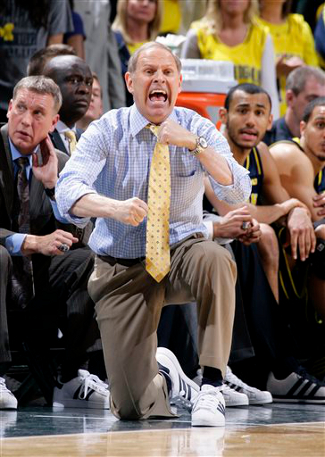
John Beilein has Michigan poised for another March run
(Photo credit: Al Goldis/Associated Press)

Although Michigan seemed to be in line for a No. 1 seed in the NCAA tournament, a loss in the Big 10 tournament championship to rival Michigan State may have been what kept the blue and maize on the 2-seed line. Thanks to the NCAA’s pod system, the Wolverines still get to play their first two games fairly close to home, in Milwaukee. However, if Friday night’s crowd was any indication, the sea of Badger red at the Bradley Center could make this feel a little more like a road game for Michigan.

By the Numbers

The Wolverines have the third-best offense in the country in terms of adjusted efficiency, according to Ken Pomeroy’s magic machines, scoring 1.214 adjusted points per possession. Michigan is incredibly patient with the basketball, works for open looks, and generally doesn’t miss once they find them. They average just 62.7 possessions per game, making them the 23rd-slowest team out of 351 D-I squads.

What is most impressive is that Michigan finds this level of offensive success without many second chances. The Wolverines reclaim just 28.8% of their missed shots, an offensive rebounding rate that puts them in D-I’s Bottom 100 in that category. To be able to score that efficiently without offensive boards takes a combination of great ball control and excellent shooting. Michigan coughs it up on only 14.9% of their possessions, which ranks 18th nationally.

As for the shooting, the Wolverines are absolutely deadly. Beyond the arc, Michigan makes 39.4% of its shots, which ranks 13th in the country. They take 40% of their shots from long range, which isn’t that surprising for a team that shoots the long ball so well. But even when Michigan isn’t torching the nets from three-point range, they work for great looks inside and convert them. On the season, they have made 53% of their two-point field goals, a stat is once again near the top of the national charts, ranking 20th.

While the Texas defense will have its hands full trying to slow down the Michigan attack, the Horns should be able to find a little more success on the other side of the ball. The Wolverines are allowing an adjusted 1.009 points per possession, a number that is up significantly from the stats that Beilein’s teams usually put up. The Wolverines have had lapses where they allow dribble penetration, they are typically exploited inside by bigger teams, and they have also had some issues getting set to stop the secondary break.

For the second-straight game, the Longhorns are facing a team that does not force too many turnovers, something that comes as a relief for a young backcourt that sometimes struggles with ball control. The Wolverines only force opponents into possession-ending mistakes 17.2% of the time, so Texas will likely not see much in the way of pressure this afternoon. As a result, the Longhorns should only have to avoid frustrating unforced errors that would make it tough to keep up with Michigan’s highly-efficient offense.

Meet the Wolverines

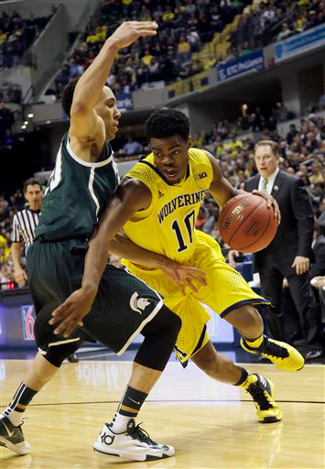
Derrick Walton, Jr. is a dynamic point guard
(Photo credit: AJ Mast/Associated Press)

It isn’t easy for a freshman point guard to follow in the footsteps of a consensus All-American, National Player of the Year, and Cousy Award winner. Is 6’1″ Derrick Walton, Jr. (No. 10) Trey Burke? Of course not. But the freshman guard has performed admirably while having to fill the shoes of a legend, posting an assist rate north of 20% while also drilling more than 40% of his threes.

Walton has an incredibly quick first step to beat tight defenses, and he couples that burst with a hesitation dribble that keeps defenders guessing. He also showed an incredible amount of hustle and scrappiness in a road win against Ohio State — the program’s first in its last ten tries — where he posted 10 rebounds despite being the smallest player on the court.

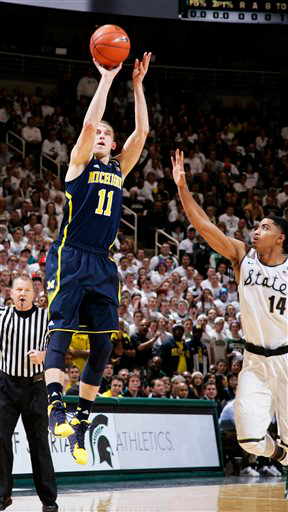
Although it’s Walton that runs the show, it’s 6’6″ Canadian product Nik Stauskas (No. 11) that gets the ink. He has made 45.1% of his three-pointers on the year, a number that’s even more impressive when you see just how closely Big 10 opponents guarded him throughout the season. Stauskas also improved his slashing ability this season, and he repeatedly puts the ball on the deck to punish opponents who overplay him on the perimeter.

Stauskas needs very little time or space to get his shot off, so defenses really have to completely deny him the ball to have any chance of stopping him. Even with a defender in his face, Stauskas often uses a quick crossover to earn just a sliver of space, which is all he needs to rise up and can a triple.

While guarding Stauskas will be enough of a chore for the Longhorns today, they also have to deal with another 6’6″ shooter in freshman Caris LeVert (No. 23). Like Stauskas, LeVert can elevate quickly and get his three-pointers up over the defense, but he also has driving ability to exploit tight defenses. His height and athleticism make him a very tough cover on the wing, and he can get to the rim in an instant with his long strides.

With Stauskas and LeVert bringing so much length to the perimeter, the Texas guards are going to find it difficult to simply face up and drive the gaps this afternoon. If the Longhorns are patient, they will find cracks in Michigan’s defense, but they have been frustrated this season by teams with similar length and have not exercised the patience necessary to find good looks. If Texas falls into that same trap this afternoon, it will be very difficult to pull off an upset.

Glenn Robinson III (No. 1) is yet another athletic 6’6″ player for the Wolverines, and he will be involved in a pair of interesting mismatches this afternoon. On defense, he will clearly be undersized against the likes of Jonathan Holmes or Connor Lammert. Although Michigan could play a zone to offset the size difference, they have typically stuck with the man defense this year, even against bigger teams like Michigan State. On the other end of the court, Robinson’s athleticism and ability to slash will be tough for those same two Longhorns to stay in front of, and a zone would likely be a death sentence against the outside shooting of Michigan.

Inside, 6’8″ senior Jordan Morgan (No. 52) will have his hands full against Cameron Ridley this afternoon. Morgan has performed admirably this season, having to step into a much different role than he had envisioned prior to McGary’s injury. On a team that does not clean the offensive glass, Morgan’s 12.6% offensive rebounding rate is incredibly impressive. The 19.5% mark he posts on the defensive end is also a big part of the team’s success on that side of the boards, where they are surprisingly ranked 54th in the country.

Backing up Morgan down low is Jon Horford (No. 15), a 6’10” big who will be very important against the Texas frontcourt this afternoon. In last Sunday’s Big 10 title game, Michigan State’s Adreian Payne quickly tagged Horford with two fouls and Morgan with one in a single possession, putting Horford on the bench just 96 seconds into the game. That forced little-used Max Bielfeldt (No. 44) into action early, a fate that Michigan sorely wants to avoid this afternoon.

In the backcourt, Michigan relies on Zak Irvin (No. 21) and Spike Albrecht (No. 2) off the bench. Irvin is another 6’6″ guy with a deadly outside stroke, but unlike the other Michigan marksmen, he doesn’t like to put the ball on the floor and try to attack with the bounce. Irvin has taken 74.6% of his shots from beyond the arc, and averages roughly four three-point attempts per game, despite seeing the court for just 15.8 minutes per game.

While Albrecht is best known for his three-point barrage against Louisville in last year’s title game (and day-after tweet to Kate Upton), he is truly a facilitator. He has seen some important minutes in crunch time this year, giving the Wolverines a steady ballhandler who creates looks for his teammates. Yes, Albrecht still shoots 39% from long range and can’t be given space, but it’s his 25% assist rate that has made him even more dangerous this season.

Keys to the Game

1) Dominate the paint – It’s going to be a battle of styles this afternoon, and whichever team does a better job imposing its will on the other will likely be advancing to Indianapolis. Michigan will obviously try to take away the paint for Texas, whether that is by using a sagging man defense or just going zone and daring a poor-shooting Longhorn team to beat them with jumpers. The Longhorns have to play their style of basketball and be persistent in getting points in the paint. If they fail to do that and just hope to win with another crazy shooting performance like they had on Friday night, the upset odds look very long.

Nik Stauskas is a three-point marksman
(Photo credit: Al Goldis/Associated Press)

2) Limit perimeter damage – With so many great shooters on the perimeter for Michigan, the Longhorns are going to have a very tough time shutting down the three-point threat. Add in the significant size advantage that Michigan enjoys at the two and the three, and the defensive assignment is even tougher for the Horns. Demarcus Holland will have to use his length to try to stifle Stauskas, and needs to play him high to not only deny the ball, but also funnel him baseline to the waiting shot blockers if he tries to go backdoor.

To guard LeVert, the Longhorns might need to call on Martez Walker for big minutes once again. The freshman has seen an increased role in the last three weeks, and his ability to limit dribble penetration and use his length to challenge outside shots are a big reason for that extra playing time. Although Javan Felix is a sophomore leader on this team, his size is a defensive liability against Michigan, so fans have to hope Walker can step up and help to limit the damage.

3) Dictate the tempo – Michigan’s lethargic pace is a direct result of their patience on offense, plus the fact that opponents usually have to exercise the same patience and move the ball quickly to find the cracks in Michigan’s defense. If the Longhorns can get out and run, they will find that the Wolverine defense is not only questionable in transition, but they also often fail to recover quickly enough to stop the secondary break.

An up-tempo game has also proven to throw Michigan’s offense out of sync, as seen in their early-season loss to Iowa State. The Cyclones and Wolverines played 74 possessions in that game, and Michigan shot just 8-of-29 from long range. While the Wolverines missed some shots they usually doesn’t, they also took quite a few early threes, rather than getting the great looks that their methodical offense typically earns. If Texas can force Michigan into speeding things up a little this afternoon, the Horns have a much better chance to finally return to the Sweet Sixteen.

« Previous Page — Next Page »