






1.09.13
Posted by Ryan Clark at 5:31PM

West Virginia Mountaineers (7-6 overall, 0-1 Big 12) at Texas Longhorns (8-6, 0-1)
Erwin Center | Austin, TX | Tip: 8 P.M. CT | TV: ESPN2
LRT Consecutive Game #235

The series between Texas and West Virginia has a short history, but it has been memorable in every way. The Longhorns hold a 2-1 edge all-time versus the Mountaineers, as WVU comes to the Erwin Center tonight for the first time as members of the Big 12.

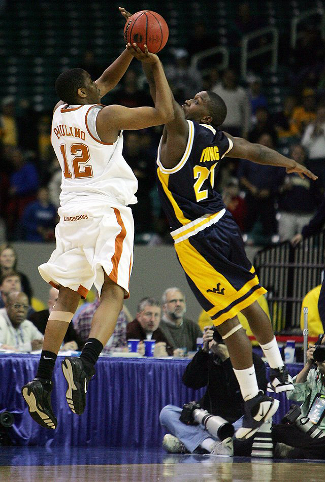
Kenton Paulino broke the hearts of WVU fans in 2006
(Photo credit: John Bazemore/Associated Press)

The teams last met in 2006, with Texas’ Kenton Paulino hitting a buzzer-beating three in the Sweet 16 just moments after Kevin Pittsnogle had tied it up on a three-pointer of his own. That was actually the second meeting of the season between the two teams, as LaMarcus Aldridge raced the length of the court to block a potential game-winning shot as time expired in a November meeting in Kansas City.

While the stakes are much lower in tonight’s matchup and the squads are not quite as talented, it’s sure to be memorable, even if only for its historical importance. The Mountaineers have scuttled this season, performing well below the expectations that had them squarely in the middle of the Big 12 pack. Texas has also failed to live up to its preseason buzz, putting the Horns far outside of the bubble as league play kicks into gear.

If the Longhorns have any hope to stay relevant down the stretch, they will have to take care of business at home against the teams that will finish in the bottom half of the league. Even though the Mountaineers are down, tonight’s game is still very important for Texas’ big-picture goals.

By the numbers

As is to be expected with any Bob Huggins team, the Mountaineers are a physical bunch that hits the glass hard and takes care of the basketball. West Virginia turns it over on less than 18% of its possessions, a mark that ranks in the Top 40 nationally. The ‘Eers also reclaim 38.6% of their missed shots, an offensive rebounding mark that is 25th-best in the country.

That ability to win second chances is huge for a team that has simply struggled to put the ball in the basket all season long. West Virginia’s effective field goal percentage is an ugly 43.8%, one of the 50 worst marks out of the nation’s 347 D-I teams, and actually a few percentage points worse than Texas’ eFG%. Many of the team’s struggles come from behind the arc, where the Mountaineers have made just 28.7% of their looks.

Fortunately, those extended possessions and an ability to get to the line have kept West Virginia’s offensive efficiency numbers respectable. The Mountaineers score an adjusted 1.016 points per possession according to stat guru Ken Pomeroy, with more than 24% of the team’s points coming from the charity stripe. As West Virginia moves more towards a dribble-drive offense and away from a five-man motion look, the team is only seeing that free-throw production go up.

On the other side of the ball, West Virginia is statistically average. Their adjusted defensive efficiency ranks just in the top third of D-I teams, as they allow 0.958 points per possession. West Virginia’s defensive turnover percentage, defensive rebounding percentage, and defensive free-throw rate are all within a few spots of the national median. For a Texas team that is suffering from the worst offensive woes of Rick Barnes‘ tenure on the Forty Acres, that average WVU defense could make the Mountaineers very welcome visitors.

Meet the Mountaineers

West Virginia has a group of talented ballhandlers in the backcourt, giving Coach Huggins some lineup flexibility. It’s also allowed the Mountaineers to shift to more of a dribble-drive offense in the last few weeks, something that helps to alleviate the team’s jump shooting nightmares and leads to free points at the stripe.

Sophomore guard Juwan Staten (No. 3) is the only Mountaineer averaging more than 24 minutes per game, as he clocks in for more than 32 minutes on the court every night. A transfer from Dayton, Staten can run the point, but also has incredible speed and nice driving ability to get to the rim. He has a reliable floater in his arsenal and uses good body control to get off some difficult shots against interior pressure.

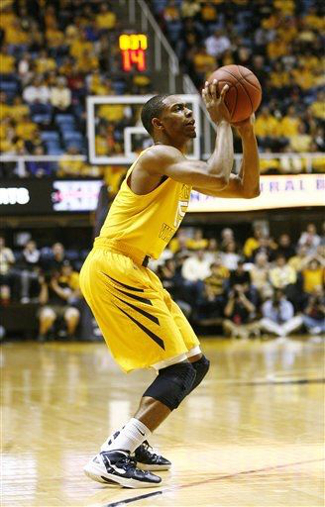
Terry Henderson knocked down six triples against OU
(Photo credit: Randy Snyder/Associated Press)

Staten’s 11 points per game and 20.4% assist rate are both tops on the team, and he also rebounds fairly well on the defensive glass. The sophomore can often be found slicing in from the weak side to snag the board and close out a good WVU stop.

The 5’11” Jabarie Hinds (No. 4) is another sophomore guard with good handles, but his role is undoubtedly that of a shooter. Although he’s shown off a quick, dangerous stepback jumper at times, the young New Yorker is still battling consistency issues. Hinds’ true shooting percentage just barely cracks the 40% barrier, a major problem for a guard who doesn’t get to the rack or the line with any regularity.

The third guard in the starting lineup is Terry Henderson (No. 15), an exciting freshman who played his way into the starting five after just a few games. Although he’s only made 36% of his threes on the season, Henderson is coming off a blistering 6-of-11 performance beyond the arc in Saturday’s loss to Oklahoma. The 6’3″ North Carolina product also gets out and runs the floor well in transition, and his long wingspan makes him a tough defensive presence on the perimeter.

Inside, senior Deniz Kilicli (No. 13) was being counted on to help offset the losses of leaders Kevin Jones and Truck Bryant from last year’s team. Unfortunately, his consistent foul trouble has limited his time on the court and made it tough for him to be the veteran leader this young team needs.

When he’s on the court, Kilicli is one of the nation’s best offensive rebounders and uses brute strength to get to the rim. He also loves the hook and baby hook, but will take both almost exclusively with his left hand. Opponents who take away his preferred hand can easily turn him into nothing more than a passing big man who has to score on putbacks.

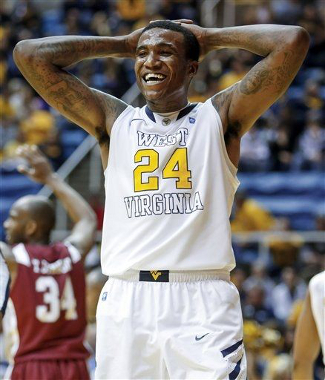
The other thing that West Virginia is missing with the departure of Jones and Bryant is scoring. That pair accounted for 52% of the team’s points last season, and La Salle transfer Aaric Murray is helping to pick up some of the slack inside. Like Kilicli, Murray has battled foul trouble this season, and is often visibly frustrated when relegated to the bench. Early whistles can get in the big man’s head and quickly throw him off his game.

Aaric Murray is easily frustrated by foul calls
(Photo credit: David Smith/Associated Press)

When Murray is clicking, though, he has a very nice offensive package. His soft touch and smooth spin moves make it easy for him to score in the post, and the recent development of his outside game just makes him a tougher matchup. Murray still needs to work on his interior passing, but he is still a reliable scorer and rebounder who averages 10.5 points and 7.5 boards per game.

When Kilicli and Murray find themselves in foul trouble, senior Dominique Rutledge (No. 1) sees a spike in minutes. He has a nice wingspan, does an excellent job on the defensive glass in his limited minutes, and is crafty with the ball when they feed him in the paint. While he’s averaging only about 13 minutes per game, Rutledge has been called upon for some 20-plus minute performances on nights where Kilicli and Murray can’t manage to stay on the court.

The other big man on the bench is 6’10” sophomore Kevin Noreen (No. 34), who has yet to make much of an impact in his year and a half. He’s averaging almost 15 minutes per game, up a bit from his 12 minute average of last year, but he usually contributes just a few boards during his short stints on the court.

Off the bench, sophomore Gary Browne (No. 14) is the third ball-handling guard for Coach Huggins, and his extensive experience as a freshman makes him a dangerous sixth man. Although he’s another option to run the point, Browne definitely has a scorer’s mentality and an ability to get himself open looks. Like most of the team, however, the sophomore isn’t consistently making those open looks, shooting just 31.1% from the floor and 18.2% behind the arc.

Fellow sophomore Keaton Miles (No. 55) also brings a lot of experience from his freshman year, when he started numerous games at the three. He’s a strong, broad-shouldered 6’7″ forward from Dallas who isn’t much of an offensive threat, but can be downright annoying on the defensive end. His block percentage and steal percentage both rank in the Top 200 nationally, as he has posted 5.7% and 3.5% so far, respectively.

Freshman guard Eron Harris (No. 10) rounds out the core rotation, chipping in about 12 minutes per game. Although he’s made an impression on the defensive end when the Mountaineers turn up their pressure, he has also proven that he can pile up some points in a hurry. In just his second collegiate game, Harris put up 15 points in a blowout of Marist at the Old Spice Classic, one of four times he’s cracked double-digits in scoring this season.

Keys to the game

1) Limit West Virginia’s second chances – The Longhorns did a fantastic job on the defensive glass against Baylor for the first 20 minutes of Saturday’s game. It was their inability to close out possessions down the stretch that proved deadly, however, as the Bears reclaimed more than 54% of their misses in the second half.

West Virginia is a great offensive rebounding team, and it’s one of the few things they do well on that half of the court. The Longhorns have showcased one of the nation’s best defenses so far this season, but that won’t mean much if they allow the Mountaineers second and third chances. If Texas can lock down the glass, their solid defense and the struggling West Virginia offense should combine to keep the ‘Eers from lighting up the scoreboard.

2) Keep West Virginia off the charity stripe – Another crippling blow to Texas’ upset chances on Saturday was a defensive free throw rate of 70.3%. In simpler terms, that means that the Longhorns sent the Bears to the line seven times for every ten field goals that Baylor took.

While the Bears managed to do this by attacking the paint with a dominant front line, West Virginia gets to the line thanks to some quick, shifty guards. The method may be different, but the concern is the same for Texas. The Mountaineers score nearly a quarter of their points from the stripe and shoot roughly two free throws for every five field goals. The Longhorns need to turn back West Virginia’s dribble penetration and avoid giving up free throws when the primary defenders can’t hold the guards.

3) Handle West Virginia’s pressure on the perimeter – The Mountaineers aren’t a bunch that will turn opponents over with much frequency, but they do love to frustrate opponents with pesky pressure on the perimeter. West Virginia makes it difficult for other teams to get their half-court sets going, challenging opposing guards well beyond the arc and forcing plays to start 20-plus feet from the hoop.

Texas has struggled with turnovers all season long, even against teams that don’t traditionally force miscues. One place where the Longhorns have been particularly bad at ball control is on the perimeter, where lazy feeds and telegraphed swing passes are picked off and turned into fast break points. The Longhorn guards have to be aware of this potential for disaster and make passes with purpose, especially when working the ball around the arc.

1.08.13
Posted by Ryan Clark at 3:17PM
TEAM W L LAST WEEK THIS WEEK
Baylor 1 0 W vs. UT, 86-79 (OT) Tue at TTU; Sat vs. TCU
Kansas State 1 0 W vs. S Dakota, 70-50; W vs. OSU, 73-67 Sat at WVU
Oklahoma 1 0 W vs. TAMU-CC, 72-42; W at WVU, 67-57 Sat vs. OSU
Texas Tech 1 0 W vs. FL A&M, 70-56; W at TCU, 62-53 Tue vs. BU; Sat vs. KU
Iowa State 0 0 W vs. Yale, 80-70 Wed at KU; Sat vs. UT
Kansas 0 0 W vs. Temple, 69-62 Wed vs. ISU; Sat at TTU
Oklahoma State 0 1 L vs. Gonzaga 69-68, L at KSU, 73-67 Wed vs. TCU; Sat at OU
TCU 0 1 W vs. MVSU, 67-64; L vs. TTU, 62-53 Wed at OSU; Sat at BU
Texas 0 1 L at BU, 86-79 (OT) Wed vs. WVU; Sat at ISU
West Virginia 0 1 W vs. Eastern KY, 74-67; L vs. OU, 67-57 Wed at UT; Sat vs. KSU

The big picture

In October, the Big 12 coaches unanimously selected Kansas as their preseason favorite in the league. Baylor earned one first-place vote, which came from Bill Self, who could not vote for his own team to win the crown. But even with such a clear-cut frontrunner in the league, the coaches predicted a contentious battle in slots two through five, with the Bears, Cowboys, Longhorns, and Wildcats all within nine points of each other in the poll.

Without Myck Kabongo, Texas has failed to live up to those expectations. The Bears also disappointed, but to a much lesser degree. Inconsistent play and shaky defense caused Baylor to drop home games to both the College of Charleston and Northwestern, overshadowing impressive efforts in the hostile road gyms of Kentucky and Gonzaga.

The Cowboys had question marks coming into the season, mostly surrounding their head coach. Travis Ford had earned high expectations in the past, but had failed to live up to them since arriving in Stillwater. A broken wrist sidelined Brian Williams in the preseason, while a season-ending knee injury once again took Jéan-Paul Olukemi out of commission for the year. Oklahoma State is currently on a two-game losing streak, but looked dominant in winning the Puerto Rico Tip-Off and still boasts one of the most talented rosters in the league.

Kansas State has lived up to its buzz as an upper-tier team in the Big 12, and has shown some flashes that might mean the team can give their in-state rivals some trouble this season. With most of Frank Martin‘s old team back under new coach Bruce Webber, the Wildcats have their old coach’s toughness meshing with the new guy’s offensive influence.

KSU was whipped in meetings with Top 10 foes Michigan and Gonzaga, but took care of a very good Florida team in a game at Kansas City’s Sprint Center. In the conference opener, an unbelievable 26-point second-half from Rodney McGruder carried the Wildcats to a statement win over Oklahoma State. We might not really know how good this KSU team is until the first Sunflower Showdown on January 22nd, but early indications are that the Wildcats should make some noise in the Big 12.

The surprise teams from the bottom half of the poll have been the Oklahoma Sooners and Iowa State Cyclones, who are both 10-3 on the year. Lon Kruger has his rebuilding project ahead of schedule in only his second season, but the Sooners have yet to prove themselves against a quality opponent. A home loss to Stephen F. Austin raises eyebrows, while narrow wins against Northwestern State and at UT-Arlington are also cause for concern.

Iowa State’s schedule also leaves room for doubt. The Cyclones have fattened up the win column against a bunch of terrible teams, while losing three of their four tough games. It should be noted that the losses to Cincinnati, UNLV, and Iowa all came away from the friendly confines of Hilton Coliseum, but it’s still clear that this team has to prove it belongs in the second tier of the Big 12. Simply defending home court won’t be enough to push Iowa State towards the top of the standings.

Mid-week games

Baylor at Texas Tech; Tuesday, 6 P.M. CT (ESPN2)

The first full week of Big 12 play kicks off with this battle for first place. Yes, friends, you read that correctly. Texas Tech is at the top of the standings thanks to a conveniently-scheduled opening game against fellow doormat TCU. As a result, the Red Raiders are above .500 in league play for the first time since March of 2007 and are tied for first until at least 7:45 tonight.

Baylor was taken to overtime by Texas on Saturday, but should be able to regroup this week. If they take care of business in Lubbock tonight, the Bears can move to 3-0 with a home win over a very bad TCU team on Saturday. That would set up a true battle for first place, as Baylor opens up Big Monday with a January 14th visit to the Jayhwaks at Allen Fieldhouse.

Iowa State at Kansas; Wednesday, 6 P.M. CT (ESPNU)

Kansas has looked downright dominant this season, losing only a very competitive game to Michigan State in the Champions Classic way back on November 13th. They destroyed Saint Louis at the Sprint Center, crushed a very good Colorado team at home, and stormed into Ohio State’s Value City Arena to beat the Buckeyes for a third time in the last 13 months. The Jayhawks can score inside and out, have an intimidating defensive presence in senior Jeff Withey, and have their eyes on a top seed in the NCAA Tournament.

So, we may have to wait a little while to answer those questions we have about Iowa State. If the Cyclones can march into Allen Fieldhouse and actually pull off a win, those doubts will be laid to rest immediately. But, if Fred Hoiberg‘s bunch loses by 10 to 15 points in a game that’s never in doubt, we probably still won’t know what to make of the ‘Clones. Saturday’s game against a similarly enigmatic Texas squad might not provide much clarity, either.

TCU at Oklahoma State; Wednesday, 7 P.M. CT (ESPN Full Court/ESPN3.com)

The Horned Frogs squandered their best chance at an early league victory when they dropped Saturday’s home game to Texas Tech. This week, the league’s newcomers have to travel to Gallagher-Iba Arena and then to Waco, a pair of games that would be tough for any squad, much less one expected to finish at the bottom of the table.

The Horned Frogs are without starting center Aaron Durley and last year’s leading scorer Amric Fields, and they won’t have starting forward Jarvis Ray back from a broken foot until sometime next month. With so many missing pieces, TCU’s adjusted offensive efficiency is currently ranked 313th according to Ken Pomeroy. Facing the nation’s 12th-most efficient defense in Oklahoma State could have the Horned Frogs challenging records for offensive futility.

West Virginia at Texas; Wednesday, 8 P.M. CT (ESPN2)

LRT’s preview of the West Virginia/Texas game will be available on Wednesday.

1.05.13
Posted by Ryan Clark at 10:20AM

Texas Longhorns (8-5 overall, 0-0 Big 12) at Baylor Bears (8-4, 0-0)
Ferrell Center | Waco, TX | Tip: 1 P.M. CT | TV: ESPNU
LRT Consecutive Game #234

The Texas Longhorns head into conference play moving in the right direction. A home win over a talented but inconsistent UNC squad and an impressive performance on the road against Michigan State revealed a confident Longhorn team that looked nothing like the one that sleepwalked through a disastrous week on the island of Maui. Last Saturday, the Longhorns added another piece of the puzzle when tenacious rebounder Jaylen Bond rejoined the squad. There was also the huge news in late December that sophomore point guard and unquestioned team leader Myck Kabongo would be eligible for the final eight games of the season.

With one of the nation’s best defenses and a string of good news, things are finally looking up for Texas. Of course, opening conference play on the road against a formidable Baylor team could stop that momentum in an instant.

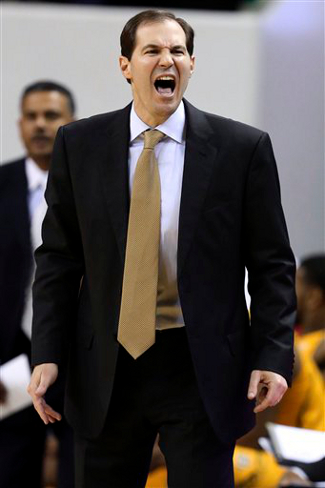
Scott Drew won’t be on the Baylor sideline today
(Photo credit: Rod Aydelotte/Associated Press)

On paper, the Bears looked like a challenger to Kansas in the Big 12. On the court, the results have been mixed. Baylor recorded the school’s first road win against a Top 25 non-conference opponent when the Bears went into Rupp Arena and upset a young Kentucky team that is still finding its way. However, that win was sandwiched between home losses to the College of Charleston and Northwestern. There’s no doubt that these Bears should be one of the elite teams in the conference, but the question is whether or not they can consistently perform at a high level through the league’s grueling 18-game schedule.

By the numbers

The Bears have a practically unstoppable combination of talent in the paint and on the perimeter, and it shows with an adjusted offensive efficiency mark that is currently 17th in the nation according to Ken Pomeroy. The Bears score 1.132 points per possession, while holding opponents to an adjusted 0.945 points.

Baylor has been impressive so far this season against one of the nation’s toughest schedules. Pomeroy has their non-con slate ranked 32nd toughest in the land, as it also included a neutral-site game against Colorado, a home date with BYU and a true road game against Gonzaga last weekend.

While the efficiency numbers above have already been adjusted to account for that difficult schedule, the rest of their stats have not, and they are still dominant. The Bears are averaging more than 40 points per game in the paint, giving them one of the nation’s best two-point field-goal percentages at 55.4% per game. Their experienced backcourt takes care of the ball, posting a Top 30 turnover percentage of just 17.3%. Surprisingly, their offensive rebounding mark is at 34.2%, which just qualifies for the top third of Division I teams.

Defensively, the Bears have been using much more man than in years past, but it hasn’t stopped oppponents from hitting nearly 37% of their three-point attempts. Although Baylor starts four upperclassmen, there are still some major issues with communication on defense, which is keeping them from being truly dominant on that side of the ball. Their adjusted defensive efficiency is still ranked 89th in the country, but there is definitely room for improvement.

Prior to their loss to Gonzaga, the Bears appeared to be making strides in that department, holding BYU and USC Upstate to less than 0.9 points per possession. The Bulldogs torched Baylor both inside and out, however, posting 1.26 points per possession and an effective field goal percentage north of 60%. There’s no doubt that Gonzaga is a title contender this season, but Baylor will need better performances against elite teams if it wants to live up to its preseason billing.

Meet the Bears

For the first time in a long time, Texas will be battling the Bears with a new face on the Baylor sideline. Jerome Tang will be at the head of the Baylor bench this afternoon, as head coach Scott Drew is sitting out the first two conference games as part of the university’s self-imposed NCAA penalties. Although Baylor will be without its head coach, there’s still a ton of talent on the court for Texas to contend with.

The man that runs the show for Baylor is Big 12 Preseason Player of the Year Pierre Jackson (No. 55). If you don’t remember him from his impressive debut season in Waco last year, you will certainly know him by the end of this one. Jackson leads the league in scoring with 19.6 points per game, but is also an incredible facilitator, dishing out more than six assists each night.

It’s incredibly tough to shut down Jackson, because he can beat you in a variety of ways. His three-point shot is incredibly accurate, and he needs very little space to get it off. Jackson loves to simply step into a smooth three as the team races up the court in transition, so the Longhorns have to quickly find him as they get back on defense.

Jackson can also easily create his own shot in the half-court set. He’s a master at varying his speeds on the drive, hesitating just long enough to get a defender to downshift before he uses his blazing speed to drive to the rim. Jackson also has a wicked crossover that he loves to use on the wings, freezing opponents while he bursts to the rack.

Baylor also runs numerous ball screens for him on the perimeter, freeing him up to quickly drive to the rim. While he’s great at finishing through traffic, he really makes the highlight reel with his great feeds to the team’s bigs. As opponents scramble to provide help on Jackson’s drives, he’ll shovel a pass into the post or zip a one-handed feed to his teammate for a dunk.

Colorado and Gonzaga both gave Jackson some problems by rushing the ball screen and doubling him hard. The Buffaloes also had the luxury of a 6’6″ guard in Spencer Dinwiddie who could sag off of Jackson to limit his drives, yet still close out and contest three-pointers with his length. Texas doesn’t have that option today, but the Horns can certainly try to use their bigs to double past the ball screens and disrupt the Baylor half-court sets.

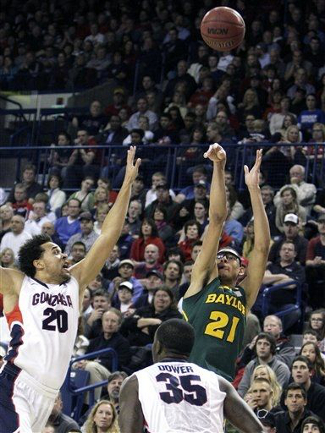
Isaiah Austin is a 7-footer with a great jump shot
(Photo credit: Young Kwak/Associated Press)

One thing that helps Baylor when they are doubled in those situations is the impressive game of 7’1″ freshman Isaiah Austin (No. 21). The big man has a great jump shot and is accurate beyond the arc, having hit 33% of his triples on the season. When Jackson is double-teamed, Austin’s height and long-range accuracy always give the Bears a relief option on the perimeter.

Austin is also very nimble with the basketball and can easily drive against opposing big men who try to guard him on the perimeter. He still has a very wiry frame and isn’t built to truly bang in the post, but with his nice shot and usual height advantage, it often doesn’t make a difference. A few more pounds of muscle will make Austin practically impossible to stop, but as it is, he’s still a match-up nightmare.

With Austin often stretching the floor, the man in the middle is junior Cory Jefferson (No. 34). He averages 13.2 points and 8.6 rebounds per game, and his offensive rebounding mark of 11.5% ranks him just outside the Top 200 nationally. Jefferson makes his hay on putbacks and easy finishes near the rim after Jackson has drawn defensive help. However, that’s not to say he can’t score outside the paint. Jefferson has a serviceable midrange game, but still lacks some consistency. The Horns want to force him to score on his jumpers, and hope that this is one of those days he’s not hitting them.

Even if Texas can keep Jefferson from scoring easy points, the Horns still have to worry about one of the nation’s most dangerous three-point shooters in Brady Heslip (No. 5). The Canadian junior has hit 35.6% of his long-range attempts this season, which is down considerably from his mark of 45.5% in 2011-12. However, last year Heslip lived on the perimeter and rarely drove the basketball. This year, he’s using the head fake to get defenders up before he drives for floaters or layups.

Rounding out the starting five is senior guard A.J. Walton (No. 22), the team’s defensive specialist. He is second in school history with 185 steals in 116 career games. While Walton is usually harassing the opponent’s best perimeter player, he still can score the ball. The senior is very smart about using his body inside to draw contact and shield the basketball, making sure to get it up and always have a chance at the three-point play.

Although Walton is probably too small to be tasked with shutting down Sheldon McClellan, he’ll likely be right in the jersey of Julien Lewis all afternoon. The one thing that may help Texas, however, is the aforementioned problem Baylor has had with communicating on defense. The Horns love to run both Lewis and McClellan through multiple screens off the ball, while Baylor often forgets to switch in those situations. If that happens this afternoon, there is little that Walton can do to stop the Texas shooters when he’s hung up on a screen without backup from his teammates.

The Bears rely primarily on their starting five, with those players eating up more than 76% of the team’s minutes. Still, the short bench is very talented and causes little drop-off when the starters need a breather.

Freshman Rico Gathers (No. 2) is built like a tank, or at least a middle linebacker. He’s only averaging 15.4 minutes per game with Jefferson ahead of him, but still manages to grab 4.3 boards and score nearly six points per game.

If Jefferson and Gathers both find themselves in foul trouble as they did against Gonzaga, freshman Taurean Prince (No. 35) will see much more than his average of five minutes. His post defense is still a work-in-progress, something that Gonzaga’s Elias Harris took full advantage of when Prince was in the game.

In the backcourt, Cal transfer Gary Franklin (No. 4) gives some quality minutes off the bench, and can both knock down the three or slice through the defense off the bounce.

Sophomore Duece Bello (No. 14) had a breakout performance in last season’s Big 12 Championship game, but hasn’t followed it up with consistent success this year. He has incredible hops and brings length to the perimeter with his 6’4″ frame, but is playing less than 12 minutes per game this season.

Freshman L.J. Rose (No. 1) also gets some time at the point each game, as he learns the ropes from Jackson. He’s currently averaging less than seven minutes per game.

Keys to the game

1) Limit second-chance points – The Bears aren’t as strong on the offensive glass as you might expect, although Jefferson has a nose for the ball on that end of the court. Still, Baylor is already so tough to stop on offense that Texas cannot afford to give up many offensive rebounds in this game. The Longhorns need to get a body on Jefferson when the shot goes up, and make sure that Austin doesn’t crash the glass from his usual spots outside the lane.

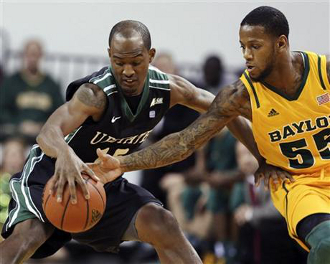
The Baylor guards have quick hands on defense
(Photo credit: Rod Aydelotte/Associated Press)

2) Turn Jackson into a passer – This key is much easier said than done, although the approach mentioned above is likely the best bet. Texas should blitz ball screens and stay close to the senior guard when he’s isolated on the perimeter. Although he can easily beat opponents off the dribble, the Longhorns will have to be ready to provide help once he drives and be willing to swallow a few points when he makes some impressive interior passes to his big men.

3) Cut down on live-ball turnovers – With Walton’s quick hands on the perimeter, the Bears get their fair share of breakaways. Couple his defense with Texas’ own turnover problems, and it could be a recipe for trouble.

Although Walton gets all the defensive praise, Jackson also gets quite a few swipes from unsuspecting opponents. Once he gets out on a fast break, his lightning-quick speed means that he is guaranteed to get to the rack on the other end. Texas is already going to have a tough time shutting down the Baylor offense, so they simply cannot be giving up fast break points if they want to have a shot this afternoon.

12.29.12
Posted by Ryan Clark at 11:37AM

Rice Owls (3-8) at Texas Longhorns (7-5)
Frank Erwin Center | Austin, TX
Tip: 1 P.M. | TV: Longhorn Network
LRT Consecutive Game #233

The Texas Longhorns wrap up 2012 with one last non-conference game, hosting in-state rival Rice this afternoon at the Erwin Center. While the Owls have been on an upward trajectory the last few seasons, this year’s squad is the definition of a rebuilding project, making this game more of a tune-up for the Longhorns. The timing is great, as Texas is coming off a pair of tough match-ups against North Carolina and Michigan State, with a road trip to Baylor looming next weekend.

By the numbers

No matter how you slice it, the numbers aren’t pretty for Coach Ben Braun and the Owls. Their adjusted offensive and defensive efficiency numbers rank in the bottom 100 nationally, with their offensive rebounding mark dead last out of 347 Division I teams. The Owls are still trying to put the pieces together after a tumultuous offseason, and it shows on the court.

As a result, Coach Braun has turned his team from one of last year’s quickest (68.6 possessions per game) to one of the slowest (64.3). They play patient basketball on the offensive end, spreading the court and waiting for the best possible shot. That patience does result in the one statistical bright spot for Rice, as their turnover rate of 17% is 22nd-best in the country. The Owls might not be able to score or rebound, but they certainly will not waste possessions with careless mistakes.

Meet the Owls

After the program’s most successful season in years, Coach Braun and the Rice faithful were ready for an experienced bunch to take the team to new heights this season. Instead, the decision not to renew the contract of assistant coach Marco Morcos unleashed a deluge of transfers and departures, gutting the once-promising roster.

Five Rice players transferred during the offseason, while a sixth returned home to Lebanon to play professionally. Of the six players, five were recruited by Morcos. Big man Arsalan Kazemi was a double-double machine at Rice and is now averaging 9.2 points and 10.4 boards for Oregon. Egyptian center Omar Oraby took his 7’4″ frame to USC, while German forward Jarelle Reischel went to Rhode Island. Point guard Dylan Ennis also transferred east, heading to Villanova, while forward Ahmad Ibrahim elected to go the professional route.

That leaves the Owls with three returning rotation guys, a host of newcomers, and a decided lack of size. The tallest players in the rotation are 6’7″ Seth Gearhart (No. 41) and British freshman Ross Wilson (No. 11). Gearhart is more of a stretch forward, however, while Wilson is struggling through the beginning of his first collegiate year. With no true big men, Rice often spreads all five players on the perimeter and constantly runs cuts through the lane, hoping for a quick-hitter that leads to a layup.

The star of the team is senior Tamir Jackson (No. 3), a 6’3″ guard who plays stifling perimeter defense and rebounds extremely well for a guy his size. On the offensive end, he’s the team’s best option to create a look, as he can put the ball on the floor and get to the rim when defenders play him a little too close. He’s also got the ability to hit a pull-up jumper at a moment’s notice, and is accurate enough from long range to be a consistent threat.

The other returning scorer is 6’4″ sophomore Julian DeBose (No. 15), who is also an excellent rebounder from the perimeter. He’s struggling with his midrange game this season, but has still managed to average 9.9 points per game by driving to the rack for layups and by converting his rare offensive boards into second-chance points.

With Ennis now on the Main Line, diminutive freshman Max Guercy (No. 1) is running the point. Listed at a generous 5’9″, Guercy is often able to get to the rim, but has had difficulties finishing in traffic. He’s good at using the hesitation dribble and varying his speeds to fool the defense, but Guercy’s inability to convert the easy looks is a huge blow for a team that is so inept on the offensive end.

Off the bench, junior forward Austin Ramljak (No. 42) has proven to be a big-time three-point threat. Although he’s been streaky from behind the arc, when the California juco product gets hot, he can light it up in a hurry. At the DirecTV Classic in Anaheim, Ramljak knocked down 9-of-18 from behind the arc in back-to-back games against Georgia Tech and Drake. On the season, he’s made a more reasonable 35% of his long-range looks, but Texas certainly can’t let him get comfortable this afternoon.

Freshman Keith Washington (No. 5) rounds out the core rotation, hailing from Philadelphia. He has an aggressive streak with good driving ability, and he has the strength to absorb contact and still get his shot up. Washington has shown some flashes this season that give fans hope that he can be a star, but for now he’s still a role player who is averaging 5.5 points in his 20 minutes per game.

Keys to the game

1) Take care of the ball – It looked like the Longhorns were heading the right direction in the turnover department, coughing it up on less than 17.5% of their possessions against UCLA, Texas State, and North Carolina. Saturday’s loss to a feisty Michigan State team exposed those weaknesses again, however, as the Longhorns ended more than 26% of their possessions with a turnover. While the Owls aren’t a team that forces many miscues, this is a major issue that the Longhorns need to get under control before tackling their Big 12 slate.

2) Deny Jackson’s driving lanes – Tamir Jackson is the only player on the Rice roster who can consistently create his own shot, and their offense can go cold for extended periods of time when he’s not scoring. If Julien Lewis and the Longhorns can turn away his drives and force him to beat them with long jump shots, Rice will have a hard time putting up enough points to hang with Texas.

3) Shadow Ramljak on the perimeter – Austin Ramljak has proven he can put up a bunch of points from outside, and he doesn’t need a ton of space to get off his shot. The Texas defenders need to stay in his shirt when he’s floating around the arc, and they have to contest his long-range attempts. The three-pointer is the great equalizer for less talented teams, so if Texas can limit the damage from behind the arc, Rice will have little hope for an incredible upset.

12.23.12
Posted by Ryan Clark at 1:35PM

#20/19 Michigan State Spartans 67, Texas Longhorns 56

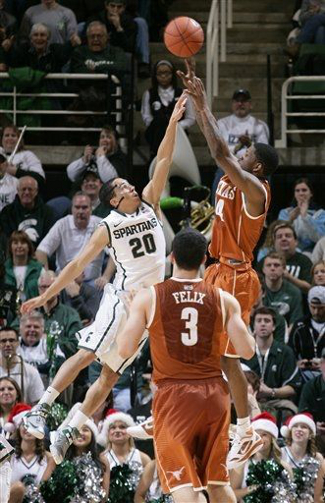
In front of a raucous crowd of nearly 15,000, the young Texas Longhorns faced their first true road test of the season in East Lansing yesterday afternoon. While they didn’t escape the Breslin Center with an improbable win, the team responded to adversity and battled down to the final minutes in a game that was much tighter than the final score indicated.

The Horns came out of the gate very shaky, hitting just one of their first nine shots, with the make coming on a simple stickback by Jonathan Holmes. Texas turned it over five times in the team’s first ten possessions, giving fans flashbacks to the disastrous start against Georgetown in New York. After eight minutes of play, the Horns had already fallen behind 12-4 and had gone more than seven minutes without a field goal.

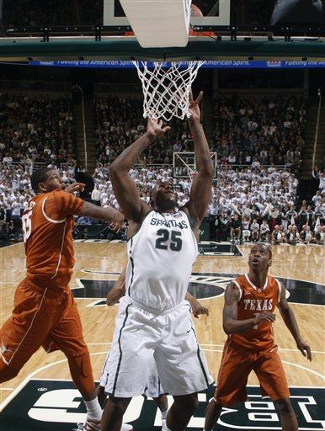
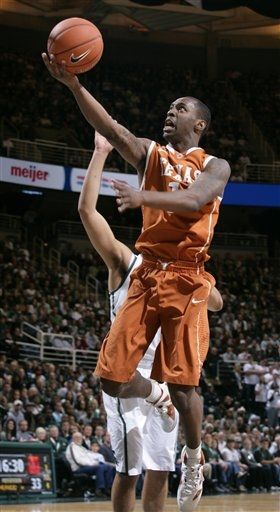
The Texas frontcourt could not contain Derrick Nix
(Photo credit: Al Goldis/Associated Press)

This time, the Longhorns didn’t wither under the pressure. The team suddenly heated up from long range and charged into the lead, while Sheldon McClellan woke up late in the half against a Michigan State defense that was keyed in on denying him the ball. He fought through tight defense, earning six free throw attempts as the half wound down, all of which he converted.

The one player Texas couldn’t stop in the first half was Derrick Nix, who had half of his team’s 28 points when they headed to the locker room. He put the Longhorn bigs in foul trouble early, sending Holmes and Cameron Ridley to the bench for extended periods of time. Michigan State continued to feed the big man in the second half, and the rotating Longhorn frontcourt was eaten alive. Nix finished with a career day, scoring 25 points to go with 11 boards. Eleven of his points came at the line, as he hit 84.6% of his free throws, well above his career average of 51%.

With Nix dominating and the Spartans putting on a run, the Longhorns found themselves down by as many as 10 points. Once again, they relied on stout defense down the stretch to hold the Spartans in check while they slowly mounted a comeback. Texas didn’t allow an offensive rebound and forced three turnovers during a seven-minute stretch where they clawed back to within two points of Michigan State. In the end, an inability to score in the clutch allowed the Spartans to slowly pull away over the final two minutes.

What looked good

Once again, the Longhorns were active in setting screens for their shooters, who had to fight through tight defensive pressure on every cut and curl. Texas has been much more active on the offensive end in their last four games, looking like a completely different team than the one that stood around on the court in the Maui Invitational. Javan Felix logged 11 assists on the afternoon, hitting the shooters at the right time for midrange jumpers.

Julien Lewis was the leading scorer for Texas, putting up 16 points for the game. Ten of his points came in the second half, where he repeatedly knocked down tough, contested jumpers in the lane. He was the only Longhorn who could be counted on to consistently score as the game wound down, and his buckets kept Texas in it until the final minutes.

Julien Lewis came up big in the second half
(Photo credit: Al Goldis/Associated Press)

Lewis is much more reliable this season, thanks to his new role as a catch-and-shoot guy. Last year, he often tried to create his own looks, and especially struggled if he couldn’t get going early. Now, Felix and the Horns are working hard to get Lewis open, and his quick release means he doesn’t need much space. The tight defense he is drawing is also opening up opponents to the shot fake and drive. Julien has done this on a few occasions this year, but with future opponents likely to throw additional pressure at him, he’ll have to mix it in even more.

The most important thing for these young Horns to take from this game was the experience. They are learning to respond to adversity and different players are trying to shoulder the load down the stretch. Connor Lammert had a huge bucket in the final minutes, although it appeared to be released after the shot clock had expired. Jonathan Holmes worked hard inside during the comeback push, but had a key hoop wiped out by a controversial charge. Lewis was a workhorse, and even Ioannis Papapetrou added a key three-point play and snagged timely defensive rebounds.

The Longhorns came up short in close games time after time last season, with most of their final possessions turning into an adventure. Texas’ primary option was clearly J’Covan Brown, and many times the late-game sets were simply him clearing out and trying to drive on an isolated defender. Opponents knew that and help defense was quick to respond.

This year, there are more players who are willing to step up and the team has more options. Unfortunately, the Longhorns are still not shooting the ball consistently, so those opportunities are not being converted. Only time will tell if this leads to a repeat of last year’s close-game frustrations, or if some of the youngsters will emerge as heroes and pull out a few tight victories.

What needed work

The player that most observers expected to take over Brown’s go-to role was sophomore Sheldon McClellan. Opponents have put a lot of energy into denying him the ball and making Texas have to work very hard to free him up. It’s been a struggle for Sheldon to get going in most games this year, as he often seems frustrated by the suffocating defense.

While he fought through the pressure late in the first half and earned some trips to the line, he was forcing things from the field all game long. He knocked down only one jumper on the afternoon, a three-pointer during Texas’ first-half run. His other two buckets came on drives to the rim, and he finished with an ugly 3-for-10 line. Most importantly, he missed two technical free throws with Texas down by one in the second half, energizing the crowd and fueling a nine-point run that gave Michigan State its largest lead of the game. He pressed the rest of the way, forcing terrible, off-balance looks.

Sheldon McClellan was mostly limited to layups
(Photo credit: Al Goldis/Associated Press)

Sheldon is drawing the bulk of the defensive attention, and it is going to be that way all season long. He has to stop backing down from the challenge and continue to fight for his looks, even when blanketed by top defenders. McClellan also has to start taking the ball to the rack. With defenders right on him as he catches the ball, almost all of his shots are contested. Shot fakes and head fakes will get the defense off balance and open up driving opportunities. Even if help shuts off those lanes, it forces opponents to rotate and will open up looks for his teammates.

Felix also forced things at time, taking some of the luster off of his 11-assist performance. The Texas bigs certainly had major issues handling passes in this game, but sometimes the blame rested on the point guard. Late in the game, Lammert bobbled a pass in the middle of the lane, but Felix had thrown it low and right into the middle of a gaggle of Spartan defenders. Also in the second half, Felix zipped an inbounds pass above the head of Prince Ibeh, which the big man tipped out of bounds. Prince often has trouble handling even easy passes, so a high heater only highlighted that weakness.

Javan also failed to make layups once he got to the rim, a problem that has been a team-wide affair in recent weeks. Felix missed a pair of layups after shaking the defense, and he also lost the ball on the way up in the final possession of the first half. Papapetrou also failed to convert his own open look at the rim after deftly slipping through the Spartan D.

The missed layup was the least of the problems for Papi on Saturday afternoon, however. He once again left a ton of points at the line, making just four of his nine free throw attempts. The Longhorns missed five other free throws, hitting only 58.3% at the stripe. A miss by Lammert also came on the front end of a one-and-one in the second half, essentially costing the team a possible two points. In a game that was close until the final minutes and in which the Spartans made nearly 77% of their free throws, the charity stripe played a huge role.

Even with that many points left at the line, the biggest problem for Texas came in defending the post. Nix and sixth man Adreian Payne had their way with the Longhorn bigs throughout the game, scoring against whoever Texas threw out there. They piled up the fouls on the Texas bigs, limiting both Ridley and Holmes to less than 20 minutes.

Ibeh was the only player to find much success against Nix, blocking two shots in consecutive second-half possessions. Nix was whistled for a technical after the second block as he argued for a foul, but Ibeh could have easily earned his own T for staring down the big man as he sat on the floor. When fighting hard for a win on the road, Ibeh’s preening after a good play could have been disastrous. He has to show some maturity and restraint in the future.

The lack of double teams on Nix was mystifying, as the Spartans had struggled with that at times this year. Michigan State players often forgot to help their big man, abandoning him against the pressure when he was doubled in previous games. In addition, the Spartans’ lack of a consistent midrange game and outside shooting meant that they likely would have struggled to beat Texas with the jumper. Instead, the Longhorns waited to offer post help until after Nix had beat the primary defender, resulting in easy buckets and needless fouls.

If one thing can be taken from the Texas struggles against Nix and Payne, it’s that the post players were forced to defend one-on-one. Against a team like Baylor that has length all over the court, doubling would be much less effective. If the Longhorn frontcourt can learn from their mistakes against MSU, perhaps it will pay off against some of the bigger teams in the Big 12.

Texas will also need to lock down the defensive glass in key situations as they move into conference play. On the whole, the Longhorns did an excellent job closing out defensive possessions with rebounds, limiting the Spartans to an offensive rebounding mark of 31%. The Longhorns performed even better in that category than UConn, Kansas, and Miami did against the Spartans, holding them well below their season average of 37.4%. However, the offensive boards that Michigan State did manage to control often resulted in second chance points. One was a big bucket at the end of the first half, and a clutch three by Keith Appling during Michigan State’s second-half push came after the Spartans reclaimed one of their missed free throws.

Texas has done good work on the defensive glass this season, but has struggled when the game is on the line. An inability to box out late in the UCLA game helped fuel that Bruin comeback, and the second chance points given to Michigan State were crippling. The Longhorns have to maintain their focus and close out defensive possessions with strong rebounds when the pressure is highest.

Finally, it must be noted that once again the turnover bug cost Texas in a big way. Although the Longhorns settled down for a long stretch of the first half, the five early turnovers killed their offense for nearly eight minutes. The team wasted 26.1% of their total possessions with miscues, the worst ball-control performance since the Georgetown game, and the third-worst of the season. It’s been said time and again, but for an offense that already struggles to score points, simply throwing away possessions is a recipe for failure.

Up next: vs. Rice (3-8); Saturday, 1 P.M.

« Previous Page — Next Page »