






12.04.12
Posted by Ryan Clark at 11:44AM

Texas Longhorns (5-2) vs. #15/23 Georgetown Hoyas (5-1)
Madison Square Garden | New York, NY | Tip: 6 P.M. CT | TV: ESPN
LRT Consecutive Game #228

Since suffering a shameful loss at the hands of Division II Chaminade on the island of Maui, the Longhorn defense has been downright stingy. After the Silverswords lit up the Texas D for 1.11 points per possession, the team has allowed just .740 points per possession in its last four games, and hasn’t allowed a single opponent to score more than .853 per trip. With their D-II loss not factoring into team statistics, the Longhorns now have the third-most efficient defense in the country, and have the best defensive mark in effective field goal percentage.

While the numbers are dominant, they haven’t come against a gauntlet of juggernauts. Mississippi State, Sam Houston State, and UT-Arlington are all averaging less than .9 points per possession on the season, with Southern Cal’s .95 not much better. Tonight’s game against a very talented and versatile Georgetown team will be the first true test for the Longhorn defense, and is only the beginning of a daunting stretch. Texas faces UCLA, North Carolina, and Michigan State in the next three weeks.

By the numbers

The Hoyas are known for their Princeton sets under Coach John Thompson III, and that patient offensive philosophy leads to some low-possession, low-scoring affairs. Georgetown has an adjusted pace of just 63.5 possessions per game so far this year, a tempo that puts them among the 40 slowest teams in D-I. On Friday night, Georgetown and Tennessee combined a 54-possession game with some terrible shooting to provide a glaucoma-inducing 37-36 final.

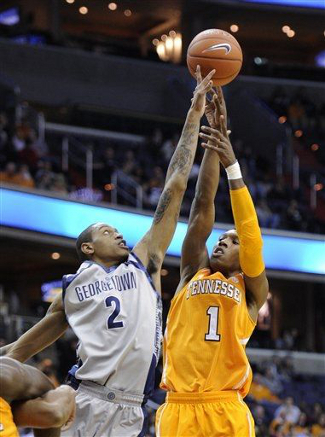
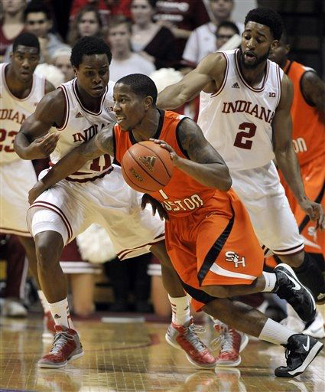
Georgetown’s length has frustrated opponents all season
(Photo credit: Nick Wass/Associated Press)

While the Hoyas mix in some traps and use a quick, active 2-3 zone to pressure opponents, they don’t typically force a ton of turnovers. Georgetown opponents have only given it up on 20.1% of their possessions, just a bit below the national median of 21.1%. Despite not forcing mistakes, the Hoyas still have a solid defense that is ranked 20th nationally in efficiency. As Texas fans know all too well, these young Longhorns have had far too many careless turnovers this season. Against a defense that is already oppressive even without the aid of turnovers, the Horns cannot afford to frequently waste their possessions with lazy or inaccurate passes.

Although Georgetown starts four players that are 6’8″ or taller, their offense does a poor job at extending possessions with rebounds. With their offensive sets often stretching the D across the floor, the Hoyas aren’t usually in position to crash the boards. As a result they have only won 23.3% of their offensive rebounding opportunities, ranking them just 333rd out of 347 D-I teams.

On the other end of the court, Georgetown is dominant on the glass. Opponents reclaim just 26.8% of their missed shots, a stat that is even more impressive when you consider how often the Hoyas use a 2-3 zone on defense. Without any specific box-out assignments in the zone, those kind of defensive rebounding numbers are very difficult to achieve.

Meet the Hoyas

Georgetown uses a balanced attack on the offensive end, as four of their starters average more than 10 points per game. The starting five features four players who are 6’8″ or taller, and all four of them are athletic, versatile players who can switch easily on defense and play a variety of roles in the smooth-flowing offense.

The one starter who doesn’t eclipse that 6’8″ mark is junior guard Markel Starks (No. 5), who checks in at 6’2″. While Starks can go quiet for long stretches, he heats up in a hurry and can score from anywhere on the court. He’s hit more than 44% of his three-point attempts this season, but will also put the ball on the floor to blow by defenses when they close out hard on the perimeter. In two games at the Legends Classic in Brooklyn, Starks lit up for 43 points against UCLA and Indiana, hitting 4-of-7 from beyond the arc against the Hoosiers.

Even though Starks typically brings the ball up the floor, big man Greg Whittington (No. 2) can also handle the basketball. He’s surprisingly deft with the ball for a 6’8″ guy and can play any position from one through four. Whittington has a nice midrange game and can quickly knock down a shot with very little space, but he can also beat defenders off the bounce when they are overzealous with the ball pressure. The sophomore is also doing a beastly job on the glass, averaging nearly nine boards per game. Even when he’s out of position, it seems that Whittington seems to glide through traffic to snatch rebounds out of the air.

Thanks to the length throughout the Georgetown lineup, Whittington also often gets the chance to take advantage of his size on the offensive end, as many teams have to use smaller shooting guards to defend him. On the very first possession of the Indiana game, Whittington drove the ball against 6-footer Jordan Hulls, forcing immediate help defense and rotations from the Hoosiers. With opposing bigs unable to keep up and opposing guards too small to shut him down, Whittington is averaging a team-leading 12.7 points per game.

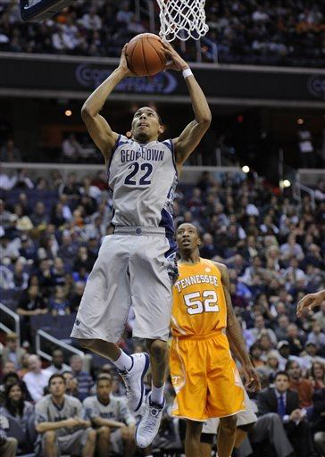
Otto Porter is expected to have a big season for the Hoyas
(Photo credit: Nick Wass/Associated Press)

The biggest star on the roster is sophomore Otto Porter, Jr. (No. 22), who is primed for a breakout season. After starting nine games in his freshman campaign, Porter was named to the Big East preseason first-team this year. He has a great jumper that’s accurate even out to three-point range, and he is an impressive passer for a big man. With an offense predicated on backcuts, post-ups, and flares, that ability to quickly and accurately find a teammate is paramount. Porter is actually second on the team with 14 dimes, giving him an excellent assist rate of more than 22% early in the season.

The team leader in assists is 6’8″ Nate Lubick (No. 34), who has 16 so far this year. While Lubick has always been a great passer out of the high post, the Hoyas are looking for some more confidence this year when it comes to his shooting. The junior has filled that role so far, often popping it from the elbow when defenses sag off of him to take away the passing angles. Although those midrange jumpers aren’t falling consistently yet, his looks from the blocks have kept his shooting percentage at a nice 57.1% mark.

The tallest member of the starting five is 6’9″ sophomore Mikael Hopkins (No. 3). Hopkins is yet another versatile player for Coach Thompson, as he can knock it down all the way out to the perimeter. Although he’s 0-for-1 from three-point range this season, he did sink an early bucket against Indiana with his feet on the arc. That shooting threat coupled with above-average handles also give Hopkins the ability to take opposing bigs in face-up situations from the mid-range.

Even though he can shoot it and put the ball on the deck, the main role for Hopkins is that of the go-to post player. He has so many good post moves in his repertoire, but so far this season, he has been struggling to hit the great looks he earns. If and when the sophomore can start consistently making his shots from within a few feet of the rim, he is going to be a big-time scorer for the Hoyas.

With such a solid starting five, Georgetown really only relies on two key bench contributors, D’Vauntes Smith-Rivera (No. 4) and Jabril Trawick (No. 55). Smith-Rivera is an exciting freshman guard who is a very stout 6’3″ that can finish through contact inside. He’s also an outside shooting threat, as evidenced by his collegiate debut against Duquesne, where he knocked down all four of his three-point tries.

At 6’5″, Trawick allows Coach Thompson to still retain a size advantage against most standard lineups. Like his teammates, Trawick is a good shooter that can hit from anywhere, and his burst with the ball makes him a constant threat to get to the rack. In that ugly win over Tennessee, Trawick’s brief scoring surge in the second half was one of the lone bright spots for the Hoya offense.

Stephen Domingo (No. 31) also has made an appearance in every game so far, but only averages a few minutes per contest. The freshman arrived at Georgetown ahead of schedule after finishing his high school requirements early and skipping his senior year. He was a Top 100 recruit in the Class of 2013 before reclassifying, and impressed as a starter on the USA’s U17 team at the World Championships in Lithuania.

Keys to the game

1) Communicate on defense – No matter how the Longhorns choose to tackle this Georgetown offense, good communication and quick help will be key. The Hoya offense has looked stagnant against zone defenses this year, often just swinging the ball around the perimeter instead of getting it into the high post. Although the offense has come a long way since facing Florida’s zone in The Game That Never Was on the USS Bataan, but the Hoyas still look much better against the man.

The Longhorns certainly have the length available to match up with the Hoyas in a man-to-man look, but that would mean giving more minutes to the likes of Prince Ibeh and Connor Lammert, while taking their best shooter off the floor in Julien Lewis. While it’s highly unlikely that those two bigs could keep up with the likes of Porter and Whittington, it’s even more unlikely that Cameron Ridley could handle extended minutes playing against a player who can stretch the floor like Hopkins.

Rick Barnes has favored the zone so far this year, and it looks like that’s the best approach against this Hoya lineup. That means that Texas will have to communicate as they pass the cutters off and that the Horns will need to find somebody to box out in defensive rebounding situations.

2) Value the basketball – As previously mentioned, the Hoya defense does a very good job at shutting down opponents without the benefit of turnovers. Unfortunately, the Longhorns have helped out their opponents by turning it over very frequently, and oftentimes without much pressure from the defense. Texas has to avoid those types of careless mistakes tonight in a low-possession game against a defense that doesn’t need any help. The Horns must squeeze every point they can out of their possessions, and throwing bad passes to some New Yorker on the front row will quickly sink their chances of an upset.

3) Move the ball – The Texas offense has looked rejuvenated over the last few games, with good motion off the ball and great passing to find the open man. With Javan Felix not having to dribble the air out of the ball while teammates stand around, the Longhorn offense hasn’t wasted time or possessions, and shooting percentages have skyrocketed.

This Hoya defense is going to make the Longhorns knock down shots, so they will have to use that same approach to get open looks and make them count. When you also consider that the Longhorns have scored nearly 24% of their points from the line this season, while the Hoyas are one of the best in the country at not sending opponents to the charity stripe, it’s clear that Texas will have to score from the floor. Good ball movement can make that happen, while stagnant, clock-burning possessions will only result in challenged jumpers and desperation heaves.

12.03.12
Posted by Ryan Clark at 12:47AM

Texas Longhorns 70, UT-Arlington Mavericks 54

The Texas Longhorns used a barrage of three-pointers and another stout defensive performance to dispatch UT-Arlington at the Erwin Center on Saturday afternoon, pushing their winning streak to three games as they head into a daunting week of neutral-site games. Although the final margin of victory was only 16 points, the game was much more one-sided, with Texas holding a lead as large as 28 points just eight minutes after halftime.

What looked good

Texas put forth its second-best offensive performance of the season, and its third-best effort on the defensive end. The Longhorns managed exactly one point per possession and an eFG of 57.8% against a UTA defense that was top-five nationally in eFG coming into the game. Julien Lewis led the way for Texas with 6-of-10 shooting from behind the arc, part of the team’s impressive 13-for-26 day from long range.

For the Longhorns, the success from three-point range is a welcome change. Last season’s team was the worst three-point shooting Texas squad in 13 years, with the five returning members of that team combining to hit just 30.7% of their threes in 2011-12. The beginning of this year wasn’t much better, as the Longhorns managed just an ugly 21.5% mark behind the arc in their first four games. Their fortunes have turned during the three-game winning streak, however, as the Horns have hit 26 threes for a success rate of more than 44%. If Lewis, Sheldon McClellan, and Ioannis Papapetrou can continue to knock down the triples, the Texas offense will actually be multi-dimensional and much tougher to defend.

A big reason why the Longhorns are finding more success behind the arc is because they are working hard to get open looks. Texas is setting numerous screens for their shooters as they run baseline cuts, and using downscreens to open up McClellan and Lewis on flares to the perimeter. While Sheldon is a player who can create good looks for himself with the dribble, Lewis has much better form and is much more accurate when he is shooting off the catch.

The three-point party also opened up the driving lanes for Texas, particularly on the baseline. With the Mavericks closing out hard on the perimeter, the Longhorns were able to put the ball on the floor and drive into the heart of the defense. Karol Gruszecki was the unfortunate victim of two nice baseline drives by McClellan in the first half, as he bit hard on the shot fake while rushing out to the perimeter.

Greek import Ioannis Papapetrou joined McClellan and Lewis in the double-digit scoring club, despite spending the first nine minutes of the game on the bench. Like Lewis and McClellan, Papi had an excellent game from long range, knocking down three of his four long-range attempts. He also put the ball on the floor for a nice drive from the corner, and earned 10 trips to the line as a result of his slashing efforts. Unfortunately, Papapetrou made just four of his free throws, dropping his free-throw mark to 54.2% on the year. For a guy with a nice jumper, the struggles from the line are baffling. If Papi is going to continue to drive to the bucket, he’s going to have to capitalize on the numerous free throw opportunities he will be earning.

Texas also had a solid performance from freshman Cameron Ridley, who once again impacted the game on both ends. He put up six points on 3-for-5 shooting, making strong, confident moves with the ball in the post. He also notched another four blocked shots and altered a handful of others, pushing his block percentage to 16.3% on the year. While it’s still very early, that number puts Cam in the top ten nationally in that category.

Ridley wasn’t the only one providing solid post defense, as Jonathan Holmes and Connor Lammert both did nice work with help D to cut off baseline drives by UTA. Holmes was unable to make too big of an impact, however, as he battled foul trouble all game long and earned the DQ after only 24 minutes on the court.

Javan Felix once again had a rough start, but was able to bounce back for a very impressive outing. Before the first media timeout, Felix had already thrown two bad passes that resulted in turnovers, and he was sent to the bench at the 15:20 mark. Demarcus Holland took over point guard duties for nearly five minutes before Felix returned, but the New Orleans native did not log a single turnover after that point. He also tallied nine assists for the game, consistently hitting the open shooters on time and in rhythm as they came free beyond the arc.

What needed work

Although Texas was able to build a lead of nearly 30 points in this game, their effort waned late in the game. UTA abused the Longhorns on the glass in the second half and took advantage of turnovers to quickly slice into the lead. For the game, the Mavs grabbed 44.4% of their offensive rebounding opportunities, their second-best performance of the season, and the best one posted by a Longhorn opponent this year.

This problem was an unhappy confluence of two recurring issues for Texas this season. This young squad has done a surprisingly poor job of securing defensive rebounds against smaller opponents, and the team has often lost focus for long stretches. Against Sam Houston State and UT-Arlington, losing focus late in a blowout only affected the margin of victory. But, these lapses in effort are often leading to stagnant offensive sets, which in turn leads to long scoring droughts.

Against Chaminade, the Longhorns didn’t even look like they cared about the game, and their offensive performance reflected that attitude. While fans are hopeful that Texas won’t ever again completely check out for an entire game, even a few possessions of lackluster play could mean disaster for this team. The margin for error looks to be very slim with the current roster, especially considering the buzz-saw of a non-conference schedule that awaits in the next three weeks. The Longhorns can’t afford to take plays off, so they have to take advantage of the opportunity to establish that mindset in these lower-risk games.

Up next: vs. Georgetown (5-1) at Madison Square Garden; Tuesday , 6 P.M. CT

12.01.12
Posted by Ryan Clark at 1:54PM

UT-Arlington Mavericks (3-1) at Texas Longhorns (4-2)
Frank Erwin Center | Austin, TX | Tip: 3 P.M. CT | TV: Longhorn Network
LRT Consecutive Game #227

The Texas Longhorns used stifling defense to earn a comfortable win over Sam Houston State on Tuesday night. This afternoon, they face a UT-Arlington team with a stingy defense of its own. While the Maverick defense is ranked fifth in Division I in effective field goal percentage, the Longhorn defense is tops in the nation in that category. Throw in the problems that both offenses have had hanging on to the ball this season, and fans could be in store for an ugly, low scoring affair this afternoon at the Erwin Center.

Meet the Mavericks

Junior point guard Shaquille White-Miller (No. 12) is listed at a generous 5’9″, but he holds his own despite the size disadvantage. In his first full season as a starter, White-Miller is still suffering from some growing pains, turning it over as many times as he’s dished out dimes. His shooting from the floor has been a rough 25%, making it even easier for opposing defenses to sag off and take away driving and passing lanes.

Fellow junior Brandon Edwards (No. 35) is a 6’6″ forward who really scraps inside for every loose ball and rebound. He performed admirably in the home opener against a bigger Oklahoma team, and is currently second on the team with nearly eight boards per game.

The big man in the middle is 6’10” senior Jordan Reves (No. 55), who is tops on the team with 12.3 rebounds per contest. UTA loves to feed the big man in the post, where he’s knocking down more than 53% of his shots. Against the likes of OU’s Romero Osby, Reves was frustrated early and struggled on both ends of the floor. If he can get comfortable against Texas, he can make a big impact. But, if Prince Ibeh and Cameron Ridley can set the tone early, it could take him out of the game.

Although the Mavs don’t take very many shots from behind the arc, the team’s top long-range threat is Polish product Karol Gruszecki (No. 33). Gruszecki came to UTA via North Platte CC, and is currently knocking down his threes at a 40% clip.

The final member of the starting five is Kevin Butler (No. 24), who started the first two games of the season on the bench. Butler is a very strong 6’5″ forward who has driving ability and can finish through contact. Last year, he led the Mavericks with 12 points in their game against the Longhorns, and he’s currently the team’s leading scorer with 10.8 points per game this year.

Butler is a very tough matchup for opponents, because the smaller UTA lineup usually dictates that he is defended by a 4. His speed and driving ability usually tilt that pairing in his favor, while his strength makes it risky for opponents to throw a smaller defender at him.

The player Butler replaced in the starting lineup is guard Jamel Outler (No. 3), a 6’2″ sophomore who transferred from Texas Tech. Despite being moved to a sixth-man role, he’s still fourth on the team with 8.8 points per game. Like Gruszecki, he’s a dangerous long-range shooter, but doesn’t take a ton of shots from behind the arc. Outler averages less than five three-point attempts per game, and has hit nearly 37% of those shots.

Junior forward Greg Gainey (No. 21) has already shown a nice, well-rounded game in his minutes off the bench. At 6’5″, he has the strength to score inside against bigger opponents, but has a nice midrange J that can stretch things out a bit. Another JUCO product, Gainey arrived in Arlington via South Plains College and has made a quick impact, averaging 7.8 points per game as a reserve.

Freshman guard Drew Charles (No. 4) is the backup point guard, but he has had some issues with ball control this season. In the Oklahoma game, the Sooner pressure forced him to travel on two consecutive possessions while trying to turn up court after receiving the outlet pass. He finished that game with six turnovers, but has managed to only cough it up two more times in the team’s other three games.

The final player in the UTA rotation is senior guard Cameron Catlett (No. 25), who played fourteen minutes against North Texas on Wednesday night after missing the first three games of the season. Last year, Catlett started the game against Texas and scored six points in 21 minutes of action.

Keys to the game

1) Force Maverick mistakes – While it’s hard to believe, UT-Arlington actually turns the ball over almost as often as Texas does. The Mavericks end 26.9% of their possessions with a miscue, and looked absolutely lost at times against Oklahoma’s backcourt pressure. Texas hasn’t forced many turnovers this season, but a little bit of additional defensive pressure could give the Horns some extra possessions this afternoon.

2) Don’t give it right back – Extra possessions are meaningless if the Longhorns turn around and give the ball back on the other end. UTA made a very nice comeback against Oklahoma by throwing full-court looks at the Sooners, so the Longhorns will have to be ready for that. Texas struggled when Sam Houston State brought backcourt pressure late in Tuesday’s game, so it is definitely an area for concern.

All of this focuses simply on bringing the ball up the court, which is unfortunately only half the battle for Texas. Lazy passes and bad angles have led to numerous turnovers when just trying to start the offense at the top of the key, so Javan Felix and his fellow Horns need to focus and take care of the ball in their half-court sets, as well.

3) Get to the line – Texas took advantage of Sam Houston State’s aggressive defense and made it to the line 38 times in Tuesday’s win. The Horns posted an incredible free-throw rate of 88.4% in that game, meaning that they took almost nine free throws for every ten field goal attempts. Fortunately for Texas, the Mavericks also tend to send their opponents to the charity stripe, as they are ranked 306th in Division I with a defensive free-throw rate of 47.6%. If Texas is aggressive against this UTA defense, they should earn numerous opportunities for free points at the line.

11.28.12
Posted by Ryan Clark at 6:55PM

Texas Longhorns 65, Sam Houston State Bearkats 37

After a harrowing week of basketball on the island of Maui, the Texas Longhorns returned to mainland action on Tuesday night, hoping for a quick recovery against Sam Houston State. Led by a stifling defensive performance, the Longhorns overcame 19 turnovers and long field goal droughts to cruise to a 28-point win.

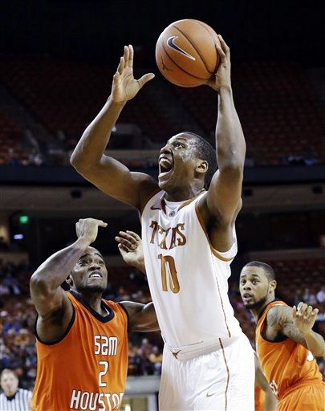
Sam Houston State was suffocated by the Texas defense
(Photo credit: Eric Gay/Associated Press)

Texas limited the Bearkats to only 0.506 points per possession on the night, while allowing just 21% shooting from the field. The Longhorns used excellent team defense and mixed in a variety of looks and lineup combinations to keep Sam Houston State frustrated throughout. That defensive dominance was never more apparent than in a stretch of eight-plus minutes, spanning both halves, in which the Bearkats managed just one field goal.

Texas stifled their opponents with sound man defense in the first half, hedging hard on ball screens while using a larger lineup. Facing a four-out, one-in look from the smaller Bearkats, Coach Rick Barnes elected to go with a smaller lineup of his own during the first half and the Longhorns began switching screens. In the second half, big man Cameron Ridley saw much more action as the Longhorns shifted into a zone defense that was just as effective.

One of the most impressive players on the defensive end was freshman Demarcus Holland, who earned his first career start. In his 26 minutes on the court, only four points were scored by players he was guarding.

The first bucket came as Sam Houston State rushed down the court and Holland couldn’t find his man, Paul Baxter, who dribbled through traffic before drilling a pull-up jumper from the free-throw line. The other basket came when the 6’2″ Holland was isolated on the block against 6’7″ Erik Williams. Even then, Holland played solid belly-up defense and kept his arms straight up, forcing Williams to take a hook shot as he stepped across the lane.

Demarcus seemed to be making the little plays all night long. In one instance, he bailed out Ioannis Papapetrou, who allowed James Thomas past him on a drive from the wing. Holland swiped at the ball, forcing Thomas to bobble it and ultimately travel along the baseline. Later in the game, Papi returned the favor for his teammate, standing tall to get a blocked shot after Holland was hung up on a screen at the free throw line. Holland also snagged five defensive rebounds, many of them coming as he sagged off to help from the weak side.

Offensively, Demarcus did not perform nearly as well. He missed one three-point attempt and had another one blocked, and he missed his two other shots on the night. He did score five points from the line, earning four of his seven free throw attempts by hustling for loose balls and rebounds. However, Holland was tagged with two turnovers for the game, one coming on an ugly pass at the end of the first half and the other coming when he simply held the ball in front of the aggressive Darius Gatson well behind the arc.

Those turnovers were once again a problem for the entire team, with the Longhorns losing it on 26% of their possessions. That number is ugly on its own merits, but when you consider that 26% is actually an improvement from the last game against Mississippi State, the scope of the problem becomes more overwhelming.

The most frustrating aspect is that many of the Texas turnovers happen because of a lack of awareness by players off the ball, while quite a few others come from making lazy passes. Javan Felix turned it over on a five-second call where he stood at least five feet behind the arc, while the rest of his team waited idly around the lane. Texas also lost one on a five-second call on an inbounds play where the Bearkats doubled to deny the pass, while no other Longhorns came back to help.

When starting the offense, passes between the two guards at the top of the key are far too often deflected or nearly stolen. This has been a problem all season long, and it was once again an issue against the Bearkats. Papapetrou has had numerous soft passes stolen as he gives the ball back to Felix, while Javan has given it away on simple passes to the wings. In this game, Felix was responsible for five turnovers, and could have had a sixth if the Bearkats had held on to one of his telegraphed passes to Holland on the wing.

Another recurring issue for the Longhorns is poor decision-making in the transition game. Texas has the athletes to get out and run, and with an offense that is struggling in half-court sets, easy transition opportunities cannot be wasted. Sheldon McClellan blew two of those chances in this game, while Holland spoiled another. McClellan barreled ahead in a two-on-three situation, trying to sidestep a charge before missing his layup. Later in the game, he had it poked away from behind as he sized up a one-on-one move. No team wants to waste their fast breaks, but an offense as inefficient as Texas’ certainly cannot afford to do so.

Although McClellan wasted those two opportunities, he did manage to lead the team with 16 points. Unfortunately, that came on 4-of-13 shooting, with six of those misses coming from inside the arc. Texas has had a lot of success finding Sheldon on baseline inbounds plays this season, and the same was true in this game. Using a different set from the one they repeatedly abused Mississippi State with, the Longhorns hit McClellan for a wide-open three on one baseline inbounds, one of the two triples he hit on the night.

McClellan came off the bench for the third consecutive game, as Coach Barnes continued to send the sophomore a message about effort, particularly on the defensive end. He ended up playing 28 minutes and contributing to the solid team D, although he did lose sharpshooter Will Bond in transition on one play, allowing him to hit his only three of the game.

Jonathan Holmes found some success inside
(Photo credit: Eric Gay/Associated Press)

In addition to freeing up McClellan on inbounds passes, Texas also did a good job isolating Jonathan Holmes on the blocks and finding him for easy buckets. While the young Longhorns are still struggling to get the ball into the post, Holmes was the recipient of two nice feeds for points in the paint. He also added a three-point bucket and a nice stickback on an offensive rebound that he grabbed despite being out of position.

Unfortunately, those issues with hitting the post players have cost Texas quite a few points this season. Many post feeds have been thrown at bad angles or zipped past the bigs far too quickly. Other times, the Longhorn guards and wings have just been completely oblivious to a wide-open teammate who has worked hard to get to the right spot on the floor. While the turnover problems are clearly the biggest issue right now for Texas, this certainly must also be high on the priority list for the coaching staff.

The Longhorn coaches will also be concerned by the team’s performance on the glass, as once again Texas could not exploit a significant size advantage. The Horns grabbed only 22.6% of their offensive rebounding opportunities, which was a huge reason why they could only manage a dismal 0.88 points per possession. Fortunately, it is clear that rebounding was a big talking point at halftime, and that the team responded to that message. The Bearkats held a 21-18 edge on the glass at half, but Texas turned the tables after the break, outrebounding Sam Houston State by a 29-14 count in the second twenty minutes.

The Longhorns also had a nice second-half effort from Julien Lewis, who picked up two early fouls and was limited to just 19 minutes for the game. He came out of the locker room and made an aggressive drive to earn two quick free throws in the second half, then followed it up with a nice backcut for a reverse layup and the foul. He also made a strong baseline drive later in the half to draw the defense and free up Ridley on the block, and he earned eight trips to the line with his constant dribble penetration.

Prince Ibeh also made a nice contribution in his limited minutes. Once again, he impacted plays inside by altering shots and keeping rebounding opportunities alive for teammates by tipping balls that were just out of his reach. More important, however, were the two strong, quick moves he made after receiving feeds in the post. After looking panicked with the ball in Maui, where he repeatedly allowed defenses to collapse on him as he froze up, seeing Ibeh exhibit some confidence is a welcome change for Texas fans.

With one more tune-up awaiting on Saturday before daunting games against Georgetown and UCLA, the Longhorns have to hope for even more improvement throughout this week of practice. Although shots weren’t falling for long stretches of the game, there were quite a few possessions where the Longhorns made nice, hard cuts and set solid screens to get the offense going. Although the effort waned throughout the game, it’s clear that some steps are being made in the right direction. Texas fans can only hope that those improvements both continue and accelerate in the coming days.

Up next: vs. UT-Arlington; 3 P.M. CT, Saturday

11.27.12
Posted by Ryan Clark at 3:35PM

Sam Houston State Bearkats (3-3) at Texas Longhorns (3-2)
Frank Erwin Center | Austin, TX | Tip: 7 P.M. CT | TV: Longhorn Network
LRT Consecutive Game #226

The Texas Longhorns return to action on the mainland tonight, hosting Sam Houston State at the Frank Erwin Center. After a pair of losses to open play in the Maui Invitational’s championship rounds, the Longhorns bounced back with a convincing win over a shorthanded Mississippi State squad. Texas hopes to build on that win tonight and establish some momentum this week before heading into a very tough pair of non-conference match-ups against Georgetown and UCLA.

Sam Houston State comes to Austin riding a two-game winning streak, having knocked off Liberty and UC-Irvine at home in the sub-regional round of the Legends Classic. This road trip to a big-time college arena will certainly not intimidate the Bearkats, as they have already battled Arkansas down to the wire in Fayetteville before being blown out by Indiana at Assembly Hall.

By the numbers

The Bearkats have struggled mightily on offense so far this year, scoring just 0.868 points per possession, a number that ranks 301st out of 347 Division I teams. A big part of this problem is Sam Houston State’s dedication to the perimeter. The team has taken nearly 39% of its shots from behind the arc, despite knocking down only 29% of those long range attempts.

Defensively, the team has bounced back against lesser competition after getting crushed by Indiana. The Hoosiers posted an insane 1.47 points per possession in their 99-45 win over Sam Houston State, but the Bearkats were able to hold Liberty and UC-Irvine to just .754 and .853 PPP, respectively. Although the Flames and Anteaters aren’t high-quality competition, it’s still impressive that the Bearkats were able to dominate the defensive glass against those two teams and turn most possessions into one-shot trips.

One number that is especially troubling for the Bearkats as they prepare to face Texas is their defensive free-throw rate. Against Arkansas and Indiana, Sam Houston State’s defensive FTRs were 62.8% and 83.0%, respectively. FTR measures how often a team gets to the line, so it is apparent that against bigger, more talented teams, the Bearkats were constantly being whistled for fouls. Although Texas has done poorly from the line, Sam Houston State still cannot afford to give the Longhorns as many free throws as they gave to their other major-conference opponents.

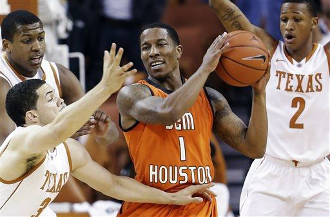
Darius Gatson leads a balanced Bearkat offense
(Photo credit: Alan Petersime/Associated Press)

Meet the Bearkats

Sam Houston State has used a deep rotation so far this season, with 11 players averaging at least 11 minutes. Senior guard Darius Gatson (No. 1) is the team leader in minutes, and even he only averages 25.3 per game.

Typically, that kind of substitution pattern would be indicative of a run-and-gun, high-pressure squad, but that isn’t the case with the Bearkats. Coach Jason Hooten is trying to incorporate five junior college newcomers this season, while hoping to replace the loss of three starters from last year’s team. While the results have been mixed, so far the team is using a balanced attack, having a different leading scorer in each of their six games.

Gatson was the leading scorer in the team’s first game, pouring in 20 against Arkansas. For the year, he’s also leading the team in points, averaging 9.5 per game. At just 5’11”, he is a bit undersized to face most major-conference opponents. However, with Myck Kabongo still unavailable for the Longhorns, Gatson will be squaring off with Javan Felix, also an undersized guard.

Swingman DeMarcus Gatlin (No. 11) was one of three Bearkats who started against Texas in last year’s game, shooting just 3-of-10 from the field in 35 minutes of action. He’s is the team’s leading retuning scorer from 2011-12, but is averaging just 6.7 points this season.

Michael Holyfield (No. 35) is the team’s other returning starter and its only true big man. At 6’11”, he is typically the anchor of Sam Houston State’s four-out, one-in look, and is really their only option for posting up opponents. He has been struggling with foul problems all season long, an issue that has plagued him for most of his career. He fouled out against Texas after playing just 26 minutes last season, and he’s averaging more than seven fouls per 40 minutes this year.

With Holyfield filling the lane, junior forward James Thomas (No. 20) is the closest thing to a 4 the Bearkats have. He’s often used to set high screens and then roll to the basket. Although Thomas is just 6’5″, he has played very tough against the bigger lineups of Arkansas and Indiana, scrapping for every point and rebound inside.

Junior guard Jeremy McKay (No. 10) has started all six games for Sam Houston State, but is still struggling to find his shot. He’s made just 28.6% of his three-point attempts and only 27.7% of his shots from inside the arc. McKay showed a nice burst off the dribble against Indiana, but his inability to knock down long shots makes it easier for defenses to sag off of him and take away that driving threat.

Former walk-on Marquel McKinney (No. 2) has earned one start so far in his sophomore campaign, and he has proven to be the team’s only real three-point threat. He’s knocked down more than 40% of his long range attempts, and is third on the team with eight points per game. At 6’3″, McKinney also gives Coach Hooten a little more size in a backcourt that features two guards under six feet.

Forward Terrance Motley (No. 24) has played well after missing the first two games of the season for undisclosed reasons. Despite coming off the bench, he’s leading the team with six boards per game, and is second on the squad in scoring. Like Holyfield, Motley is averaging more than seven fouls per 40 minutes of hoops, so the Longhorns will want to attack him and hope to pile up the whistles.

Coach Hooten has another promising option on the bench in Nathaniel Mason (No. 33), a 6’4″ wing who transferred from Des Moines Area CC. He showed some nice driving ability and knocked down a three against the Hoosiers, but he’s only 25% from behind the arc on the year.

A trio of guards round out the deep rotation, with Aaron Harwell (No. 5), Paul Baxter (No. 21), and Will Bond (No. 32) combining to average about 37 minutes per game. Baxter is a freshman from Austin’s Bowie High, and the son of former Longhorn Ron Baxter. Harwell was a big contributor last year after transferring from Centenary, but has a limited role this season. Bond arrived in Huntsville from Trinity Valley CC, where he was a three-point marksman. This season, he’s hit more than 38% of his attempts from beyond the arc.

Keys to the game

1) Hang on to the ball – The Longhorns have been absolutely atrocious when it comes to turnovers this season, coughing it up on 29.4% of their possessions against D-I opponents. Even in their shocking loss to D-II Chaminade, the Horns ended 23.4% of their possessions with a turnover. Although the Bearkats aren’t known for a high-pressure D, many of the Longhorn turnovers this season have been unforced errors. With points and wins hard to come by on this young season, Texas simply cannot afford to waste possessions.

2) Dominate the glass – In their two Maui losses, the Longhorns were essentially shut out on the offensive boards. Chaminade and USC claimed 71.8% and 80% of the Texas missed shots, respectively, limiting the Horns to a seemingly endless string of one-shot possessions. Fortunately, Sam Houston State has had problems keeping their major-conference opponents from dominating the boards. Texas needs to exploit that size advantage and own the glass on both ends of the floor.

3) Get Sheldon McClellan going – Although McClellan had a nice game against Mississippi State, his performances have been streaky so far this year. Sheldon has appeared to get frustrated easily and not always embrace the role of go-to scorer that the team needs him to accept. Sam Houston State gave Texas a lot of trouble last year by doubling down on the baseline and trapping along the boundaries. McClellan can’t let that defensive approach frustrate him and take him out of the game this time around.

« Previous Page — Next Page »