






7.26.12
Posted by Ryan Clark at 10:58PM

Thursday morning, ESPN’s College Basketball Nation gave college hoops fans a brief drink in the vast offseason desert, revealing the brackets of the November and December tournaments that will air on the Worldwide Leader. Now in its 29th season, the EA Sports Maui Invitational is the most well-known of these early-season events, and once again Rick Barnes and his Longhorn squad will take part in the famous tournament this November.

The opportunity to discuss and analyze brackets — even those that aren’t played out in March — is a great distraction from the fact that there are still 102 days until the 2012-13 regular season tips off. With that in mind, we’re stretching our breakdown of this year’s Maui field over two days. It’s up to our dear readers to find ways to occupy the other 100.

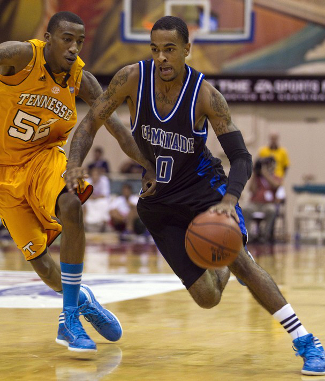
Chaminade Silverswords

The Longhorns will open play on the island of Maui with on November 19th against host Chaminade. The Silverswords are just 6-76 all-time in the tournament, with their most recent win coming in 2010 against another Big 12 school, Oklahoma. Chaminade escaped with a narrow 68-64 win over the Sooners, locking up 7th-place in that 2010 tourney. While they are best known for the monumental upset of top-ranked Virginia in 1982, the Silverswords also boast a pair of Maui wins over Louisville and victories against Villanova and Princeton.

Bennie Murray leads a veteran Chaminade backcourt
(Photo credit: Eugene Tanner/Associated Press)

This year’s Chaminade squad has nowhere to go but up, as they wrapped up their 2011-12 campaign by losing eight of their last ten and sputtering to a disappointing 11-14 finish. It was destined to be a rough year for the Silverswords, as they were blasted in their three EA Sports Maui Invitational games last November, losing to UCLA, Georgetown, and Tennessee by an average of 28.3 points.

Although Chaminade lost leading scorer and rebounder Matt Cousins to graduation, the squad will be very experienced and eager to return to the NCAA Division II tournament after a one-year absence. Four of last year’s starters are back on campus, including three seniors. All told, the returning nucleus of Bennie Murray, Lee Bailey, Dominique Cooks, and Waly Coulibaly accounted for 65% of last season’s minutes and nearly 63% of the team’s points.

As is to be expected with a D-II squad, the Silverswords will be very undersized when compared to their mainland opponents. Sophomore Casey Oldemoppen and juco transfer Tyree Harrison are the team’s biggest bodies, with both checking in at just 6’8″. Although the experienced backcourt should improve on the ugly 0.91 assist-to-turnover ratio they posted last year, that height disparity will still lead to a lot of second-chance points for the Longhorns and the other D-I teams.

* * * * * * *

After taking on Chaminade in opening round action of the EA Sports Maui Invitational, the Longhorns will face either Illinois or Southern Cal on November 20th.

Illinois

The 2011-12 campaign was a brutal one for the Illini faithful. Longtime coach Bruce Webber watched his team lose 12 of their last 14 games, ultimately finishing 6-12 in the Big 10. The slow meltdown of a once-proud program spelled the end for Coach Webber in Champaign, but he found a new home at Kansas State before Kentucky had even cut down the nets in New Orleans.

The biggest challenge for the Illini was simply trying to put the ball in the basket. Illinois had a putrid offense that was more efficient than only Nebraska’s in league play. They were one of the 50 worst teams in all of Division I basketball in both three-point percentage and free-throw rate, meaning not only that they couldn’t hit from outside, but that they also weren’t being aggressive inside. If not for a stifling defense that allowed just 0.933 adjusted points per possession, Illinois wouldn’t have even been competitive in the six league games it did manage to win.

So with the entire Illinois roster back, except for lottery pick Meyers Leonard, why is there optimism surrounding the 2012-13 season? There isn’t an influx of new talent headed towards Assembly Hall. In fact, there’s only one new player who will see the court this year, Coastal Carolina transfer Sam McLaurin. A graudate student who is eligible to play right away, McLaurin was so flippant about his move that he announced his transfer destination with the tweet, “Fuck it im going to Illinois. #illinination”

With that hope not being a result of new faces on the court, perhaps the optimism comes courtesy of the new man at the reins, former Ohio coach John Groce. Fresh off a Sweet 16 appearance and a near-upset of North Carolina in the NCAA regional semis, Groce inherits a team full of talent that has yet to live up to expectations. Fans can only hope that he is able to reach a group of players that seemed completely checked out at the end of Webber’s reign.

D.J. Richardson and Brandon Paul are returning, and will make the Illini backcourt one of the most experienced in the nation. Joining them on the perimeter is junior wingman Joseph Bertrand, who showed flashes of brilliance throughout the season, especially in a January upset of Ohio State. He earned starts in 14 of the team’s 18 league games, and fans are hopeful he’ll truly break out in 2012-13.

The biggest hole was left by Leonard, who went pro after just two years at Illinois. That means there are a lot of expectations weighing on sophomore Nnanna Egwu, a raw 6’10” Nigerian center who appeared in every game last year. With Leonard chewing up the bulk of the post minutes in Webber’s four-guard look, Egwu averaged just under 10 minutes per game. He will have to make a big leap to be competitive in a physical Big 10, but will still likely be going through some growing pains when the team is in Hawaii.

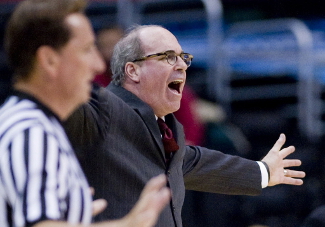
Kevin O’Neill hopes USC will bounce back in 2012-13
(Photo credit: Chris Pizzello/Associated Press)

Southern Cal

USC had an even more disappointing season than Illinois, but Coach Kevin O’Neill and the Trojans should bounce back quickly. Unlike the Illini, the abysmal season in L.A. wasn’t a result of inexplicable chemistry issues. Rather, the Trojans were a walking MASH unit, playing in some late-season Pac-12 games with only six scholarship players. Pro prospect Dewayne Dedmon and forward Aaron Fuller both missed significant chunks of the year, while point guard Jio Fontan sat out the entire season following knee surgery.

This year, the Trojans are back at full force, and welcome some much-heralded new faces to the locker room. Ari Stewart and Eric Wise are eligible to join the team in 2012-13, having sat out last season after transferring from Wake Forest and UC-Irvine, while former Tennessee Volunteer and hip-hop artist Renaldo Woolridge can immediately play thanks to the graduate transfer rule.

The Trojans also welcome 6’3″ guard J.T. Terrell, who averaged more than 11 points per game for Wake Forest in 2010-11. Following an arrest just two months before the 2011-12 season, Terrell left Wake and played at Peninsula College, where he led the team to an NWAACC playoff berth while averaging over 24 points per game.

Even with a depleted roster, Coach O’Neill was able to make his Trojan squad one of the toughest defensive units in the country. USC allowed just 0.944 adjusted points per possession, 47th-best in D-I hoops. They forced turnovers on nearly a quarter of their opponents’ possessions, one of the ten best marks in the country last year.

Where USC struggled was on the offensive end, and that struggle was a mighty one. The team’s adjusted offensive efficiency was 326th out of 345 Division I teams, thanks in large part to the third-worst three-point percentage in the country. USC also was one of the ten worst teams in offensive rebounding percentage, free-throw rate, and effective field goal percentage. It would be practically impossible for the healthy, reloaded Trojans cannot to do worse on the offensive end this year.

The EA Sports Maui Invitational will be an early indication of just how well this team can perform in 2012-13. O’Neill has been an outstanding defensive coach in his four years as head coach at USC and Arizona, so there’s no question they will remain competitive. The pieces are there for the Trojans to make a remarkable turnaround, but the offense has to at least reach serviceable levels to take advantage of that stingy D.

For a look at the other half of the EA Sports Maui Invitational bracket, check out Part Two of our preview.

4.17.12
Posted by Ryan Clark at 11:47PM

Fittingly, the final game of the 2011-12 Texas basketball season played out the same way that the entire season had unfolded. The Longhorns dug themselves a big hole, missed numerous chances within spitting distance of the rim, fought back with suffocating defense, and ultimately failed to execute in the final minutes. For fans who hadn’t had a chance to really get to know this young Longhorn team, the NCAA Second Round loss to Cincinnati was a perfect microcosm of a season filled with growing pains and gut-wrenching losses.

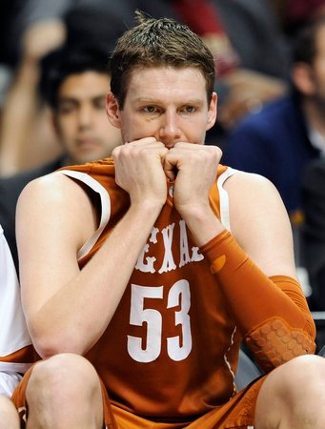
Clint Chapman’s collegiate career ended in Nashville
(Photo credit: Donn Jones/Associated Press)

For most of the Texas fanbase, the defeat closed the book on something of a lost season. Nine of the team’s 13 non-conference games were on the Longhorn Network, a channel with practically non-existent distribution in the school’s own city of Austin. The first year of a new sports channel is certainly filled with roadblocks, as evidenced by the well-told history of the Big Ten Network. But the timing couldn’t have been worse for fans of Texas basketball, as the Horns returned just three scholarship players and welcomed six freshmen. Without exposure in the non-conference months of the schedule, most fans had their first good look at a brand new roster when Big 12 play opened in January.

The first month of conference play was rough, to say the least. The Longhorns opened things up with a road loss to Iowa State — a defeat that looked terrible at the time, but eventually proved to be just one of many big wins at Hilton for the Cyclones. Texas was able to right the ship with a pair of victories at home over Oklahoma State and A&M, but then had to march directly into a brutal six game stretch against the Big 12’s top teams. By the end of January, the Horns were just 3-6 in league play, and those fans who were forced to miss the first half of the season were quickly getting restless.

A recurring theme throughout the year was Texas’ inability to execute late in close games. Five of the Longhorns’ first six conference losses came by six points or less, and the team would finish the season with a dismal 3-9 record in two-possession games, including the 65-59 loss to Cincinnati to cap the year. In almost every late-game situation, Texas would spread the floor and lose all semblance of off-the-ball movement. Against the Bearcats, they did that exact thing on each of the three possessions following the under-four media timeout. Combine those wasted possessions with three fruitful ones for the Cincinnati offense, and you had the recipe for yet another last-minute defeat.

The repetition of the same mistakes and problems made much of the 2011-12 campaign feel like Damon Lindelof and Calton Cuse had FedExed a late-season LOST script to the Texas basketball offices. For the fans, watching Texas basketball was just as frustrating as some of the final episodes of that confounding TV show. If you looked at the big picture for Texas basketball, it seemed like the building blocks were being established for something greater down the road. In the meantime, though, the team seemed to simply be spinning its wheels.

Loyal readers of this website were probably tired of the “counting wins for an NCAA bid” and “unable to execute in the clutch” storylines by mid-January. But the fact of the matter is that when the team or a player made strides in one area, another part of the boat sprung a leak. One game we would be excited over the flashes of brilliance from Sheldon McClellan or the improvements of Clint Chapman. By the next game, McClellan would be struggling once more and Chapman would get himself into early foul trouble. The same storylines carried throughout the year, because the Longhorns couldn’t find a way to turn the page. Narratively, they were stuck somewhere in the second act.

The one positive in having such clearly defined, repetitive issues is that it makes those areas for improvement a top priority in the offseason. This year, the NCAA will allow coaches to work with their team over the summer, something that will be very important for the five returning Longhorn freshman and the stellar incoming class of recruits. Texas fans, coaches, and players know what problems need to be addressed heading into 2012-13. Now the only question is whether or not the Longhorns can make the necessary changes.

* * * * * * * *

The feeling that this season was simply a table-setter for the future wasn’t limited to just the product on the court. There was never a moment during this long and difficult season where I doubted that Longhorn Road Trip would continue into a seventh season. While Rick Barnes and his big freshman class were building the foundation for future glory, I was carefully laying the plans to bring LRT and this incredible journey to a fitting end.

Longhorn Road Trip started six years ago as a crazy idea to attend every game for one season. Every year, there seemed to be another reason to keep it going. The unbalanced Big 12 schedule meant I didn’t travel to Hilton Coliseum, Mizzou Arena, or Bramlage Coliseum during the first year, so the second season seemed only natural. The Maui Invitational and the goal of 100 games brought me back for a third year, while Season Four offered a chance to see the college careers of Damion James, Justin Mason, and Dexter Pittman from start to finish. Road games in Greensboro, East Lansing, and L.A. made Season Five appealing, and the quest for 200 consecutive games meant there was no way I was missing a sixth year of trips.

But even after reaching that 200-game milestone in the road loss to Iowa State, I knew that Season Seven was on the agenda — and that it would be the last for Longhorn Road Trip in its current form. The storyline for 2011-12 was simply whether or not this young, untested team could reach the NCAA tournament and extend Texas’ streak to 14-consecutive appearances. While I was enjoying the opportunity to cover the team’s pursuit of that goal, even bigger goals and richer story arcs were just a year away.

When you throw in another trip to the Maui Invitational, a showdown with a Big East power in New York City, another excellent Big 10 road trip, return games with UCLA and North Carolina, and the first road games against West Virginia and TCU, Season Seven is going to be full of exciting trips and thrilling games. My better half — who has stuck with me through the last four years of this crazy journey — even wants to join in on XLRT2013, and I’m exploring options to hit every round of the NCAA tourney, from the First Four to the Final Four. It’s safe to say that we’ll be going out with a bang in the final full season of LRT, one that will include my 250th-consecutive game sometime in late February or early March.

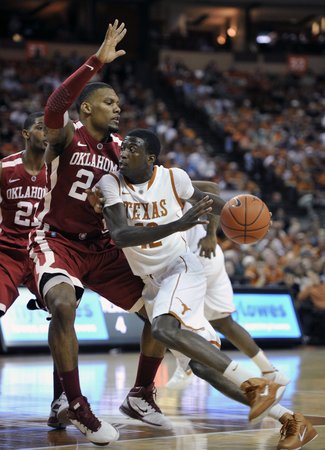
Myck Kabongo will return to lead the Horns next season
(Photo credit: Michael Thomas/Associated Press)

With those big plans on the horizon, the icing on the cake came in the form of Myck Kabongo’s return and the signing of incoming freshman Cameron Ridley. Texas fans have been burned by numerous early entries in recent years, leading to their pessimistic view that both Kabongo and J’Covan Brown would be leaving the program at season’s end. Although Brown did elect to pursue his NBA dreams, Kabongo chose to remain on the 40 Acres, leaving the Horns with a prescient point guard that has only scratched the surface of his potential.

The signing of Ridley and big man Prince Ibeh will help to replace seniors forwards Chapman and Alexis Wangmene, although the freshmen will likely take time to adjust to the physical nature of frontcourt play in the Big 12. Sophomores Jonathan Holmes and Jaylen Bond will have to step up in a big way, as once again the interior will be the biggest question mark for UT at the start of the season.

But even with those concerns, fans will finally be greeted with a fairly familiar roster when the season tips off in early November. If the sophomore quintet can make strides during this crucial offseason, the outlook is rosy for a much more successful campaign in 2012-13. And, for the seventh-straight year, LRT will be there to cover it for you, every step of the way.

3.16.12
Posted by Ryan Clark at 2:28AM

[6] Cincinnati Bearcats (24-10) vs. [11] Texas Longhorns (20-13)
Bridgestone Arena | Nashville, TN | Tip: 11:15 A.M. CT | TV: CBS
LRT Consecutive Game #220

For the 14th-consecutive season, the Texas Longhorns are in the NCAA tournament. If you regularly read this website, you’re already quite familiar with that nugget of knowledge, and you also know that Texas is one of just six programs that own an active streak of at least that length. Hidden behind that gaudy number, however, is a series of disappointments.

In those 13 previous visits to the NCAA tournament, the Longhorns have exceeded seed expectation just one time. In 2002, the 6th-seeded Longhorns were able to win two games in the NCAA tournament, knocking off 3-seed Mississippi State in front of a partisan crowd in Dallas to advance to the Sweet 16.

Of those other 12 trips to the Big Dance, the Longhorns simply matched seed expectation six times, and fell short of seed expectations in six others. Seed expectation doesn’t even tell the whole story, as nine of the 13 trips to the NCAAs under Barnes ended with the Longhorns losing to a lower seed. While the Selection Committee doesn’t always get the seeding right, the overall trend is troubling. Under Barnes, it appears that the Longhorns can’t handle the pressure of being the favorite.

The Bearcats are playing their best basketball in March
(Photo credit: Frank Franklin II/Associated Press)

Fortunately, this year there are no expectations. With one of the 20 youngest teams in America, the Longhorns had to fight all season long just to get into the tournament. As a result, Texas enters the Big Dance as the lower seed in its opening game, a first in Barnes’ 14 years with the program. The Longhorns proved that they are a dangerous team in near-upsets of elite squads like Baylor, Kansas, and Missouri, but never logged a big win that would make them truly scary. Could this talented, inexperienced team be the one that finally gets the monkey off its coach’s back?

If they are going to do so, the Longhorns will have to get through the 6th-seeded Cincinnati Bearcats. Known best for their brawl with intra-city rival Xavier, Mick Cronin’s team has quietly and steadily improved over the last two months. Last weekend, a big win over Syracuse in the Big East tournament semifinals captured the attention of the college basketball world and once again put the Bearcats firmly in the national spotlight. A loss to Louisville in an ugly championship game put an end to the movie-script tale, but it left the Bearcats with something to prove heading into the NCAAs.

By the numbers

When you look at these two teams on paper, the match-up becomes even more intriguing. Where Texas has a statistical strength, Cincinnati does as well. Where the Bearcat numbers are weaker, those of the Longhorns are, too. With two teams so perfectly aligned to neutralize the strengths of their opponents, this game will likely come down to who can actually execute when pushed out of their comfort zone.

Despite having an offense that often stalls out, the Longhorns have been able to manufacture points by earning free throws. Texas is one of the best teams in the country at getting to the line, shooting more than two free throws for every five field goal attempts. On Friday, that could be much more difficult against a Bearcat D that hardly ever sends opponents to the charity stripe. Cincinnati allows just one free throw for every four field goal attempts, one of the ten best defensive FTR marks in the country.

On the other end of the court, Texas has consistently sent its opponents to the stripe all season long. The Horns have a defensive free-throw rate just shy of 42%. Fortunately, the Bearcats are one of the 25 worst teams in D-I hoops when it comes to grinding out points at the line. With a team that makes just 64.1% of their free throws, that is probably a net positive for Coach Cronin. It’s also reassuring for the Horns, who will likely give the Bearcats many more attempts than they are used to.

The one area where the teams’ strengths and weaknesses diverge is on the glass. Cincinnati and Texas are both fantastic on the offensive end, but horrible on the defensive boards. The Longhorns are ranked 15th in the nation in offensive rebounding according to Ken Pomeroy, snagging 38.4% of their missed shots. The Bearcats aren’t too far behind, grabbing 36% of their own misses. Defensively, both teams are ranked in the bottom 100 of Division I, with the Bearcats holding a slight edge. The winner of this game will likely be the one who finds greater success turning their numerous second chances into points.

Meet the Bearcats

Like Texas, Cincinnati has a very small rotation with a thin frontcourt. The team’s main presence in the paint is Yancy Gates (No. 34), who became a household name when he landed a sucker punch on the jaw of Xavier’s Kenny Frease. He was suspended six games for his role in the melee, but came back and produced workmanlike numbers in Big East play. A stout 6’9″, 260 pounds, the senior posted five double-doubles in twenty conference games and averaged more than nine boards in Big East contests.

Thanks to Gates’ suspension, Cincinnati discovered a new offensive approach that worked wonders for the team. With just two other forwards left to play consistent minutes during the six-game suspension, Cronin and the ‘Cats went with a four-guard look. Floor spacing improved, driving lanes opened up, and the offense was immediately more efficient.

Naysayers would point to the quality of opponents on the Cincinnati schedule in mid-Decembber, but the results were hard to argue with. In the first eight games of the season — a stretch which ended with the Xavier game — the Bearcats scored just 0.99 points per possession. In the eight games that followed — which included the team’s first three Big East contests — Cincinnati put in 1.17 points per possession, and did it without their senior big man.

It wasn’t just the suspension of Gates that led to the new look for Cincinnati. Junior guard JaQuon Parker (No. 44) had missed the first seven games of the season and saw his first action in that infamous Xavier game. With Gates out of the lineup and sophomore Justin Jackson (No. 5) now the only starting forward, Parker was thrust into the starting five in only his second game of the season.

Just 6’3″, Parker is a strong 210 pounds, and he brings some added toughness to a team that is rather undersized by Big East standards. He’s the team’s second best rebounder, snagging more than five per game, and he’s strong enough to finish through contact when he drives into traffic. Parker is solid going to his left and is able to find cracks in the defense off the bounce, an absolute must-have skill in the Cincy attack.

Jackson, meanwhile, has become the team’s sixth man now that Gates is back in the starting five. He’s a long and lean 6’8″ guy with a face-up game and ridiculous athleticism. He has excellent speed in the open court, which opponents quickly realize when he swats away a fast break bucket from behind the play.

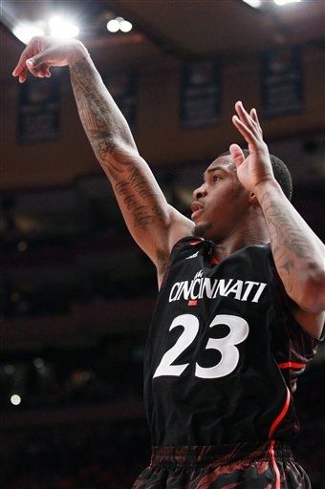
Sean Kilpatrick is a threat from long range
(Photo credit: Frank Franklin II/Associated Press)

One thing currently limiting Jackson’s game is his tendency to commit needless fouls. He actually averages 5.6 whistles per 40 minutes, and is the only Bearcat who has fouled out of more than two games this season. Of course, he’s all but guaranteed that title at the team banquet, as he’s already been DQ-ed six times this year.

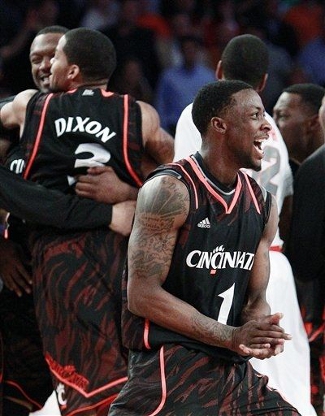
In the backcourt, you’ll find the only two Cincy players to start all 34 games this year, senior Dion Dixon (No. 3) and sophomore Sean Kilpatrick (No. 23). Dixon is yet another guard who can quickly drive the lane and finish at the rim, and the Bearcats find a ton of success by simply setting back picks for him on the perimeter.

Kilpatrick can also penetrate and finish, but his biggest role on the team is knocking down triples. With Parker, Dixon, and point guard Cashmere Wright (No. 1) slicing up defenses on the drive, Kilpatrick can camp out on the arc for the kick-outs. His 228 long-range attempts are the most on the team by far, and his 6-of-9 performance behind the arc was key to upsetting Syracuse in the Big East tournament semis. That was the best three-point game in quite some time for Kilpatrick, who had gone more than a month since previously cracking the 33% barrier from behind the arc.

At the point, Wright is key to making the four-out, one-in approach work. He can feel out defenses on the dribble, find the weak spots, and turn that into points or a well-timed assist. Wright has great body control inside to finish amidst the trees, but also does a great job slipping dump-offs to the big man on the block when the defense converges. His assist rate is just outside of the Top 100 nationally, as the junior logs a dime on nearly 30% of the buckets made when he’s on the court.

Those six players eat up almost 84% of the team’s minutes, so the rest of the rotation sees very little action. Freshman guard Ge’Lawn Guyn (No. 14) and Senaglese big man Cheikh Mbodj (No. 13) both average about nine minutes per game. Guyn provides some backup minutes for Wright at the point, but had just five assists in his limited Big East action. Inside, Mbodj still looks like he lacks confidence at times, despite being an All-American at the junior college level

Keys to the game

It’s the biggest game of the year for the Longhorns, so we’re expanding from the typical trio of game keys to an entire list. Texas doesn’t need to do all of these things to win, but these are the most important things for the Horns to keep in mind when facing the Bearcats.

1) Deny dribble penetration – The Cincinnati offense is predicated on penetration from the guards, leading to layups at the rim, dump-offs to the bigs, or kick-outs for three. The Bearcats do not shoot very well from the field, with a two-point field-goal percentage that is in the bottom half of Division I hoops. Texas needs to close off the driving lanes and turn back the penetration, forcing Cincinnati to beat them with the jumper.

2) Rotate quickly in help situations – With a backcourt as quick and talented as Cincinnati’s, that goal of denying dribble penetration is easier said than done. There are going to be possessions where the Bearcat guards get past the Texas perimeter defense, and the rest of the Longhorns need to be ready to react. Cincinnati loves setting those back picks on the wings for their guards, so the help defense has to be there. Texas cannot afford to let Cincinnati drive unimpeded to the rim.

3) Limit second chances – If Texas can successfully force Cincinnati into taking jump shots, there will be quite a few misses clanging off the iron. Unfortunately for Texas, that can often work out even better for a Bearcat team that cleans up the offensive glass. The Horns are going to give up offensive boards, but need to limit second-chance points for Cincinnati. That means getting a body on Gates, Jackson, and Parker once the shot is up, and not allowing easy buckets in the scramble after long boards.

4) Make the misses count – As good as the Bearcats are at reclaiming missed shots, the Longhorns are even better. Cincinnati utilizes both man and zone defenses, but Texas should be able to do a solid job on the offensive glass against both looks. The Bearcats will have no specific box-out assignments in the zone, while Texas actually has a height advantage to exploit in man-to-man situations. The Longhorns are bound to reclaim a lot of their missed shots in this game, but they have to actually turn those into points. Fortunately, Texas did a great job of this against Missouri, so Horn fans are hoping that will carry over into this one.

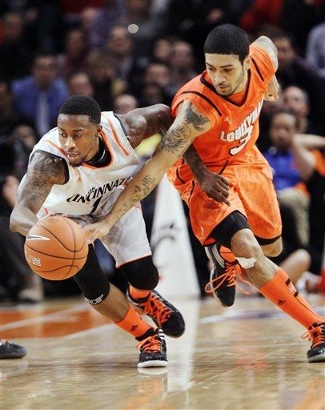
Although rare, Cincinnati does occasionally turn it over
(Photo credit: Frank Franklin II/Associated Press)

5) Stay aggressive against the zone – With Texas shooting poorly from outside this season, Cincinnati will probably stick with their zone for much of today’s ballgame. Unfortunately, the Horns have had some rough, futile stretches in games where they have faced that type of defense. During the painful sets, players stand around, cuts are lackadaisical, no one flashes to the middle, and guards don’t try to collapse the defense with penetration. When the Longhorns actually execute — like they did against Baylor in the first half of their game in Waco — the youngsters can easily slice up a zone. The rub is that they have to be willing to play intelligently and do all of those little things to score against Cincinnati today.

6) Shake things up – Cincinnati hardly ever turns the ball over, but when they do, it’s typically in the open court. DePaul and Marquette were both able to rattle the Bearcats in transition, and that led to easy points. Sometimes that was the result of poking the ball away in the open court, but often the miscues happened just because Cincy guards weren’t comfortable at that pace. The Bearcats are excellent at controlling the ball in their half-court sets, and are very tough to beat at their preferred tempo. Texas isn’t exactly a run-and-gun team, but the Horns might want to consider mixing in some pressure to force some mistakes and get a few easy points.

3.12.12
Posted by Ryan Clark at 6:47AM

The streak lives on in Austin, Texas.

After an up-and-down season in which the Longhorns lived on the bubble for the final few weeks of play, Rick Barnes continued his perfect mark on the Forty Acres, earning his 14th NCAA tournament bid in his 14th season as Texas’ head coach. The Longhorns’ streak is tied for fourth-longest among active streaks with Gonzaga and Wisconsin, and falls behind only Kansas (23 consecutive appearances), Duke (17), and Michigan State (15).

Although Barnes and the NCAA tournament have become synonymous over the last decade and a half, this year’s bid wasn’t a sure thing until the final days. Texas needed a comeback victory over Iowa State in the Big 12 Championship quarterfinals, and benefited from numerous losses by bubble teams across the country. The Longhorns also managed to narrowly avoid the First Four games in Dayton, making the field just one slot ahead of the “Last Four In.”

Texas will open play against Cincinnati in Nashville on Friday morning at 11:15 CT. Although the Bearcats were runners-up in last weekend’s Big East tournament, they grabbed even more headlines in early December with their infamous “Crosstown Brawl” with rival Xavier. Four players were suspended for six games as a result of their participation in the melee, most notably senior big man Yancy Gates. Rather than folding, the Bearcats seemed to gather strength from the ugly incident. Mick Cronin led his team to a 12-6 mark in the tough Big East, putting the Bearcats in a three-way tie for fourth.

In the Big East Tournament, Cincinnati survived a thrilling double-overtime battle with Georgetown, the team’s second win over the Hoyas this season. A night later, the Bearcats became just the second team to knock off Syracuse this year, and the first to do it with Fab Melo on the court. Sean Kilpatrick led a three-point barrage for Cincinnati, which hit eight of its first 10 long-range looks. After building a lead as large as 17 points, the Bearcats were able to withstand a late rally by the Orange and advance to the Big East tournament finals.

The hot shooting of the semifinals would be short-lived for Cincinnati, which missed 11 of its first 12 shots against Louisville in the championship game. The ‘Cats would recover to finish 39.2% from the field, but sank just three of 14 from behind the arc. Cincinnati’s 0.746 points per possession were the fewest for the team all season long, much worse than the team’s previous season low of 0.803, posted against Xavier.

Ken Pomeroy gives Texas a 52% chance to knock off the Bearcats, predicting a one-point margin of victory. If the Longhorns do in fact earn a victory in the Round of 64, they would advance to face either Florida State or St. Bonaventure on Sunday.

3.11.12
Posted by Ryan Clark at 1:19PM

Just hours before the 2012 NCAA bracket is finally revealed, St. Bonaventure has become the first and only bid thief of the year, stealing the final at-large slot in the Big Dance and sending one mystery team into the NIT field. A week ago, a development like that might have been terrifying for fans of the Texas Longhorns. But after a week in which in appeared that nobody wanted to win and punch their ticket, the Horns look to be safely in the field as the clock counts down towards the Selection Show.

It now appears most likely that Texas will be an 11-seed in the NCAA field, but with teams being moved up and down one line to accommodate bracketing rules, we could see the Longhorns as high as 10th or as low as 12th. Perhaps most importantly, it seems like Texas has played its way right past the First Four in Dayton, giving a young and thin roster a little more rest before playing on Thursday or Friday.

Of course, it’s been a crazy year, and the profiles at the bottom all start to look the same after a few minutes of staring at them. The committee could come out of left field and leave a team out that most have thought was safe all along. But when you compare Texas’ four RPI Top 50 wins to other bubble teams, it would be hard to find enough teams that could reasonably be included before the Longhorns.

With that in mind, we’re taking a look at where the Longhorns might end up. What’s important to remember when looking at potential landing spots is that the top four seeds are geographically protected as much as possible, while teams from the same conference can’t be put in the same pod. If Texas is an 11-seed or 12-seed, they will end up in a pod with the 3/14 and 6/11 games or a pod with the 4/13 and 5/12 games.

What all that means is that the Longhorns won’t be making any hotel reservations in Omaha. Missouri and Kansas will be protected seeds and should both land in Nebraska for their second and third round action, ruling that out as a destination for Texas. It also most likely eliminates Greensboro, as Duke and North Carolina should be the protected seeds for that site, and both look to be on the top two seed lines. Unless Texas is slid up to a 10-seed, they wouldn’t be able to play in the Greensboro pods.

The other teams that should be on the top two seed lines are Syracuse, Kentucky, Ohio State, and Michigan State. The Buckeyes aren’t allowed to play in the Columbus pods, so their most likely destination is Pittsburgh. That’s certainly where Syracuse will end up, so we can scratch the Steel City off of the list of possible Texas destinations, as well. Kentucky will take up one of the two Louisville pods, while Michigan State should get sent to Columbus.

The only other pod that we can safely eliminate from consideration at this point is one of the two in Albuquerque. Baylor is likely destined for a 3-seed, and although Albuquerque is only about 50 miles closer to Waco than Nashville, there are certainly more top seeds in the eastern half of the U.S. Somebody has to go to the Albuquerque and Portland pods, so it just makes the most sense to put Baylor there.

What we’re left with, then, are seven possible pods for the Longhorns: Two in Portland, two in Nashville, one in Albuquerque, one in Columbus, and one in Louisville. Of course, all of this deduction is thrown out the window if the committee surprises us and puts Texas on the 10-seed line.

« Previous Page — Next Page »