






1.03.15
Posted by Ryan Clark at 10:50AM

#11/10 Texas Longhorns (11-2 overall, 0-0 Big 12) at Texas Tech Red Raiders (10-3, 0-0)
United Supermarkets Arena | Lubbock, TX | Tip: 1 P.M. CT | TV: ESPNU
Vegas: Texas -8 | KenPom: Texas, 64-57 (80%)

The most anticipated Big 12 season in years is just hours away, and the Texas Longhorns open things up in Lubbock this afternoon. From top to bottom, the Big 12 is the deepest league in the country, currently boasting the nation’s top RPI, while also earning the top conference rating from Ken Pomeroy, by a wide margin.

Pomeroy’s conference ranking takes into account the offensive and defensive efficiencies of every team in the leauge. To put the first seven weeks of the Big 12’s dominance into perspective, the ACC — which currently is ranked second — is closer to the fifth-ranked SEC than they are to first, and are nearly as close to the Pac-12 in sixth. There’s the Big 12, a big gulf, and then everyone else.

With such a deep league, the names of numerous Big 12 contenders have littered the pages and websites of the college basketball media. While a few pundits have dared to pick Texas, most have stuck with Kansas. And why not? Over the last ten years, the Jayhawks have taken advantage of a nearly automatic home-court advantage, great coaching, and great talent to win at least a share of the league crown every single year.

To take the title this year, Texas, Kansas, and the laundry list of contenders will have to survive a meat-grinder schedule. Eight of the league’s ten teams are in the Top 50 of Pomeroy’s rankings, while K-State sits just outside the Top 100, and even Texas Tech is ranked 141st. The usual formula for a conference title — defend your home court, sweep the bottom of the league, and pick off a tough road win or two — might not even be possible this season. The “bottom of the league” consists of just two teams, which both have great home courts and a roster of talented parts that haven’t yet put it together.

For the Longhorns, their difficult task became a little easier when they received some much anticipated good news yesterday morning. After breaking a bone in his wrist in the third game of the year, point guard Isaiah Taylor is back for Texas, just in time to lead his team into the melee of the Big 12 conference race.

For a Longhorn team that has posted abysmal turnover numbers the last few weeks, his return comes as a huge relief. While Taylor can’t make every pass and eliminate all of the team’s miscues, it’s hard to imagine that things won’t get at least a little better with him at the helm, and other players back in their natural roles.

Texas may also get a bit of a boost this afternoon from Mother Nature. Even though it’s been nearly a decade since United Supermarket Arena was consistently full for conference games, numerous Big 12 teams have fallen victim to upsets on the High Plains over the years. With winter storms blanketing the Texas Panhandle last night and this morning, the USA will likely be very empty. As long as Texas doesn’t fall into the lull that sometimes accompanies early-afternoon games and sparsely-attended contests, they should find it a little easier to survive the annual Lubbock trip.

By the Numbers

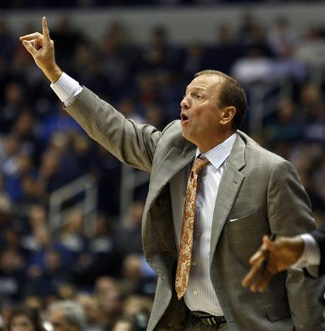
In Year Two of the Tubby Smith era at Texas Tech, you can see that the pieces are beginning to fall into place. Smith landed the best recruiting class that the Red Raiders had seen in 11 years, which gives them the kind of athletes that can compete in a major power conference.

Those athletes are still learning to compete at this level, as evidenced by their poor offensive efficiency and struggles against zone defenses. The Red Raiders are scoring jut 97.6 adjusted points per 100 possessions, which currently ranks 227th out of 351 Division I teams. Thanks to an ugly 30.5% mark from beyond the arc, opponents are able to play sagging zone defenses and dare Tech to beat them with long jumpers.

Another part of the problem is that when the Red Raiders do manage to get it inside, they aren’t able to turn that into points. Tech currently has the nation’s fourth-highest field goal rate, earning a free throw for every 1.86 field goals they try. However, they are leaving a ton of points at the line, converting on just 66.9% of their attempts. Add in a sub-optimal turnover percentage of 20.5%, and it becomes clear that the Red Raiders are still often shooting themselves in the foot on offense.

On the other side of the ball, Coach Smith has his team playing much better defense. The year prior to his arrival, the Red Raiders had an adjusted defensive efficiency that was ranked 254th out of the 347 teams in D-I at the time. Last year, they improved to 110th, and are currently sitting at 81st with 95.9 adjusted points allowed per 100 possessions.

That number will certainly rise against a Big 12 loaded with efficient offenses, but it’s another sign of the improvement Tubby has brought to Tech. The Red Raiders do a good job pinching from help positions to discourage penetration, and they close out nearly three-quarters of their defensive stops by securing the rebound. For a team that often played matador defense in recent years — an appropriate style, considering their mascot — any progress is worthy of note.

Meet the Red Raiders

Although Tech lost star Jordan Tolbert and sharpshooter Dusty Hannahs to offseason transfers, a seven-man recruiting class has lessened the impact of those departures. It’s also given Coach Smith a blend of experience and youth, skewing towards the latter, which will set the building blocks for his rebuilding project.

Tubby has a very deep bench, and he uses it to the fullest. The Red Raiders have a core rotation of seven players who all average between 20 and 25 minutes, along with three other role players who typically see some action in each game. Tech doesn’t use this depth to play an up-tempo, trapping style, but it does offer Tubby a chance to immediately pull players when he sees a teaching opportunity.

The player who sees the most minutes is senior guard Robert Turner (No. 14), who was Tubby’s first recruit as a JUCO transfer two summers ago. Although he runs the point and has the ability to slash to the lane, Tech’s struggles against zone defenses often result in him dribbling the air out of the ball before putting up a challenged or off-balance shot before the 35-second buzzer.

Turner has the team’s second-highest percentage of shots taken, as he’s responsible for 26.6% of the attempts when he’s on the court. Unfortunately, he has an effective field-goal percentage of just 43.7%. He does somewhat make up for that lack of production by jumping passing lanes on defense and stripping it from unsuspecting guards to start the break.

The highest percentage of shots taken belongs to newcomer Devaugntah Williams (No. 0), a JUCO transfer from Missouri-West Plains. Williams plays about 24 minutes per game and takes more than 30% of the shots when he’s on the court, but is much more effective than Turner. That is a result of good speed with the ball and the ability to quickly change direction while penetrating. Although it was a little more wild than his usual drives, his spin and drive to the rack with two seconds left against Auburn provided the game winner.

Williams is also a very streaky shooter from behind the arc, and the team’s struggles in two recent losses in Las Vegas underscore the importance of his long-range game to their success. On the season, Williams has made 37.5% of his three-point attempts, despite going 0-for-14 from long range during that two-game losing streak. Williams also had a stretch earlier in the year where he made 14-of-23 in a five-game stretch, so his accuracy tonight could be the biggest factor in Tech’s output.

On the wing, freshman Justin Gray (No. 5) has started 12 of the team’s 13 games. He’s a very long 6’5″ and has great hops that aid him in quickly springing up to block shots. His individual block rate of 4.2% ranks third on the team and 299th in Division I. That bounce also helps to make him a good rebounder from the wing, something that is important for a Tech team which will be a bit undersized against Texas today.

Down low, two newcomers anchor the frontcourt for Coach Smith. Zach Smith (No. 11) is a really exciting 6’8″ forward, who was one of the top 20 seniors to come out of the state of Texas last season. He is very quick and slippery with the ball for a guy his size, and he passes very well from all over the court. Smith injured his back on December 19th, played just 14 minutes in a loss to Loyola Chicago three days later, and sat out of the loss to Houston. However, he returned to action on Monday night against North Texas and showed no ill effects of the injury, logging 34 minutes and stuffing the stat sheet.

Norense Odiase (No. 32) is the man in the middle, and man is the operative word for this 6’9″, 270-pound freshman. He moves remarkably well for a guy his size, although he does clearly struggle when opponents push the pace for extended stretches. Odiase is very strong with the ball down low, and is a solid rebounder and shot blocker. He’s also the team’s biggest offender when it comes to leaving points at the line, as he draws 5.5 fouls per game, but has made less than 59% of his free throws.

Off the bench, Randy Onwuasor (No. 3) is another guard that plays solid perimeter defense and can jump-start Tech with a take-and-make. He’s joined by Toddrick Gotcher (No. 20), a junior guard that can easily create for himself and teammates with the bounce, thanks in large part to a knack for mixing speeds.

Rounding out the bench options in the backcourt is freshman Keenan Evans (No. 12), a lightning-quick guard who can easily burst to the rim or drain a three from well beyond the arc. Evans has connected on 41.2% of his threes in his limited minutes, and will likely be an impact player for Tech in future seasons.

Down low, most of the minutes are eaten up by the two starters, but Tubby does rotate in a quartet of forwards. Senior Clark Lammert (No. 35) averages less than eight minutes per game, and is best known for taking charges and being the brother of Connor Lammert. Sophomore Alex Foster (No. 34) is used even more sparingly, likely due to his hideous 35.7% turnover rate. Fellow sophomore Aaron Ross (No. 15) should prove to be a solid option down low, but he’s still getting into game shape after seriously injuring his knee in April. He returned to action on December 14th and has averaged less than seven minutes in six appearances.

The bulk of the frontcourt reserve minutes go to freshman Isaiah Manderson (No. 1), but he is still only seeing the court for about 11 minutes per game. He’s a long and lean 6’10”, with probably an additional two inches of height coming from his hair. Manderson has a quick release on a midrange jumper that is smooth, albeit inconsistent. At this point, his biggest problem is really poor defense, and that will likely limit his minutes under Coach Smith.

Keys to the Game

1. Pack it in – The Longhorns have the size to make things very tough inside for most opponents, and Tech’s inability to shoot from outside means that the Longhorn guards can make things even tougher by sagging off enough to limit penetration. As long as Texas doesn’t let Williams or Evans go off from long range, they should not have much to worry about in terms of threes and long jumpers.

2. Control the basketball – With Taylor finally returning for Texas, this will be the first chance to see if the Longhorns can make a drastic cut in their turnover rate. The Red Raiders have forced mistakes on 22.3% of their defensive possessions, albeit against a relatively weak schedule. Even though Tech’s defense is pretty good, the Longhorns will face much tougher in the coming weeks. Improving ball control is not only important to avoid an embarrassing upset today, but also to contend in the league this season.

3. Clean the glass – Tech has posted solid rebounding numbers on both ends of the court, but they have not faced many teams with the size of Texas. The Red Raiders currently boast rebounding marks of 36.8% and 72.1% on the offensive and defensive ends, respectively, despite playing most of their minutes with forwards that are 6’8″ and 6’9″.

Against LSU, a team with an effective height that’s 28th in the nation according to Pomeroy, the Red Raiders managed an offensive rebounding rate of just 25% in an overtime loss. The Longhorns should present a similar challenge for Tech tonight, and they must exploit that advantage to prevent Tech from hanging around and being in position to steal an upset in the final minutes.

12.20.14
Posted by Ryan Clark at 5:15PM

Long Beach State 49ers (5-6) at #9/9 Texas Longhorns (9-1)
Frank Erwin Center | Austin, TX | Tip: 7 P.M. CT | TV: LHN
Vegas: Texas -15.5 | KenPom: Texas, 71-56 (93%)

Although the Longhorns are favored in the rest of their non-conference games, there are still a pair of good tests left on their December home schedule. Stanford, who travels to Austin on Tuesday night, is the bigger name, but tonight’s opponent, Long Beach State, is certainly one of the better mid-majors to come through the Erwin Center in recent years.

Dan Monson has challenged his Long Beach State squad
(Photo credit: David Kohl/Associated Press)

Don’t let the 5-6 record fool you. Dan Monson drew up a brutal schedule for his 49ers, one which is currently ranked 6th-toughest in the country by Ken Pomeroy. That ranking doesn’t even include their remaining non-con schedule, which has road games with Texas, St. John’s, Syracuse, and Louisville.

Although the 49ers have played quite a few major-conference opponents close this year, they fell short in most of their upset bigs. Still, they managed to snag a pair of nice scalps in wins over Kansas State at home and Xavier on a neutral court. The 49ers had previously been blasted by Xavier in Cincinnati, playing such awful defense that they were able to lose by 23 points while shooting nearly 55% from the field.

Texas clearly has the edge on paper, but Long Beach State has a team that is quick and athletic enough to hang with big-name opponents. The 49ers also have a pair of familiar names that have played at other successful D-I programs, so this is not the clear mismatch that typifies most December home games for Texas. If Texas’ intense defensive focus happens to go on an early Christmas break, things could get interesting tonight.

Players to watch

The most familiar transfer at Coach Monson’s disposal is senior Tyler Lamb (No. 1), the former UCLA Bruin who is taking a ton of shots for the 49ers this season. Lamb is responsible for more than 25% of LBSU’s attempts when he’s on the court, and has made more than 35% of his three-point attempts this year.

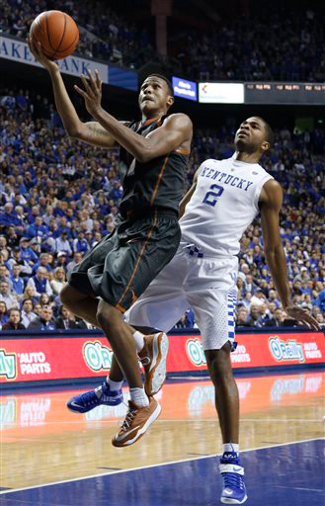
Mike Caffey is still working on his levitation skills
(Photo credit: Mike J. Terrill/Associated Press)

Lamb also makes great cuts without the ball, which usually lead to easy layups when point guard Michael Caffey (No. 5) finds him flashing to the rim. Caffey has an outstanding assist rate of 32.7%, a number buoyed by his ability to exploit defensive cracks with dribble penetration and then find wide open teammates.

Defenses also have to pay very close attention to Caffey when he passes the ball off, as Long Beach State does a great job freeing him up on flares out to the perimeter, where he’s absolutely deadly in catch-and-shoot situations. Caffey leads the team with 44 long-range attempts, and has knocked down half of them.

Inside, freshman Temidayo Yussuf (No. 4) and senior David Samuels (No. 11) will have the tough task of matching up with the size of Texas. Both are a very lanky 6’7″, but Yussuf has much more muscle than would be expected of a mid-major freshman. He has no problem banging inside and absorbing contact while getting his shot up, but still needs some work on his post defense. Samuels uses more of a face-up game on offense, but his length helps inside defensively, and also causes some issues for opposing guards when he switches on perimeter screens.

Although he doesn’t average a ton of minutes, senior Eric McKnight (No. 12) is another name that will be familiar to college basketball fans. McKnight started his collegiate career at Iowa State, but became well-known as part of Florida Gulf Coast’s Dunk City run through the NCAA tournament. After earning a degree at FGCU, McKnight took advantage of the graduate transfer rule, and has played in nine of LBSU’s 10 games this season. In those appearances, McKnight has averaged 16.6 minutes, but has been plagued by foul trouble, being whistled for more than six fouls per 40 minutes.

Despite coming off the bench, Branford Jones (No. 14) is playing more than 21 minutes per game, and he is another three-point threat for the 49ers. Jones has made more than 40% of his long-range shots, but also makes significant contributions on the defensive end. His personal steal rate of 2.7% is ranked in the Top 500 nationally, but he manages to play that pesky defense without fouling. He is averaging just 2.4 fouls per 40 minutes, which also ranks in the Top 500.

Keys to the game

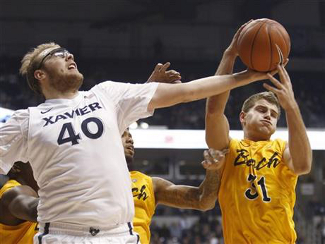
The 49ers have struggled to win defensive rebounds
(Photo credit: David Kohl/Associated Press)

1) Clean the offensive glass – While Long Beach State’s defense has been hit-or-miss this season, a recurring problem has been second-chance points. The 49ers have allowed opponents to reclaim 38% of their misses, which is currently one of the 30 worst marks in Division I. They have allowed opponents to crack the 40% plateau in five games, including a hideous 60% allowed at Stephen F. Austin on December 5th. The Longhorns are currently the sixth-best team in the nation when it comes to earning second chances, so they should be able to score a ton of extra points after winning back their own misses tonight.

2) Don’t lose the shooters – Long Beach State only shoots a few more threes than the average team, but they are quite accurate when they do put up a long-range shot. The Longhorns need to be ready to challenge on the perimeter when Caffey and the other 49ers create with dribble penetration, as kickouts are very common for LBSU. Texas also has to be ready to fight through screens off the ball, as Caffey will frequently be using them to try to free himself up for a catch-and-shoot from the arc.

3) Focus on feeding the post – In the first half against Texas State, the Longhorn big men gave up far too easily when fighting for post position. They came out of the locker room with a renewed focus on pounding it inside, and the bigs have played three strong halves of basketball since then. Long Beach State does not have the size to match up with Texas inside, and their own big men are prone to foul trouble. Texas needs to try to get Cameron Ridley and Myles Turner going inside, not only to tag Long Beach State with some fouls, but also to build on the recent success by both players before conference play arrives.

12.16.14
Posted by Ryan Clark at 2:11PM

Lipscomb Bisons (4-5) at #9/9 Texas Longhorns (8-1)
Frank Erwin Center | Austin, TX | Tip: 7 P.M. CT | TV: LHN
Vegas: OFF | KenPom: Texas, 77-57 (97%)

First things first, let’s address the mascot. Lipscomb insists that its mascot is the Bisons, not the Bison. Apparently at some point in time, bisons was an acceptable plural for that animal, and although it’s fallen out of general favor, it is still listed in some dictionaries. I know we’re all going to cringe every time it’s said tonight, but I have faith that we can remain strong and survive without stabbing anything into our ears.

No time for a formal preview post today, so I’ll be tweeting details about three Lipscomb players to watch and three things to watch for from UT in tonight’s game. You can catch that later this evening via the LRT Twitter feed, and the tweets will also be archived in this post at some point tonight, most likely after the game.


https://twitter.com/LonghornRdTrip/status/545006041365086208

https://twitter.com/LonghornRdTrip/status/545006555465146369

https://twitter.com/LonghornRdTrip/status/545006780539871232

https://twitter.com/LonghornRdTrip/status/545007232736165888

https://twitter.com/LonghornRdTrip/status/545007463674544128

https://twitter.com/LonghornRdTrip/status/545007670957047809

https://twitter.com/LonghornRdTrip/status/545008435796770817

12.13.14
Posted by Ryan Clark at 11:59AM

Texas State Bobcats (5-1) at #8/9 Texas Longhorns (7-1)
Frank Erwin Center | Austin, TX | Tip: 7 P.M. CT | TV: LHN
Vegas: Texas -22.5 | KenPom: Texas, 70-51 (98%)

After a long week off for finals, the Texas Longhorns are back in action tonight, when they host Texas State in the first of a five-game homestand that will close out the non-conference slate. Although the Longhorns will face a pair of solid foes in Long Beach State and Stanford, they are still favored in each of those five games, with Ken Pomeroy currently giving Texas win percentages of at least 84% in all of them.

Tonight’s game falls in that time frame that can usually lead to lackluster performances by good teams. For most major conference teams, this is the start of the easier portion of their schedule, having just wrapped up the November tournaments and early December power-conference matchups. Throw in finals and a short holiday break just around the corner, and you find that this is typically the weekend that contending teams look rather pedestrian.

Danny Kasar had a rough first year in San Marcos
(Photo: Jim Cowsert/USA TODAY Sports)

Even with the Longhorns favored by a massive spread, this would be a dangerous night for them to fall asleep on the job. Texas State is now in the second year of the Danny Kaspar era, and after a dreadful first season, he’s restocked the roster with a ton of JUCO talent.

The Bobats have made nearly 40% of their threes this season, and have posted a defensive turnover rate of 25.7%, currently the 10th-best mark in Division I. Good three-point shooting is always an ingredient in upsets, and the Longhorns have also had trouble hanging on to the basketball. Although the Bobcats have taken a very small percentage of their shots from behind the arc, the interior size of the Longhorns will likely force them to spend more time on the perimeter tonight. If the Bobcats continue to shoot that well from beyond the arc, they could make things interesting.

Thanks to the explosion of streaming options and the expansion of college basketball coverage in the nine years I’ve been writing on this website, it’s very rare that I haven’t been able to see an opponent at least once before writing a game preview. With the incredibly soft schedule that Kaspar lined up for November, this will be one of those situations. Texas State has played a pair of teams that aren’t in Division I, while their other four opponents have an average KenPom rank of 302.5. There are only 351 D-I teams.

Without having seen the Bobcats play, the game preview will be quick and dirty, and really just consist of stats. In the team’s four D-I games, they utilized a seven-man rotation, with six of those players combining to play more than 84% of the available minutes. The seventh, JUCO combo guard Ethan Montalvo, averaged just under 15 minutes in D-I contests.

Junior center Emani Gant (No. 21) and 6’7″ sophomore forward Kavin Gilder-Tilbury (No. 1) are both high-usage players for Coach Kaspar, utilizing 24% and 24.7% of the possessions when they’re on the floor. In last year’s meeting with Texas, the 6’8″ Gant found his time limited by foul trouble, but still scored seven points and logged four assists. Gilder-Tilbury also contributed seven against the Longhorns, but connected on just one of his five three-point attempts.

This is the only D.J. Brown picture I could find.
Here, he plays airplane instead of defense.
(Photo: Marcio Jose Sanchez/Associated Press)

The bulk of the backcourt minutes are chewed up by seniors D.J. Brown (No. 0) and Wesley Davis (No. 10). Brown is a graduate transfer from San Jose State, and his leadership at the point has filled a massive hole for the Bobcats. In D-I games, he’s posted an assist rate of 20.5% during his time on the floor, while turning it over on just 9.9% of the team’s possessions. Davis is an excellent defender, as evidenced by his 5.2% steal rate against D-I competition, currently the 23rd-best mark in the country. The Longhorns were able to avoid falling victim to his quick hands last year, as he logged just one steal in 17 minutes.

Cameron Naylor (No. 24) and JaMarcus Witherspoon (No. 23) are two of the many JUCO additions to the Texas State roster. Naylor earned all-league honors in the Panhandle Conference last year, and has been the best offensive rebounder for the Bobcats so far this season, in terms of OR%. Witherspoon is a 6’4″ guard whose aggressive play has drawn more than five fouls per forty minutes.

Keys to the game

1. Hang on to the ball – The Texas State defense doesn’t do a very good job of forcing bad shots, instead relying on turnovers to shut down their opponents. The Longhorns have had a rash of troubling turnovers with Isaiah Taylor out of action, so they will need to take care of the ball tonight. If they can avoid dumb turnovers, they should be able to find some very easy looks inside.

2. Dominate the glass – The size advantage should not only allow Texas to find easy looks inside, but should also allow them to limit second-chance opportunities, while earning some putbacks of their own. The Longhorns outrebounded a very large Kentucky team last Friday night, but fell victim to rebounds when it mattered most. It should be much easier tonight for Texas to impose their will on the glass from tip to final buzzer.

3. Limit damage from the perimeter – Texas State only takes 23.8% of their shots from beyond the arc, but they have yet to face a team with as much size as the Longhorns. The Bobcats have made 39.6% of their limited three-point attempts, so Texas needs to make sure that they are getting hands up and actually challenging any long-range shots that Texas State tries tonight. Gilder-Tilbury was the team’s best three-point shooter last year, but it’s been Brown who is leading the way this year, sinking 8-of-16 since arriving in San Marcos.

12.06.14
Posted by Ryan Clark at 11:46AM

#1/1 Kentucky Wildcats 63, #6/7 Texas Longhorns 51

As the Kentucky Wildcats charged out of the locker room in the second half, college basketball fans likely felt like they had seen this script before. The visiting Longhorns had played a tough 20 minutes to reach the half tied with Kentucky, taking away enough of UK’s strengths to overcome their own offensive struggles. But, as it had been with Providence and Buffalo earlier this year, the Longhorns soon saw just why No. 1 Kentucky is the most dangerous team in the country. The Wildcats surged ahead with a 10-0 run to open the half, and even built a lead as large as 16 points with less than 12 minutes to go.

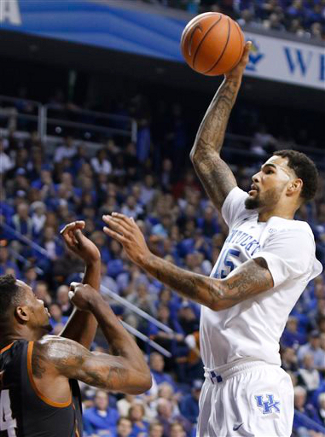
Willie Cauley-Stein carried UK to victory
(Photo credit: James Crisp/Associatd Press)

But unlike the Friars and Bulls, the Longhorns refused to be buried. With 23,000 members of Big Blue Nation screaming at deafening levels, Texas clawed its way back into the game. Led by a poised Demarcus Holland, the Longhorns went on a 7-0 run of their own, and whittled the lead down to just five points with 1:44 to play. The Longhorns could not get any closer, as they failed to score on their final four possessions, and Kentucky padded the final margin with free throws and an authoritative alley-oop from Willie Cauley-Stein to cap the victory.

Although the constant whistles were frustrating, and the Longhorns had many moments that were extremely maddening for fans, this had to be one of the most positive losing experiences for the program in recent memory. Texas stood toe-to-toe with the nation’s best team in a hostile road environment and battled through adversity that would have certainly caused recent Longhorn teams to crumble. Without starting point guard Isaiah Taylor, and with foul trouble forcing coach Rick Barnes to constantly shuffle his big men, the Longhorns acquitted themselves well on the biggest of stages.

With the team now off all week due to finals, let’s take a look at six notes from a great showdown that Rick Barnes described as “a big-boy game.”

1. Horns dominated the glass, but lost the key rebounds

Kentucky entered the game having won more than 48% of their offensive rebounding chances. That ability to extend possessions and get easy follows in the lane had helped to buoy their strong offensive efficiency numbers. Texas did a fantastic job eliminating that aspect of the UK offense in the first half, using a 2-3 zone to force Kentucky into jump shots, while grabbing almost every single rebound. The Longhorns won back 87.5% of UK’s missed shots in the first half, and prevented Kentucky from scoring any second-chance points.

The final numbers say that Texas dominated the boards, as the Longhorns were the first team to win the rebounding battle against Kentucky this season, posting a 42-31 edge on the glass. However, Texas was so dominant on the boards in the first half that those overall stats obscure the fact that Kentucky won the boards when it mattered the most. The Wildcats reclaimed 67% of their missed shots in the second half and turned those into 10 second-chance points. On numerous occasions in the second half, Texas played excellent defense and forced a missed shot, only to see the Wildcats win it right back and make an easy follow.

2. Cameron Ridley continued to struggle

The last two weeks have been extremely tough for the big man, and the first few minutes against Kentucky again put Ridley in a bad spot. In Texas’s first six possessions, Ridley missed a jumper and was tagged with two offensive fouls, forcing him to the bench for the remainder of the first half, having seen just three minutes of action.

The big man was able to play an additional ten minutes in the second half, but again found himself whistled for an offensive foul midway through the second frame. Ridley has looked very tentative in recent weeks, seeming to freeze against pressure and double-teams. With the added complication of offensive fouls limiting his effectiveness even further, his only real impact on the game was five turnovers, including those three offensive fouls and a travel 25 feet from the basket.

Texas proved that they could hang with one of the nation’s best frontcourts, even with Ridley sitting on the bench. However, if the Longhorns want to be able to compete at the highest level, they will have to find a way to raise Ridley’s confidence once again and generate consistent production from him in conference play. If not, they will find it tough sledding against teams with comparable size.

3. Prince Ibeh was an unlikely hero down low

With Ridley neutralized early, Prince Ibeh was called on to provide minutes from the bench. On defense, his presence in the lane caused problems for the Kentucky frontcourt, as he made their shots in and around the lane very difficult. Ibeh battled foul trouble of his own, and you could clearly see the difference in the UK offense when he was riding the pine.

On the other end of the court, Ibeh was the recipient of some nice drive and dish plays that he was able to flush home. As usual, every one of his trips to the free-throw line was an adventure, where no one — including Ibeh himself — could guess where each of his shots would go. On the night, he was just 2-for-8 from the line, bringing his season average down to 29.4%. With Ibeh’s defense being an integral part of Texas’s success, his ineptitude at the line will continue to be a glaring weakness for the Horns, and one that teams will surely exploit in close games.

Demarcus Holland impressed against the Wildcats
(Photo credit: James Crisp/Associatd Press)

4. Demarcus Holland’s confidence is soaring

With Taylor out of action, Holland has shown much more of the offensive aggression of which we’ve seen flashes in the last two seasons. His ability to pick the right opportunities for a quick drive have been on display in the last five games, and that led to five assists and a key three-point play last night.

Holland also took over quite a bit of the ball-handling duties against the Wildcats, as Javan Felix struggled at the point. Kentucky likes to throw in some backcourt pressure to hurry opponents and force turnovers, but Holland proved himself a poised floor general in breaking that pressure. He repeatedly brought it up the floor and initiated the Texas offense, while only turning it over once on the night.

While Holland’s emergence as a steady ballhandler and floor general is a big development in Taylor’s absence, it also gives the Longhorns additional options once Isaiah returns. If opponents know that Holland is able to drain it from deep — where he’s now 5-for-11 on the year — and can also easily find space with the bounce, it will very difficult for opponents to focus solely on the big men when he and Taylor are on the court.

5. Felix resisted the temptation to take bad shots

With Holland taking over more of the ballhandling, Felix was able to slide back into his more natural role off the ball. As a result, it seemed like he took far fewer questionable shots, although his rushed three in the final few possessions came at an extremely inopportune time. Instead, Felix often opted to put the ball on the floor and find space inside the arc, where the length and speed of Kentucky forced him into some acrobatic misses.

Even though Felix wasted less possessions by firing up bad, early shots, he did still cost Texas numerous possessions in other ways. Poor ball control and questionable passes resulted in five turnovers for the guard, something that was absolutely crippling in a close game against a highly-efficient team.

It will be interesting to watch the backcourt dynamic in these final weeks of the non-conference schedule. If Holland emerges as the primary ballhandler, there’s reason for Texas fans to be optimistic that Felix will not only improve his shot selection, but also cut down on turnovers. It’s clear that Felix was put in a poor position by the Taylor injury, but Holland may be able to give him an opportunity for redemption by putting him back in his natural role.

6. The Longhorns again struggled with turnovers

Rick Barnes was frustrated by constant turnovers
(Photo credit: James Crisp/Associatd Press)

Felix and Ridley’s ten combined turnovers were just a fraction of the miscues that plagued Texas all night long. The Longhorns finished with 22 turnovers, wasting more than 32% of their possessions.

With those turnovers including numerous offensive fouls and a shot clock variation, there were less opportunities for Kentucky to turn those miscues into easy fast-break points that could whip Big Blue Nation into a frenzy. Still, Texas should be commended for their ability to get back quickly on the live-ball turnovers and limit the number of points they gave up as a result.

Even with the defense recovering and eliminating many of the fast-break opportunities, the Wildcats still scored 19 points off of the Texas mistakes. With the game separated by only two possessions in the final minutes, the Longhorns will certainly agonize over the ridiculous number of wasted opportunities and extra possessions that they gave Kentucky.

Perhaps most troubling is that these problems are nothing new for the Longhorns. Although the 32.8% turnover rate was easily the highest for the Horns so far this season, it was the fourth consecutive game in which Texas coughed it up on more than 20% of their possessions. With a very tough Big 12 conference slate just a few weeks away, the Longhorns have little time to correct an extremely troubling trend.

Up Next: vs. Texas State (4-1); Saturday, 7 P.M. CT (LHN)

« Previous Page — Next Page »