






1.04.14
Posted by Ryan Clark at 3:34PM

Oklahoma Sooners (11-2) at Texas Longhorns (11-2)
Frank Erwin Center | Austin, TX | Tip: 7 P.M. CT | TV: LHN

After a surprisingly strong non-conference campaign, the Texas Longhorns are ready to tip off against tougher competition in the Big 12. The Horns — who are the sixth-youngest team in Division I, according to Ken Pomeroy — reeled off 11 wins in 13 non-conference games, including an impressive road victory against a talented, albeit inconsistent, North Carolina team.

Texas was not the only surprise team in the Big 12, though. Their opponents in tonight’s conference opener, the Oklahoma Sooners, have also posted an 11-2 mark. After losing three starters from last year’s team that went to the NCAA tournament, Oklahoma was expected to be a middle-of-the-pack team that might hang around on the bubble. Although the Sooners will probably still finish in the middle of the table in a fairly loaded Big 12, they have shown that even the top-tier teams in the league should be worried about playing them.

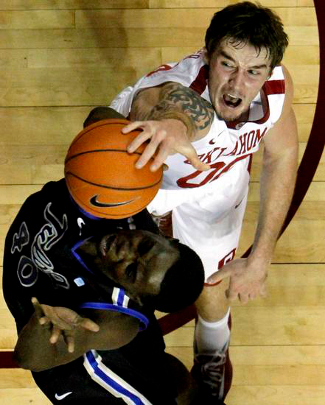
Lon Kruger has OU exceeding preseason expectations
(Photo credit: Nate Billings/The Oklahoman)

If the Sooners are truly going to live up to the new expectations they built in non-conference play, they will have to overcome some long odds in the first few weeks of the season. League schedule-makers did Lon Kruger no favors, giving the Sooners road trips to Texas, Kansas State, and Baylor in their first five games, while tabbing Kansas and Iowa State as the teams to visit Lloyd-Noble during that stretch.

Making an early statement in the Big 12 would be quite impressive for OU, given that opening gauntlet. Pomeroy gives the Sooners odds of no greater than 39% to win any of their first five games, with OU having a 32% chance to win tonight’s tilt in Austin, their most-winnable of the three road games. Looking at the cumulative odds for that stretch shows that Pomeroy gives the Sooners a 15% chance to be sitting at 0-5 in league play on January 19th.

By the numbers

Texas fans have seen some up-tempo basketball from the Horns this season, but it has been nothing compared to the track meets going on in Norman. Oklahoma has the ninth-fasted adjusted tempo in D-I hoops, according to Pomeroy, squeezing in 74.6 possessions per game. With the Horns having 72 possessions per game, fans should be treated to some exciting, up-and-down action tonight.

Oklahoma plays with a four-out, one-in look, but the team still has fared pretty well on the offensive glass. The Sooners have reclaimed nearly 35% of their missed shots, thanks in large part to guards and wings that rebound really well for their size. Oklahoma did have trouble when they played a much larger Michigan State team, as they won only 20.5% of their offensive rebounding chances in that game. Against the size of Texas’ frontcourt, OU could face similar struggles tonight.

Keeping the Sooners away from offensive rebounds will be especially important for Texas tonight because Oklahoma generally doesn’t miss very many shots to begin with. OU’s effective field-goal percentage of 53% ranks them 56th in the country, and it’s not a number inflated by layups. OU has a handful of good shooters who can knock down midrange looks and they are also accurate behind the arc, even though a long-range attack isn’t a key aspect of their gameplans.

All told, the Sooners score an adjusted 1.14 points per possession. Although their defensive numbers of 1.032 adjusted PPP are just a shade below the national average, that per-possession disparity adds up in a hurry when the game is played at Oklahoma’s pace. Since Texas loves to play nearly as quickly as the Sooners do, the Longhorn defense will have to step up tonight. The Texas offense is simply not reliable enough to keep up with Oklahoma’s if the Sooners are scoring at their usual rate.

Ryan Spangler is Oklahoma’s lone presence inside
(Photo credit: Steve Sisney/The Oklahoman)

Meet the Sooners

Oklahoma lacks the interior size it enjoyed with Amath M’Baye and Romero Osby last season, so Coach Kruger has adjusted his approach this season. The Sooners typically trot out only one big a time, with former Gonzaga Bulldog Ryan Spangler (No. 00) holding that role in the starting five, despite checking in at just 6’8″.

Spangler plays much bigger than his listed height, providing excellent interior defense and great performances on the glass. The sophomore has scored a ton of hoops on tip-ins this season and has a defensive rebounding rate of 23.8%, ranking him 73rd in Division I. Spangler has also shown the ability to face up opposing forwards and centers and take them off the bounce, but he has yet to prove that he has much of a shot. Teams can easily turn him into a one-dimensional threat by giving him space anytime he leaves the block, but they must always be aware of his location on the floor so they can get a body on him as soon as a shot goes up.

The team’s leading scorer is senior Cameron Clark (No. 21), an exciting player who averages 18.5 points per game, or roughly 21% of OU’s scoring. Clark made a splash as a sophomore before returning to a reserve role on last year’s loaded squad and ultimately ascending to the leadership role in his senior year. He is an incredibly athletic player who has always been known for his highlight-reel dunks, but he also has a good shot that is accurate all over the floor. Although his midrange game can be streaky at times, Clark has made 50% of his threes, but averages less than three of those attempts per game.

Even though Clark can sometimes go through cold spells from the midrange, he always finds a way to score. In Monday night’s overtime loss to Louisiana Tech, the senior was just 7-of-17 from the floor, but repeatedly attacked the basket to earn trips to the line. He also proved just how clutch of a player he can be when he grabbed an airballed three and raced out to the perimeter to hit his own game-tying, fadeaway triple with just 0.6 seconds left on the clock in regulation.

OU’s other aggressive scorer is sophomore guard Buddy Hield (No. 24). Hailing from the Bahamas, Hield has a good understanding of how to vary his speeds to beat the defense, and he has great strength and body control to score through contact. Like all of the Oklahoma guards, Hield is also very good at passing while driving to the hoop, often setting up Spangler underneath or kicking out to open teammates for midrange jumpers or threes.

Freshman point guard Jordan Woodard (No. 10) has been very impressive in his first year at Oklahoma, but he is coming off of the roughest outing of his young career. In the loss to Louisiana Tech, Woodard coughed it up eight times against just two assists, and made only 31% of his shots. Typically, he is another aggressive perimeter player for the Sooners, repeatedly attacking the rim for easy points or trips to the free throw line. Like Hield, Woodard’s driving ability often opens things up for little dumpoffs in the paint or kickouts to open teammates, and his personal assist rate of 26.9% ranks him in the Top 200 nationally.

Sophomore guard Isaiah Cousins (No. 11) rounds out the starting five for Oklahoma, and he is yet another solid shooter for the Sooners. He doesn’t take many three-point attempts, but has made 41.4% of his tries this season. Understandably, Cousins fires up a few more from long range when he’s feeling it, so he usually knocks down two or three if he makes any.

Cousins is also an excellent defender, thanks to quick hands, good footwork, and length that can clog passing lanes and make it tough for smaller guards. He often comes up with a nice swipe or two in each game by knocking it away from an oblivious rebounder or by stripping opponents when providing help defense. Many teams have been flustered by Oklahoma’s active defense, and Cousins’ skills on that end of the court are a big reason why.

Keys to the game

Texas has to stop the drives of Hield and the OU guards
(Photo credit: Sarah Phipps/The Oklahoman)

1) Limit penetration – Although they have good shooters, everything starts with dribble penetration for the Sooners. If Texas can limit the number of times Oklahoma beats them with the bounce, it forces the Sooners into taking challenged jumpers instead of allowing wide-open looks on kickouts. The Sooners still have the shooters to knock down some of those tough looks, but if the Longhorns want to keep Oklahoma from lighting up the scoreboard, they have to keep the OU guards in front of them.

2) Win transition battle – Both teams like to get the ball up the court in a hurry and score easy points before the defense is set, so tonight’s game could very well come down to which team is able to get more fast break buckets. The Longhorn defense can’t afford to give up transition hoops to an offense that is already going to be tough to stop, and their offense certainly needs to get as many points as it can without having to score in the half-court.

3) Exploit size advantage – The Longhorns are going to enjoy a definitive size advantage in this one, although they will likely have to use Cameron Ridley in short spurts thanks to the tempo of the game. Exploiting that size advantage is easier said than done, however. Oklahoma loves to trap and swarm everywhere on the court, but especially on the blocks. The Texas bigs have had issues this season with slow decision-making, something that will be deadly against a pressure defense.

Not only do the Longhorn bigs need to be quick and decisive with the ball on the block, but they will also need to contribute in the pick-and-roll game. Clark will likely be tasked with guarding Jonathan Holmes or Connor Lammert, which is already a size mismatch in favor of Texas. Add in OU’s preference for switching on ball screens, and Texas has a great opportunity to get Lammert and Holmes quite a few points as they crash to the hoop against smaller guards.

12.21.13
Posted by Ryan Clark at 12:34PM

#5/5 Michigan State Spartans (9-1) at Texas Longhorns (10-1)
Frank Erwin Center | Austin, TX | Tip: 3 P.M. CT | TV: CBS

The Texas Longhorns shattered pre-season expectations when they ran out to a 9-1 start this season. Even with that stellar start, there were still doubts about how the team would perform when facing quality competition. The young team needed comebacks to earn many of their early-season victories against mid-major foes, and they melted down in the final minutes of a road game against Temple before stealing victory on a last-second three by Javan Felix.

Wednesday night, the Longhorns fired a warning shot to the doubters and the rest of the Big 12, pushing North Carolina around in their own house to earn a quality road upset. The win didn’t answer all questions, however. North Carolina has been up-and-down all season, and their 24-for-47 mark at the line played a massive role in Texas’ win. Meanwhile, the Longhorns again had to cling to their lead in the final minutes, once again giving up a comfortable advantage, as they had done in Philadelphia.

This afternoon, Texas gets another chance to send a strong message when it hosts Michigan State at the Erwin Center. The Spartans have only one blemish on their record, a home loss to those North Carolina Tar Heels that Texas knocked off just days ago. The Spartans came out flat in that one, letting Carolina set the tone physically. A valiant first-half comeback leveled things at the break, but as the team battled through a slew of injuries, the Heels pulled away in the second half.

Those injuries have been a theme for Michigan State over the last few weeks. Big man Matt Costello (No. 10) has been fighting mononucleosis and has missed the last two games. Although he was already dealing with the illness and missed the start against North Carolina, Costello still made a major impact with his effort and hustle in 17 minutes on the court.

Point guard Keith Appling (No. 11) injured his hip just before half against the Tar Heels, coming down hard after he went up to block a shot. He has not missed any games due to the injury, but Coach Tom Izzo limited him to just 27 minutes in an easy, blowout win over North Florida on Tuesday.

Two guard Gary Harris (No. 14) has been plagued by an ankle injury, which he aggravated in the loss to UNC. Harris had missed the prior game against Mount St. Mary’s and then turned it while trying to drive the lane against Carolina. He has been held out of the last two games, but is expected to be back in the starting lineup this afternoon.

Numbers to know

The Spartans have a Top 50 offense according to Pomeroy’s adjusted offensive efficiency metric, and unselfishness is a big reason why. Michigan State scores a raw 1.13 points per possession, and the team logs an assist on nearly 65% of its baskets, which ranks them ninth in Division I.

The Spartans shoot the ball well and don’t turn it over, which makes up for the fact that their offensive rebounding numbers are very average for an Izzo team. MSU reclaims just 31.1% of their missed shots, but make more than 37% of their tries from behind the arc and nearly 54% inside it. Although the Spartans aren’t extending possessions, they oftentimes don’t even need a second shot. Their miserly turnover rate of 15.8% also keeps wasted possessions to a minimum.

On the other end of the floor, Michigan State has the seventh-best defense in the country when ranked by adjusted efficiency. The Spartans hold opponents to just 0.92 adjusted points per possession, but most impressively, they do it without fouling. Michigan State’s defensive free-throw rate of 32.2% is ranked 38th in Division I, yet they still have an 11% steal rate than ranks in the Top 50. They challenge shots and force bad looks, and they do sound work on the defensive glass, limiting opponents to reclaiming only 27.8% of their offensive-rebounding opportunities.

Players to watch

Every player who has stayed at Michigan State for four years during Izzo’s tenure has made it to a Final Four, so for senior point guard Appling and senior forward Adreian Payne (No. 5), the goal is clear — Arlington or bust.

Appling is the one who makes the Michigan State offense hum with his excellent court vision, and he’s also the trigger man on a very good transition game. Appling immediately looks up after defensive stops to scope out opportunities to push the pace.

In the past, the point guard has struggled with turnovers, but he has made improvements in that department each season. This year, his 15.7% turnover rate is at the lowest point in his career, while his assist rate of 27.7% is also a new career high. While he can still try to force questionable three-pointers when the team is struggling, his overall decision-making is solid.

Payne, meanwhile, has developed into a stretch forward who is a handful for opposing teams to contain. He now is a consistent threat beyond the arc, making the pick-and-pop a viable play for the Spartans. After taking just three three-point attempts in his first two seasons, Payne knocked down 38.1% of his 42 attempts last season and is on pace for more than 100 attempts this year. Not only did the big man up the volume of his shots this year, but he has also become incredibly deadly, sinking nearly 47% of his tries.

That outside threat forces defenders to shadow him to the perimeter, where Payne can also put the ball on the floor and beat other forwards to the rim. That limits his effectiveness on the offensive glass, but his size and instincts make him a vacuum on the other end. Payne’s defensive-rebounding rate of 23.1% ranks him among the top 100 players in D-I.

While Harris is expected back from his ankle injury today, his effectiveness will be key for the Spartans. After knocking down more than 41% of his three-point attempts as a freshman, Harris has made just 27.6% this year, and only 25.8% in his last three games. Some of that decrease is surely due to the ankle issues, but it is also a result of opponents now having a year of film on the sophomore.

A big part of Harris’ game is being able to shot fake against tight perimeter defense and then blowing by for a wide-open midrange jumper or a layup. Until he can get off the schneid this season, opponents can give him a little space and take away that offensive weapon. Of course, if he’s lacking burst thanks to the ankle problems, opponents would also have the luxury of being able to challenge Harris’ threes and not have to worry about him beating them for open midrange looks.

Keys to the game

1) Challenge shooters – North Carolina was able to give Michigan State fits early in their match-up simply by getting pressure on the ball and sticking close to shooters. Texas can easily do the same thing this afternoon, but also must avoid their bad habit of biting on shot fakes. If the Longhorns can stay on the ground and in position while harassing the Spartan shooters, their strong defensive rebounding should lead to quite a few one-shot possessions.

2) Push the tempo – Michigan State’s halfcourt defense is one of the best in the country, which is especially troubling for a Texas team that lacks a true perimeter threat and often stalls out in halfcourt sets. Texas likely will not force many turnovers by the Spartans, so the team has to be looking for opportunities to push the tempo and get easy buckets off of Michigan State misses.

3) Stop the ball in the open court – The Spartans are also going to be looking for opportunities to catch Texas napping, so the Longhorns must have their heads up and be ready to meet Appling beyond the perimeter. It is already going to be tough enough to slow down Michigan State’s offensive attack, so the Horns cannot afford to give up easy points because no one stops the ball.

12.18.13
Posted by Ryan Clark at 12:58PM

Texas Longhorns (9-1) at #14/18 North Carolina (7-2)
Dean E. Smith Center | Chapel Hill, NC | Tip: 6 P.M. CT | TV: ESPN2

The Texas Longhorns survived their first road test by the skin of their teeth when they knocked off the Temple Owls in an overtime thriller in Philadelphia on December 7th. Tonight’s road game will be a challenge of a completely different caliber for the young Horns, as the North Carolina Tar Heels not only represent a significant step up in competition, but also bring an extra 15,000 fans.

While Ken Pomeroy only gives Texas a 13% chance to win, the Horns can still prove quite a bit even if they don’t pull off an upset. They competed with an NCAA-caliber team when taking BYU down to the wire, so another solid performance against one of the top teams in the nation will prove that the Longhorns can be competitive in a stacked Big 12 Conference this season.

Numbers to know

Like the Longhorns, the Tar Heels excel at beating their opponents down the court. That reliance on fast break points is especially evident when you look at their two big wins in contrast to their two surprising losses. The Tar Heels scored a combined 26 fast-break points in victories over Kentucky and Michigan State. In a home loss to Belmont and a road loss at UAB, the Heels managed just four combined fast-break points.

That’s not to say that UNC can only score when they are in transition or on the secondary break. In half-court sets, the Heels again mirror the Longhorns with a strong interior presence. UNC is only an average shooting team, with an effective field-goal rate of 50.1%. However, they reclaim more than 37% of their missed shots to extend possessions and get second-chance points. Further underscoring the important of points in the paint for Carolina is the fact that they take 84.1% of their shots inside the arc, a distribution that is actually the highest in all of Division I hoops.

Carolina’s interior strength stretches to the other end of the floor, as well. They allow opponents to shoot just 42% inside the arc, a mark that ranks 22nd nationally. However, they do send foes to the line with some regularity, giving 4.4 free-throw attempts for every 10 field goals. For a Texas team that does not shoot the ball well at the line, that’s not something that will be easy to exploit.

Finally, it must be noted that a big part of Carolina’s success in transition is due to their ability to force mistakes. The Heels have the 30th-best defensive turnover rate in D-I, causing their opponents to cough it up on 21.8% of their possessions. Texas is certainly not as turnover-prone as it was last season, but the team has gone through some bouts of sloppy play this season.

Who to watch

Guard Marcus Paige (No. 5) is the one who makes everything work for Carolina. He’s on the floor for more than 35 minutes per game and leads the team with more than 19 points. Although Paige is the top scorer and takes more than 25% of the team’s shots, he is also its best playmaker, dishing out more than four dimes per game for an assist rate of just over 22%. On a team that is fairly awful from long range, Paige is also its only three-point threat for the moment, having made 37.5% of his 56 tries.

Inside, sophomore Brice Johnson (No. 11) is coming into his own after having a hard time finding a true role last year. With the Heels settling on a four-guard look last season, Johnson saw the floor for only about 26% of the team’s minutes. Now, he’s firmly entrenched in the starting lineup and has the highest usage rate on the team. Johnson is a rebounding machine on both ends of the floor, and his 8.3% block rate is a big reason why the Heels are tough to score against inside.

Joining Johnson in the front court is James Michael McAdoo (No. 43), a highly-talented, incredibly-athletic guy who has constantly had to battle questions about his motor. After passing up on opportunities to go pro, the consensus is that the junior hurt his draft stock by sticking around too long. He has a lot to prove this season, but has done admirably so far, putting in nearly 14 points per game while grabbing 5.8 boards. With P.J. Hairston and Leslie McDonald still in NCAA eligibility limbo — something Texas fans can surely sympathize with — UNC’s success could depend upon McAdoo’s ability to step up and be another leader and playmaker.

Keys to the game

1) Control the ball – With North Carolina’s ability to force mistakes and Texas’ history of going through stretches of sloppy play, there is a high danger of quickly losing control of the game by losing control of the ball. The Longhorns gave up 21 points off of turnovers when they last traveled to Chapel Hill in 2011, and junior Jonathan Holmes (No. 10) should certainly remember how those mistakes fueled a crowd of over 21,000. Live-ball turnovers will be absolutely crippling against this team and in this environment, so the Longhorns must hang on to the rock.

2) Limit transition scoring – Simply cutting down on turnovers won’t stop the Carolina transition machine. The Heels love to look for opportunities to push the tempo off of missed shots, especially bad ones. Texas has battled some issues earlier this season with taking bad shots early in shot clocks that then led to runouts and easy points. The Longhorns don’t need to completely abandon the offensive glass, but they do need to be ready to get back at a moment’s notice and have somebody ready to stop the ball.

3) Clean up the defensive glass – Carolina doesn’t shoot the ball well from outside, and their overall shooting percentage isn’t that stellar, either. When the Heels aren’t killing teams in transition, they are killing them with second chance points, so Texas has to close out good defensive possessions with solid rebounding. The Horns are currently the 25th-best D-I team on the defensive glass, so the battle between these strengths of the two teams could be a deciding factor in the game.

12.14.13
Posted by Ryan Clark at 4:24PM

Texas State Bobcats (3-6) at Texas Longhorns (8-1)
Frank Erwin Center | Austin, TX | Tip: 7 P.M. | TV: Longhorn Network

The Texas Longhorns are back in action tonight at the Erwin Center, hosting Texas State in a game that has all the ingredients for a letdown performance. The Horns are coming off of a thrilling overtime win at Temple last Saturday, in which Javan Felix hit a clutch three with just seconds left to earn the win. Since then, the players have had a week off to deal with final exams, and now face a Bobcat team that should have no chance for an upset. With massive tests against North Carolina and Michigan State looming in the next week, it wouldn’t be a huge surprise to see a lackluster effort from the Horns tonight.

By the numbers

Texas State comes in sporting a disappointing 3-6 mark, with one of those wins coming on Wednesday against Division II foe Cedarville. The Bobcats are in the midst of a major culture change under new coach Danny Kaspar, who was famous for stifling defense at Stephen F. Austin. Texas State, on the other hand, was practically allergic to defense under old coach Doug Davalos, and the team always played at a breakneck pace. The Bobcats finished in the top seven of Ken Pomeroy’s adjusted tempo rankings in each of Coach Davalos’ seven seasons. This year, Texas State is ranked 314th out of 351 Division I teams in that department.

It’s going to be a long process for Kaspar to get the Texas State program to the level at which he had the Lumberjacks. Through the first nine games of his tenure, the Bobcats are in the bottom third of D-I hoops in both adjusted offensive and adjusted defensive efficiency. They are seventh-worst in the nation at defending the three-point line, with opponents hitting more than 43% of their attempts. On the offensive end, they turn it over roughly once in every five possessions, and rarely manage to get to the free-throw line. Earning just three trips for every ten field-goal attempts ranks Texas State as the 31st-worst D-I team in free-throw rate.

Meet the Bobcats

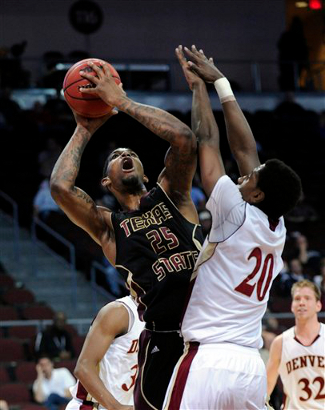
Joel Wright is the go-to guy for Texas State
(Photo credit: David Becker/Associated Press)

To say Texas State relies heavily on senior forward Joel Wright (No. 25) would be a significant understatement. Wright’s usage rate of 35.7% is second-highest in the country, and he takes more than 33% of his team’s shots when he is on the floor. He can score in a variety of ways, as he can easily attack with the bounce from the perimeter, moves well without the ball, and has a nose for offensive rebounds. He also has shown an ability to knock down triples consistently, but he only takes a few from beyond the arc each game.

Unfortunately, with Wright the only reliable scorer on the team, he often forces things. He repeatedly takes on multiple defenders by himself in face up situations, rather than probing and drawing the extra defenders before hitting teammates. He also fails to exploit opponents who double him on the catch near the paint, missing opportunities to set up teammates with kickouts.

One player who should help take the load off of Wright this season is JUCO transfer Emani Gant (No. 21), who has a great post game despite being listed at just 6’8″. He makes strong, confident moves when he gets the ball down low, not allowing teams enough time to challenge him with help defense. His spin moves are smooth and he has a great ability to finish near the rim.

Another newcomer that will likely be a big part of Kaspar’s program-building project is freshman forward Kavin Gilder-Tilbury (No. 1). He came off the bench in the team’s first eight games, but earned the start in Wednesday’s win over Cedarville. Gilder-Tilbury has a great jumpshot that he can hit all over the court, but he has been especially hot from long range. He has made 14 of 29 from beyond the arc, and has taken just more than half of his total attempts from long range.

Guard Wesley Davis (No. 10) started most of the team’s games last year, but found himself coming off the bench in this season’s opener at Houston. His ability to put the ball on the floor and get to the rim has made him one of the top scorers on an offensively-challenged team, and it put him back in the starting lineup for every game since that season-opener.

Joining Davis in the backcourt is point guard Phil Hawkins (No. 0), a senior who is being trusted to implement Kaspar’s new, patient style of play. His assist rate is actually lower than his turnover rate, a stat that not only underscores how the Bobcats have struggled to score, but also serves as a reminder of Wright’s preference for trying to beat guys one-on-one. If Texas State is going to find success in the Sun Belt, they will have to get away from the mindset of dumping it in to Wright and letting him work and instead have Hawkins step up as more of a leader at the point.

Keys to the Game

1) Frustrate Wright – Although Wright is going to get his points against Texas, the Longhorns can easily force him to play into their hands. Wright often fails to identify help defense — or is perhaps just overly confident he can beat two and three defenders at once — and will repeatedly drive against sound, established defense. If the Longhorns give him just enough space to still be able to close out on jumpers and are also ready to provide the interior help that has made them dominant around the paint, Wright will likely make quite a few mistakes. When one player ends more than 35% of his team’s possessions, getting him to waste some of those on bad shots and turnovers is a very easy way to win.

2) Score in transition – Old habits die hard, and Texas State is still learning how to actually play Kaspar-style defense. The Bobcats often fail to stop transition, not only after missed shots, but even after their own makes, too. The Longhorns have used an up-tempo attack all season long, and they have scored a nice chunk of points in the transition game. Taking advantage of Texas State’s defensive lapses should give Texas quite a few easy hoops tonight.

3) Exploit size advantage inside – The Bobcats two tallest players, Gant and seldom-used Gordon Ball (No. 31), are listed at just 6’8″. The Longhorns, meanwhile, have four rotation guys taller than that, and are ranked 21st nationally in defensive rebounding percentage and 22nd in offensive rebounding percentage. If Texas continues that kind of dominance against a much smaller Texas State team, they should limit the Bobcats to numerous one-shot possessions and also earn quite a few second-chance points of their own. That size advantage should also make it very difficult for Texas State to score inside and should turn them into a jump-shooting team.

12.07.13
Posted by Ryan Clark at 6:14AM

Texas Longhorns (7-1) at Temple Owls (4-3)
Wells Fargo Center | Philadelphia, PA | Tip: 11 A.M. CT | TV: ESPNU

The Texas Longhorns face their first road test of the season this afternoon, as they travel to Philadelphia to take on Temple in an off-campus game at Wells Fargo Arena. I’m currently in Puerto Rico to compete in participate in Great Urban Race Nationals, which means that not only will this be the first road game I’ve missed since March of 2006, but also that you’re getting an incredibly abbreviated look at the Owls.

After losing five players from last year’s squad that lost in the NCAA tournament’s round of 32, Temple is now led by Anthony Lee (No. 3), a 6’9″ forward who is a handful in the post. Although he prefers to go over his right shoulder and score with a little left-handed hook, Lee has strong post moves in both directions and is an outstanding rebounder, especially on the defensive glass.

Point guard Will Cummings (No. 2) is a quick guard who loves to attack the rim and can easily slither through traffic to get there. With Temple’s constant motion and multiple screens off the ball, he’s also a great asset thanks to his timely passes that hit those cutters in the perfect position to score.

Sophomore guard Quenton DeCosey (No. 25) is a smooth ballhandler who can get to the rack in a hurry with his long strides. He has made only 33% of his triples and his mid-range game is wildly inconsistent, so Texas would be best served by giving him some space near the arc. DeCosey also has a tendency to dribble the air out of the ball and force passes, so he can be just as frustrating at times for Temple fans as he is exhilirating at others.

The X-factor in today’s game could be Dalton Pepper (No. 32), a 6’5″ guard who can light it up in a hurry. He needs very little space to get his shot off and is very accurate on the quick catch-and-shoot coming off of the numerous aforementioned screens. He’s been a streaky scorer, but still averages 16 points per game.

Keys to the game

1) Take advantage of second chances – Temple has had issues locking down the defensive glass this season, which is great news for a Texas team that is among the best nationally when it comes to grabbing offensive boards. Although the Owls will have the size advantage in the backcourt and on the wings, the Texas frontcourt should still get its share of short-range opportunities and tip-ins after their own missed shots. If the Longhorns can convert these extra chances into points, they should have a shot at the road win today.

2) Push the tempo after defensive boards – The Texas offense has gone through some dry spells in the half-court set this season. Fortunately, Temple prefers to play a man defense, and the Longhorns have had their greatest issues against the zone. Still, looking up after defensive boards for the quick strike downcourt will keep the Texas offense humming. Since the Owls hardly ever turn the ball over, pushing after defensive boards will be Texas’ only good chance at getting transition points.

3) Make free throws – This might seem like a stupid thing to include in the Keys to the Game, but after an awful outing in which Texas made just 15 of 29 against Vanderbilt, it deserves a mention. Compounding the problem is the fact that the Owls send opponents to the line fairly frequently, with a free-throw rate that is just outside of the nation’s bottom 20%. If Texas leaves a bunch of points at the line again this afternoon, it will be very tough to escape Philly with a road win.

« Previous Page — Next Page »