






11.10.13
Posted by Ryan Clark at 12:15PM

Texas Longhorns 76, Mercer Bears 73

A tumultuous offseason came to a close for the Texas basketball team on Friday night, as the Longhorns finally tipped off their 2013-14 campaign with a game against the Mercer Bears. With huge questions surrounding the young, rebooted lineup and fan expectations at their lowest point in more than a decade, the Horns put together an exciting — albeit inconsistent — performance to start the season with a 76-73 win.

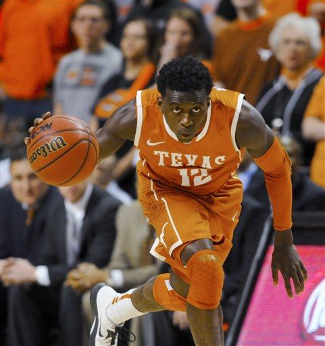
Myck Kabongo bolted from the 40 Acres this summer
(Photo credit: Brody Schmidt/Associated Press)

The offseason turmoil was well-documented, with five different Longhorns leaving the program after the 2012-13 season ended with a loss to Houston in the CBI. Forward Jaylen Bond actually announced his departure just before that game, and ultimately landed at Temple. Shooters Sheldon McClellan and Julien Lewis both hit the bricks shortly after, heading to Miami and Fresno State, respectively. Point guard Myck Kabongo decided to test the NBA waters, and was not selected in June’s NBA Draft. Kabongo is currently on the roster of the Austin Toros of the NBA’s D-League.

While only Bond’s decision wasn’t seen coming a mile away, even that one was understandable considering the pecking order in Texas’ frontcourt. But the biggest offseason blow did come as a surprise, as the versatile forward Ioannis Papapetrou decided in August to go pro in his native country of Greece. The Texas roster was decimated, forcing Coach Rick Barnes to hold an open tryout just to pick a few walk-ons and get enough bodies for practice.

The final roadblock in the soap-opera offseason came when sophomore point guard Javan Felix had sports hernia surgery at the start of October. The Texas program gave no recovery timetable, leading to debates amidst the dwindling fanbase over who would run the point for the Horns as the season tipped off.

The roster upheaval was the biggest storyline of the last seven months, but another had emerged during the disastrous 2012-13 season and it carried over into the summer. Long a topic in the echo chamber of internet message boards, the fate of Coach Barnes was being discussed by mainstream media. With the early struggles of the football team and rumors swirling about Athletic Director DeLoss Dodds, many fans and sportswriters were talking about the inevitable waves of change headed for Bellmont.

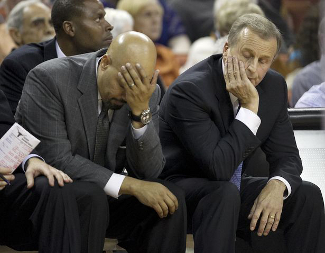
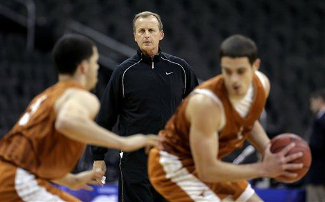
Rick Barnes is under the microscope this season
(Photo credit: Ralph Barrera/Austin American-Statesman)

The first of those changes came with last week’s announcement of Steve Patterson as the next Texas AD, and it set an interesting backdrop for Barnes and the Horns as the season tipped off. The consensus from both the media and fans is that the Longhorns are in for another rough season, and many believe it will be the last for Coach Barnes. Others suggest that with expectations set so low, Barnes should be able to meet or exceed them and buy himself more time.

While the big-picture questions will likely be shadowing the program all season long, the Longhorns were at least able to start to answer some of the questions about the team in Friday night’s win. The Longhorns pushed the tempo and showcased a shooting touch that was sorely lacking last season. It was apparent that although Texas may struggle to log wins this year, the team will at least make it entertaining for its fans.

The recap

The Longhorns came out firing, shooting 50% from the field and knocking down six triples to build a lead as large as 12 points late in the first half. The experienced Mercer squad refused to fold, and its leader Langston Hall quickly responded with seven points in a 30-second stretch. The teams traded buckets as the half wound down, and the Longhorns took just a three-point edge to the locker room.

Mercer turned things around in the second half, finally finding its range from behind the arc. After shooting just 3-for-16 on threes in the first twenty minutes, the Bears drilled six of their next nine attempts and stormed to a nine-point lead with 9:44 to play. Staring a season-opening loss in the face, the Longhorns put a renewed focus on their interior scoring and turned up the defensive pressure. Fueled by Cameron Ridley’s second-half surge, Texas went on an 18-2 run in less than seven minutes.

Mercer continued to claw at the narrow margin in the final minutes, and the Bears found themselves with an opportunity to tie the game with five seconds left. Coach Barnes elected not to foul with his team up three, and the Bears found Jakob Gollon on the left wing for a potential game-tying trey. Connor Lammert stood tall and barely left his feet, blocking the final shot to secure an opening-night victory.

What looked good

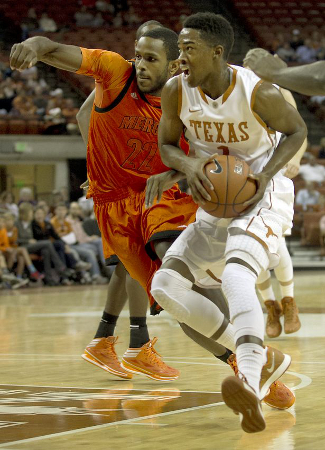
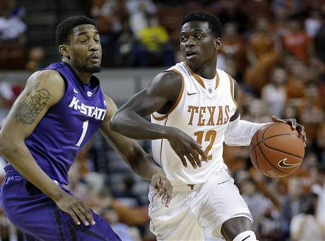
Isaiah Taylor had a solid collegiate debut
(Photo credit: Ralph Barrera/Austin American-Statesman)

The brightest spot for Texas and its fans was the excellent debut from freshman Isaiah Taylor. The youngster ran the point, shifting Felix off the ball to an undersized shooting-guard role. Taylor made quick, aggressive moves with the ball, and was able to shift gears in an instant to keep the defense off-balance. His smooth handles made it easy to weave through traffic, and he took full advantage of the new emphasis on defensive contact to earn fourteen trips to the line. He also showed an ability to pull up and hit the floater in traffic, something the tiny guard may have to rely on against bigger, stronger opponents. Taylor finished with 17 points in 29 minutes of action.

While Taylor didn’t attempt a three-pointer in the game, the rest of the Longhorns found a ton of success from beyond the arc. Texas made six of their eight three-point attempts in the first half and finished the game with a 46.7% success rate. Last season, the Longhorns made just 29.7% of their threes on the year, and cracked the 40% mark in just five of their 34 games.

Three of the long-range makes came from Texas big men, with Jonathan Holmes knocking down a pair and Lammert adding the third. Holmes showed the ability to hit three-pointers last year when he took them in rhythm, and that trend continued in the season opener. His first came as a trailer in transition, while his second was a wide open look late in the game. Lammert added his on a pick-and-pop play. If the Texas forwards can consistently make their long-range looks, it adds an extra dimension to the Longhorn offense that will spread the floor and open up driving lanes.

Freshman Damarcus Croaker also added two threes on back-to-back possessions, with a defender providing token pressure on both. He threw a pass out of bounds moments later and sat on the bench for the rest of the game, but it’s reassuring to know that the new guards will at least add some long-range pop. Although one game is certainly not a sample size worthy of any true conclusions, there’s reason to believe that Texas fans might not have to struggle through the painful scoreless stretches of last season.

The Longhorn offense also came from the entire stat sheet, as all ten players who saw the floor scored at least two points. Big man Prince Ibeh made two out of three free throws to log his points, which is certainly noteworthy after he made just 37.5% of his free throws last year.

The Texas offense also featured good ball movement, especially right out of the gate. The three-guard lineup whipped the ball around the perimeter as they looked for post entry opportunities. Although the Mercer defense is experienced and generally well-disciplined, when the Bears were caught out of position, the Texas guards were quick to put the ball on the floor and attacked the defense off the bounce. While last year’s team often passed the ball around the arc with little direction or sense of purpose, there was a clear game plan for this one and the team stuck to it.

On the defensive end, there was a ton of energy. The Longhorns used a lot of zone looks, including a 1-3-1 and what even looked like a 1-2-2. They threw out some full-court pressure to force a few first-half mistakes and looked really strong in man-to-man as they mounted their comeback late in the game.

What needed work

On the flip side, that defensive energy didn’t always equal results in the first half. The Longhorns seemed overly amped up, repeatedly biting on head fakes. Texas trapped quite a bit out of their zones in the first half, but players who were supposed to be rotating were often late or lost their assignments. On one particularly poor defensive set, Holmes drifted towards a man flaring to the arc as the Longhorns trapped past the opposite elbow, and he let a Mercer player cut right behind him to the rim for an easy hoop.

Ridley also seemed to struggle in the zone, as his size and conditioning made it tough for him to match the energy and effort of his teammates for long stretches. Mercer was very disciplined when it came to making quick, crisp passes, and his lapses allowed for open midrange jumpers and cuts to the paint. However, when the Longhorns switched to a man-to-man at the end of the first half and again in the second, Ridley actually looked phenomenal. He cleaned up shots from the help-side and also stood his ground to block shots from the Mercer bigs near the rim. Ridley finished the night with five blocks and 11 boards in 27 minutes of action.

While Ridley and Lammert provided a spark down the stretch, it took a while for the Texas interior game to get going. The bigs were working hard to establish post position in the first half, but they simply weren’t clicking with the guards. On some possessions, the bigs couldn’t get position for a good entry pass, while on others they would finally get their spot but the guards couldn’t find them. On the few occasions in the first half where the ball made it down low, the Texas bigs were usually out of position or they struggled to make a good move.

Fortunately, things changed down the stretch, as the guards and bigs worked together to get good angles down low and seal off the defenders. Ridley and Lammert logged some easy layups as a result, while the latter also cleaned up the glass with some key tips from the weak side late in the game.

A recurring problem last season was Felix getting himself into tough situations, and unfortunately that was again an issue against Mercer. Javan had three turnovers on the evening, but also repeatedly had shots blocked when he drove against a set interior defense. He left his feet without a plan on a few occasions early in the game, leading to desperation passes into the teeth of the D. Felix did log nine assists on the game, but his 4-of-14 line is worthy of concern. It will take time for the point guard to settle into his new combo-guard role, so hopefully the decision-making and shot selection improve over time.

The turnover bug was not just an issue for Felix, but for the entire Longhorn roster. Although the turnover rate of 17.9% was an improvement on last year’s 21.4% mark, that isn’t saying much. Texas was in the bottom third of Divison I hoops last season, so it would be tough to match that level of carelessness this season.

The Horns had six turnovers in the first 8:16 of the game, but managed to tighten things up the rest of the way. It’s worth noting, however, that many of the miscues were of the self-inflicted variety. With a young team and a lot of new faces, it’s natural that teammates sometimes won’t be on the same page, but for a Texas team that is going to have to battle for every win, the unforced errors will have to be reigned in.

Up next: vs. South Alabama (1-0); Tuesday, 7 P.M. CT

3.20.13
Posted by Ryan Clark at 1:37PM

Texas Longhorns (16-17) at Houston Cougars (19-12)
Collge Basketball Invitational First Round | Hofheinz Pavilion | Houston, TX
Tip: 8 P.M. CT | TV: AXS TV | Radio: Longhorn IMG Radio Network (Affiliate list)
LRT Consecutive Game #254

For the first time in fifteen years, the Texas Longhorns will be sitting at home when the NCAA’s Round of 64 tips off tomorrow morning. Although Texas will not be part of the NCAA tournament, the team is still participating in a post-season event, albeit a much-less prestigious one. Tonight, the Longhorns open play in the College Basketball Invitational, traveling to Houston’s Hofeinz Pavilion.

Like Kentucky in the NIT last night, the Longhorns could not host a first round game in the CBI because their home floor is being used to host NCAA tournament games this weekend. The road trip could grow longer, as even if the Longhorns advance to the quarterfinals of the CBI on Monday, a school spokesman told Mark Rosner that the Frank Erwin Center could not be flipped in time for a home game that night. That means that a win in tonight’s game would slate Texas for another road game on Monday, at George Mason University in Fairfax, Virginia.

Tonight’s match-up revives a long-dormant Southwest Conference rivalry. Houston and Texas have not faced off since the 2000-01 season, when the Longhorns notched a 71-60 win in Houston. It was the second consecutive win for UT over the Cougars, and gave Texas a narrow 32-31 edge in the series. Tonight’s head coaches, Rick Barnes and James Dickey, have previously met six times. Barnes holds a 6-0 record against his counterpart, with all of the match-ups coming during the final three years of Dickey’s tenure at Texas Tech.

By the numbers

The Cougars run an up-tempo attack, logging an average of 70.4 possessions per game, adjusted for the opposition. That quick pace ranks 20th in Division I, according to Ken Pomeroy.

Houston does not force many turnovers, instead opting to get their transition opportunities after reclaiming opponents’ misses. Cougar opponents cough it up on just 17.9% of their possessions, ranking Houston in the bottom fifth of the country when it comes to forcing miscues. The Cougars are near the median in D-I for reclaiming opponents’ misses, grabbing 31.2% of their opportunities. The average for all Division I teams is 31.8%.

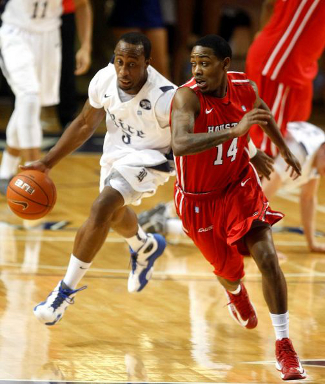
Houston’s guards have struggled to contain the basketball
(Photo credit: Johnny Hanson/Houston Chronicle)

That inability to force turnovers and the average performance on the glass are two reasons why Houston has one of the worst defenses in the country. However, it is a problem with turning back dribble penetration — especially in the second half of many games — that has allowed Cougar opponents to score 1.073 adjusted points per possession. Those struggles with keeping the ball in front of the defense allows opponents to get to the rack and find easy looks inside, leading to the sky-high 49.7% field-goal percentage that Houston opponents have logged inside the arc.

On the other end of the floor, Houston has had much less trouble. The Cougars score an adjusted 1.057 points per possession, currently good for 88th out of 347 Division I teams. Houston has a nice blend of quality shooters who can knock it down from outside and talented forwards who can score in the paint and crash the glass. The Cougs’ field goal percentages both inside (50.2%) and outside (36.9%) the arc put them in the top 20% of Division I teams.

In addition to being able to put the ball in the basket, Houston also benefits from making possessions count. The team coughs it up on just 18.5% of its possessions and reclaims 33.3% of its missed shots. With a nice stable of bigs in the frontcourt, Houston also makes its way to the line fairly often, posting a free-throw rate of 40% on the season. In simpler terms, that means that the Cougars earn two free throws for every five field goals they take.

Meet the Cougars

At the point, juco transfer Tione Womack (No. 14) runs the show. He came to Houston from Hagerstown CC in his home state of Maryland, and took over the starting role a month ago. In the last nine games, he has averaged 28 minutes per game as the starter and dished out four assists per game. Although he’s not very strong at 6’1″ and only 170 pounds, Womack sets the table for his teammates, logging assists on 22.5% of the buckets scored when he is on the court.

The man who previously held the starting gig was 6-foot freshman J.J. Thompson (No. 3). He has seen his minutes drastically reduced with Womack now holding the reins, even failing to see the court in three of those nine contests. In the other six, he averaged 8.2 minutes, pulling his season average down to roughly 21 minutes per game. Turnovers were a major issue for the freshman this year, as he posted a 1.37 assist-to-turnover ratio on the season.

The shooting guard for Houston is hometown product Joseph Young (No. 0), a selection to this year’s All-Conference USA Third Team. Young is deadly from long range, having connected on more than 42% of his attempts this season. He also can knock down the pull-up jumper, and will put the ball on the floor to punish teams that play him too tightly on the perimeter. His 17.9 points per game are tops on the team, and his offensive rating of 124.2 is ranked 33rd out of all D-I players.

On the wing, Danuel House (No. 23) is a tough cover. He’s a very strong 6’7″ with great handles and an ability to slip right through the defense. That slashing ability gets House to the line with regularity, where he knocks down 72% of his attempts. His free-throw rate of 58.8% ranks him 100th in the country at getting to the line, something that will be a concern for a Texas team that frequently sends opponents to the stripe.

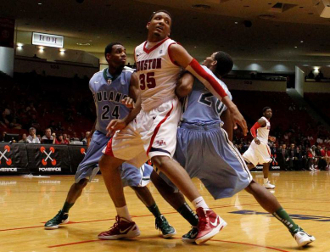
Forward TaShawn Thomas is the star for Houston
(Photo credit: James Nielsen/Houston Chronicle)

The Cougars have a very deep frontcourt filled with bigs who are not only strong, but very athletic, as well. Sophomore forward TaShawn Thomas (No. 35) is the most dangerous of these, as his selection to the First Team All-Conference USA squad would indicate. At 6’8″ and 215 pounds, the Killeen product is a handful inside. He is second on the team with 16.8 points and leads the squad with 9.5 rebounds. That number is inflated a bit by the up-tempo approach of Houston, but his offensive and defensive rebounding rates of 10.5% and 21.9% are still both ranked in the Top 250 for D-I players.

Thomas has a nice repertoire of moves, which could cause issues for a Texas frontcourt that was destroyed by the likes of OU’s Romero Osby and Kansas State’s Thomas Gipson. Thomas can bull his way inside for points, but also can go over either shoulder to hit hook shots and can knock down turnaround jumpers from anywhere near the paint. The Texas bigs will have to stay home and avoid biting on fakes if they hope to limit his damage tonight.

Joining Thomas in the frontcourt is Mikhail McLean (No. 1), another 6’8″ forward for Coach Dickey. McLean is averaging just 13.9 minutes per game, but has seen his role increase over the final few weeks of the season as he works his way back from a broken hand. Although he’s not a focal point of the offense, McLane has started nine of the last ten games and has done a great job reclaiming missed shots.

The Cougars see little dropoff when they go to their reserves in the frontcourt, as senior forward Leon Gibson (No. 15) started 12 games this season. A transfer from Navarro JC, Gibson has the prototypical back-to-the-basket game that allows him to score easily when he gets touches on the block. He is also a beast on the glass, but his limited 16 minutes per game prevent him from being ranked nationally in rebounding percentage.

Another solid reserve for Coach Dickey is swingman Jherrod Stiggers (No. 21), who would draw all of the attention as a long-range sharpshooter, if it weren’t for the presence of Young. Stiggers has knocked down 39.8% of his three-point attempts this season. Texas has the sixth-best defense in the country when it comes to defending the arc, so the Horns must continue that level of dominance if they want to neutralize Stiggers tonight.

Fellow guard Brandon Morris (No. 2) will likely see the court for ten to twelve minutes tonight, but is not a huge offensive threat. His 2.9% steal mark would be ranked nationally if he played more minutes, so the Texas guards cannot afford to be loose with the ball in his vicinity.

Forward J.J. Richardson (No. 55) rounds out the rotation, but his minutes have been limited all season long due to a nagging foot injury. In a road game against crosstown rival Rice, Richardson showed just what kind of a post presence he could be at full strength, putting in 13 points on 5-of-6 shooting from the field. Since then, he has played in just five of the team’s ten games, and he logged only eight total minutes in Houston’s two games at the C-USA tournament.

Keys to the game

1) Stop transition – Although the Longhorns have been wildly inconsistent all season long, the one aspect of their play that has been generally strong is the defensive effort. If Texas can prevent Houston from pushing the pace after missed Longhorn shots, it should be able to force the Cougars to score in the half-court. That will play to Texas’ strengths, while also eliminating easy points for Houston. If the Cougars are not able to pile up fast-break points against the Horns, they will likely find it difficult to advance to the CBI quarterfinals.

2) Attack the paint – Houston has repeatedly struggled to keep the basketball in front of its perimeter defenders, opening up the lane to dribble penetration. If the Longhorns can avoid their bad habit of settling for jump shots, they should be able to frequently slash to the rim and get easy buckets, or at least draw help defense that opens up teammates.

3) Win on the glass – The Cougars are fairly average when it comes to rebounding the basketball, while the Longhorns have had a Jekyll and Hyde history on the two ends of the court. Texas does a great job rebounding its own misses, but lost many close games due to an inability to secure defensive boards in crunch time. If the Longhorns can continue their success on the offensive glass, they will be able to earn extra possessions against a Houston defense that is already very poor.

The real challenge will come on the other end of the floor, where the Cougs have an active frontcourt that can kill Texas with second-chance points. If the Longhorns can mitigate the damage from extra Houston possessions, they might escape Hofheinz to play another day.

3.17.13
Posted by Ryan Clark at 5:34PM

Although the Texas Longhorns failed to make the NCAA tournament field for the first time in 15 years, their season is not yet over. Citing sources, the Houston Chronicle’s Joseph Duarte reported that the Longhorns have accepted a bid to the 2013 College Basketball Invitational. Texas will open play at the University of Houston on Wednesday, at 8 P.M. CT. The winner of Wednesday’s game will advance to face the College of Charleston or George Mason in the second round on Monday, March 25th.

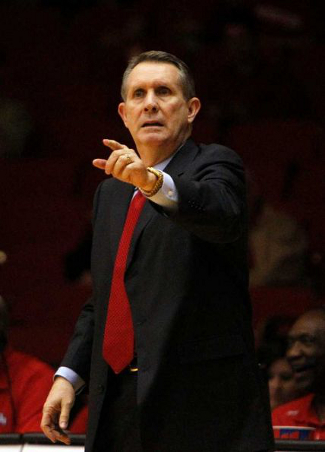
James Dickey and Houston will host Texas in the CBI
(Photo credit: James Nielsen/Houston Chronicle)

The matchup with Houston will renew an old Southwest Conference rivalry that has been dormant since the 2000-01 season. The all-time series is nearly even, with Texas holding a two-game winning streak and a narrow 32-31 overall edge. Texas coach Rick Barnes also has a 6-0 record against Houston’s James Dickey, with all of those games coming in the last three years of Dickey’s tenure at Texas Tech.

Now in its sixth year, the CBI is a 16-team tournament culminating in a best-of-three Championship Series. All games are played at the home arenas of the participating teams, meaning that the Longhorns would be able to host games if they can advance to later rounds. With the Erwin Center home to NCAA tournament games this weekend, Texas had no choice but to open CBI play on the road.

The College Basketball Invitational is produced by the Gazelle Group, a New Jersey-based sports marketing firm. The Gazelle Group also manages exempt November events that the Longhorns frequently play in, such as the 2K Sports Classic, Legends Classic, and CBE Classic.

For Coach Barnes, this post-season bid is his 21st-consecutive and 24th overall in his 26-year career. The 21-year streak includes all four years he spent at Clemson and the final two years of his stint at Providence. It is comprised of 18 NCAA bids and two NIT appearances, in addition to this year’s CBI nod.

Although the CBI bid extended Barnes’ streak of post-season appearances, his personal string of 17-straight NCAA bids was snapped on Sunday. Barnes’ 17-year run was tied with that of Duke’s Mike Krzyzewski for the longest active streak, but Coach K can now lay sole claim to that title. The Blue Devils earned a No. 2 seed in this year’s NCAA tournament, extending Krzyzewski’s streak to 18 years.

Fans will be able to purchase tickets for Wednesday’s game online or by calling the University of Houston box office at 1-877-COUGAR5.

The clash between Texas and Houston is one of four CBI first-round games that will be broadcast live on AXS TV, the cable network owned by Mark Cuban, Ryan Seacrest, and the Creative Artists Agency. In Austin, AXS TV can be found on AT&T U-Verse (Channel 1106) and Grande Communications (880). Satellite customers can also watch the game on DIRECTV (Channel 340) and Dish Network (362).

EDITOR’S NOTE: A previous version of this post did not include potential second round opponents and listed both possible game times.

3.14.13
Posted by Ryan Clark at 10:07AM

[7] Texas Longhorns (16-16) vs. [2] Kansas State Wildcats (25-6)
Big 12 Championship Quarterfinals | Sprint Center | Kansas City, MO
Tip: 6:00 P.M. CT | TV: Big 12 Network (Affiliate list) | Internet: ESPN3
LRT Consecutive Game #253

Last night, the Texas Longhorns took the first and easiest step in their pursuit of an improbable Big 12 title, dispatching No. 10 seed TCU, 70-57. Texas must win the conference tournament to avoid missing the NCAA tournament for the first time in 15 years, which means that the young Horns have to put together four wins in four days. With the first victory under their belt, things now get much tougher for Rick Barnes’ inconsistent bunch.

Awaiting the Horns in the quarterfinals are the experienced Kansas State Wildcats, who beat the Horns by a combined 38 points in the team’s two meetings earlier this year. It has long been said that it’s tough to beat the same team three times in a season, but those prior results offer Texas fans little reason for optimism about tonight’s match-up. Even in the relatively-close 12-point loss to Kansas State in Austin, Texas was out of the game for the entire second half, and trailed by as many as 19 points.

Ken Pomeroy gives the Horns a 27% chance to win, predicting a six-point margin of victory for the ‘Cats. The Longhorns will have to overcome those odds and what will amount to a home crowd for KSU if they want to keep their NCAA dreams alive.

Meet the Wildcats

For an in-depth look at the Kansas State roster and the team’s style of play, check out LRT’s game preview from the first meeting between these two teams.

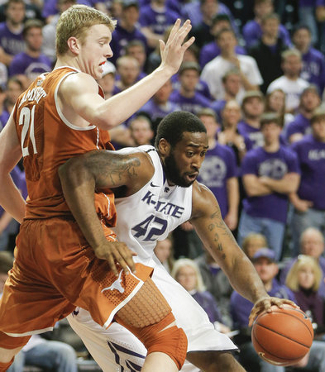
Texas could not slow down Thomas Gipson in Manhattan
(Photo credit: Travis Heying/The Wichita Eagle)

The first match-up

When Texas and Kansas State first faced off on January 30th, the game was quickly out of reach. The Longhorns had two leads in the first four minutes, but trailed 9-7 at the under-16 media timeout. Texas would never get any closer, falling victim to a brutal stretch of offensive inefficiency. For a span of more than 12 minutes in the first half, Texas managed only eight points, with all of them coming from Sheldon McClellan.

The Longhorns did manage to get some good looks early in the game, but could not make any buckets. With shots not falling, Texas only made things worse by constantly turning it over and giving up easy points to the Wildcats. On the night, Texas ended 27.5% of their possessions with a turnover and allowed KSU to score 33 points off of those miscues. In a lopsided 83-57 loss, those wasted possessions and free points were easily the difference in the game.

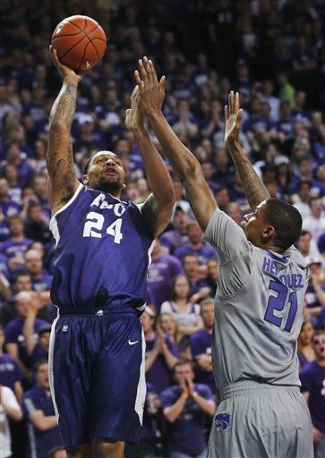
Most troubling for Texas fans is that this beatdown came with Rodney McGruder limited due to foul trouble and Will Spradling (No. 55) playing with a broken nose he suffered in the first half. With those two only chipping in 12 points, it was Texas-born big man Thomas Gipson (No. 42) who dominated the game, scoring 17 points and grabbing seven boards in only 21 minutes on the court.

The rematch

Even with Myck Kabongo back in the lineup, things did not get much better for Texas when they hosted Kansas State on February 23rd. The Longhorns failed to challenge the Kansas State shooters all afternoon, allowing the Wildcats to knock down 50% of their 18 three-point attempts.

Texas still managed to find itself down just three points late in the first half, but a disastrous exchange shoved the momentum to the Kansas State sideline before the teams headed to the locker room. With 22 seconds left, it appeared the Wildcats would hold for the last shot. Instead, Javan Felix fouled Angel Rodriguez (No. 13), who knocked down a pair of free throws. Kabongo then turned it over with just two seconds left in the half, and the Wildcats raced down the court for a three from Shane Southwell (No. 1) just before the horn.

Things continued to deteriorate in the second half. The Longhorns took more than four minutes to score a basket, allowing Kansas State to extend its lead out to fifteen points. Texas never recovered, trailing by as many as 19 points midway through the half. The Horns closed the gap for cosmetic purposes, but still dropped the final decision at home, 81-69.

Kabongo led the way for Texas, scoring what was then his career high of 24 points. McClellan came off the bench to score 15 points, rebounding quickly from his benching in the TCU game just five days earlier. Both players were able to score in transition and Kabongo drove to the rack in half-court sets, but otherwise the offense was bogged down.

The Longhorns also again struggled to keep Kansas State from reclaiming missed shots. The Wildcats snagged 41.4% of their offensive rebounding opportunities in Austin, improving upon the impressive 40% mark they had posted in Manhattan. Those extra chances only resulted in seven second-chance points for K-State, but they demoralized the Longhorn defense when it did manage to force a missed shot.

Keys to the game

1) Look for transition opportunities – In both games against Kansas State, the Texas offense had a very difficult time scoring in their half-court sets, but did find some success on the break in Austin. Unfortunately, the Wildcats take good care of the ball, turning it over on only 18.4% of their possessions. That means that transition opportunities for Texas will have to come off of missed K-State shots. Of course, the Horns have had difficulties winning defensive rebounds against the Wildcats, so this could be a very tall order.

2) Communicate and rotate on defense – Kansas State’s offense can look like a well-oiled machine when it is clicking, as the Longhorns discovered when the ‘Cats sliced them up with crisp ball movement in Austin. In addition, Rodriguez has the ability to slash through defenses and pull defenders away from the K-State bigs inside and the shooters waiting on the perimeter. The Longhorns must play sound team defense, communicate, and rotate quickly if they hope to disrupt a Kansas State offense that scored 1.26 points per possession against them in their two earlier meetings.

Texas needs another strong showing from Kabongo
(Photo credit: Eric Gay/Associated Press)

3) Aggression from the guards and wings – Texas found success in the second half of last night’s game when Kabongo, McClellan, and Julien Lewis started attacking with the bounce and making harder cuts off the ball. As a result, the Horns posted a free-throw rate of 82% against TCU, meaning that they shot more than eight free throws for every ten field goal attempts. Coming on the heels of a 62.7% free-throw rate against Texas Tech, it appears that the normally-stagnant Texas offense is finally making an effort to grind out points at the line.

Combine this recent trend with Kansas State’s penchant for sending opponents to the stripe, and the Longhorns may be able to pile up some points. Even if Texas does not end up drawing many fouls by attacking with the bounce, any sort of aggression will be an improvement. Static possessions with excessive perimeter passing and challenged looks late in the shot clock have unfortunately been the norm for Texas for much of the season. If the ballhandlers can be aggressive, while Lewis and McClellan work hard to get open off the ball, Texas can stay competitive this evening. If not, the Horns will likely be victims of a third K-State beatdown this year.

3.13.13
Posted by Ryan Clark at 4:01PM

[7] Texas Longhorns (15-16 overall, 7-11 Big 12) vs. [10] TCU Horned Frogs (11-20, 2-16)
Big 12 Championship First Round | Sprint Center | Kansas City, MO
Tip: Approx. 8:30 P.M. CT | TV: Big 12 Network (Affiliate list)
LRT Consecutive Game #252

The Texas Longhorns open play in the Phillips 66 Big 12 Championship with one, straightforward goal: win the whole damned thing. For the Longhorns, anything less than that will mean an end to a 14-year streak of NCAA appearances. And while Texas is hoping to preserve its historic streak, the rest of the program’s history is stacked against it. The Longhorns have never won the Big 12 Championship, despite appearing in the finals on six different occasions.

Rick Barnes and the Horns face an uphill battle in KC
(Photo credit: Charlie Riedel/Associated Press)

Even getting to that championship will be extremely difficult, as Texas must win three games in a row to reach that point. Until Saturday’s overtime win at Texas Tech, the Longhorns had not even strung together two consecutive victories in league play. Furthermore, Texas would still have to get past Kansas State and then either Oklahoma State or Baylor, three teams which the Horns posted a 1-5 record against in the regular season.

Of course, the old adage holds that you must take it one game at a time. For Texas, that would be sage advice. Although the Horns open tournament play against last-place TCU, they have to remember that the Horned Frogs have pulled off surprising upsets to earn their two league victories. Earlier this season, TCU shocked the college basketball world with a home win over a Top 5 Kansas team. On Saturday, they wrapped up their regular season by building a massive lead against Oklahoma and then hanging on for the improbable win. If Texas makes the mistake of looking ahead to a possible matchup with Kansas State tomorrow night, the Horns might not even get there.

Meet the Horned Frogs

For an in-depth look at the TCU roster and the team’s style of play, check out LRT’s preview of the first match-up between these two teams.

The first meeting

Texas had to grind it out with TCU in the first game, which saw only 57 possessions on the night. Even with such a slow tempo, the Longhorns were able to build a lead as large as 19 points and won the game by a 17-point final margin. Texas used stifling defense to limit the already-anemic TCU offense to just 0.753 points per possession, while having one of its best shooting nights of the season on the other end.

One reason Texas was able to get so many good looks is that the team made it a point to work the ball inside-out against TCU. Connor Lammert cracked double-digits in points for the first time in his collegiate career, logging 10 on a perfect 5-for-5 shooting night. Since then, the freshman has continued to play with confidence, earning starts in the team’s last two games.

Ioannis Papapetrou also had a solid night against the Horned Frogs, scoring 13 points in his 34 minutes on the court. More importantly, the Greek forward snagged nine boards on a night where the Longhorns performed terribly on the glass. The Longhorns grabbed just 30 rebounds as a team, posting an ugly 26.9% mark on the offensive glass.

For TCU, the bright spots were in the frontcourt, where Connell Crossland (No. 2) continued his surge in conference play. The senior had 12 rebounds, including four on the offensive end. Fellow big man Adrick McKinney (No. 24) led TCU in the scoring department with 13, while also logging eight boards.

The rematch

When the two teams squared off once again on February 19th, Myck Kabongo was back on the court for Texas, and he made an immediate impact. The sophomore point guard scored eight points in the first half and dished out five dimes, as the Longhorns took a 33-25 lead to the locker room.

Texas moved the ball extremely well in the first half, while Kabongo was aggressive with the bounce. The Longhorns could have been even more efficient on offense, if not for a series of poor passes into the paint that resulted in turnovers.

On the other end, the Longhorn defense had a tough time shutting down a TCU team that typically struggles to score. Even though Demarcus Holland did a solid job turning back the penetration of point guard Kyan Anderson (No. 5), the Horned Frog bigs repeatedly found great post position. Cameron Ridley especially struggled to force McKinney off the block, and he played only six minutes as a result. Even with that interior success, TCU did not limit its scoring to the paint, as Garlon Green repeatedly knocked down midrange jumpers.

In the second half, TCU coach Trent Johnson made adjustments to slow down the Horns, most notably tabbing Nate Butler Lind (No. 21) to guard Kabongo. While he is perhaps a step slower than Anderson, Butler Lind’s extra length made it tougher for Kabongo to score, even when the Texas point guard was able to drive the lane.

The Longhorns briefly experimented with a zone in the second half, but Anderson quickly took advantage without Holland in his shirt. Anderson penetrated the zone and hit his teammates in good position as the defense collapsed, logging six assists in the second half alone. He also chalked up some of those dimes by being alert after missed Texas shots, judiciously picking the spots where he could push the tempo for transition points. His leadership allowed the Horned Frogs to tie the game with just under nine minutes to go, and he kept them within a few buckets of Texas down the stretch.

In the end, it was clutch plays from Connor Lammert and Holland that iced the game, keeping Texas just ahead of a determined TCU squad. After a pass by Kabongo from the opposite three-point line, Lammert made an acrobatic, backwards layup in transition as he was fouled, and then he converted the free throw. A few possessions later, Holland drilled a three from the corner as the shot clock neared zero. Thanks to those timely buckets, the Longhorns escaped Daniel-Meyer Coliseum with a 68-59 win, their first true road win of the season.

Keys to the game

1) Clean up the glass – Although TCU is just an average rebounding team, the Longhorns had trouble keeping them away from the offensive boards in both games. Texas allowed the Horned Frogs to reclaim 37.8% of their misses in the first meeting between the two teams and 45.2% of their misses in the second game. The Horned Frogs do not shoot the basketball well and rely mostly on scoring from their bigs in the post. If the Horns wants to avoid the upset tonight, they have to take advantage of that offensive weakness by limiting second and third chances once they have forced missed shots.

Texas must challenge TCU big man Adrick McKinney
(Photo credit: Orlin Wagner/Associated Press)

2) Make the bigs uncomfortable – With TCU’s preference for dumping it into the post, Texas has to make it a point to put the Horned Frog bigs in uncomfortable positions. (No, not the back of a Volkswagen.) The Longhorns can force TCU to make entry passes further up the lane or perhaps choose to immediately double on the catch near the block. With TCU hitting less than 31% of their threes on the season, the risk of doubling down is diminished greatly.

No matter which approach is taken, the Horns have to focus on making things tough for McKinney and Devonta Abron (No. 23). The Longhorns also need to make sure that their interior fouls count, limiting the number of and-one opportunities they concede. At the line, TCU is the eighth-worst team out of 347 in the country, making less than 60% of their attempts. If the Horns are beat in the paint, they must make the Horned Frog bigs earn both of the points, not give up the two and still allow a chance for the bonus.

3) Aggression from the guards – TCU has a very stout defense that packs it in tight and forces opponents to beat them with outside and midrange shooting. In the last meeting, Kabongo showed how easily dribble penetration can make that TCU defense break down. The adjustment to put Butler Lind on Kabongo slowed down his attack, and it also slowed down the Horns as a result.

If the Texas point guard is unable to mix things up with the bounce, Holland, Sheldon McClellan, and Julien Lewis will need to pick up the slack and drive from the wings and along the baseline. Otherwise, the Longhorns will be forced to win this game with their jump shots, and those have been very inconsistent all season long.

« Previous Page — Next Page »