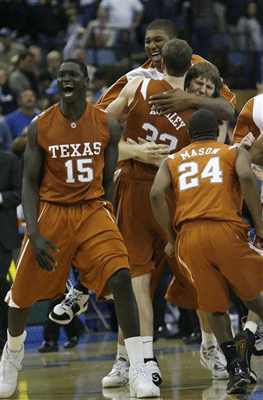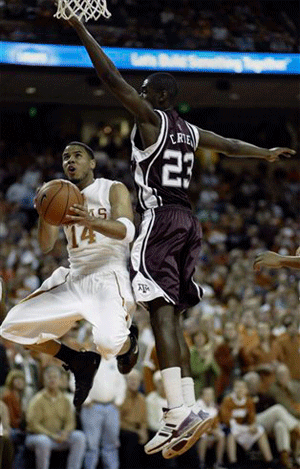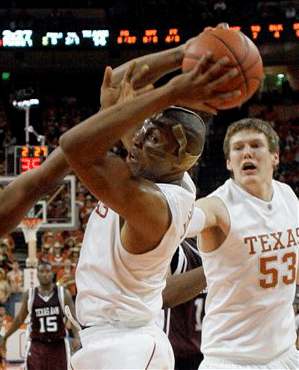







One of the most interesting thing about the first round of the NCAA tournament is usually the intriguing match-ups it creates between teams who hardly — if ever — play each other. Last year, the Longhorns were scheduled to face New Mexico State for the first time in 16 years, so we decided to put out our own scouting report to familiarize fans of the (other) Aggies with their opponents. And considering how big football is in Texas, it’s safe to say that the LRT scouting report might even be useful for Longhorn fans who were a little late joining the basketball party.
There’s a lot to cheer about in Austin these days The big picture At first blush, the scariest thing about the Longhorns is their high-powered offense, which finished 2nd in the nation in adjusted efficiency. For much of the season, Texas sat atop those rankings, propelled by an absolutely insane performance in the Legends Classic. The Longhorns dismantled New Mexico State and Tennessee by a combined 199-165 tally and logged mind-boggling efficiency ratings of 141.4 and 132.4 in the two games. But as Texas fell from its perfect 12-0 mark to a troubling 14-3 in the span of only three weeks, defense was the huge culprit. The Longhorns were allowing teams to torch them from anywhere on the court, but particularly from behind the arc. The poor defense came to a head in an embarrassing road loss to Texas A&M on January 30th, where the Aggies ran roughshod over a porous Longhorn D en route to an early 19-3 lead and eventual 80-63 victory. The loss was a turning point of sorts for Texas, as Rick Barnes’ team ran off eight straight wins in a perfect February. The key in many of the victories wasn’t the highly-efficient offense, but rather a suddenly stiff defense that held three opponents under 54 points during the streak. While that defense was non-existent in last weekend’s shootout with Kansas at the Big 12 Tournament, teams who may face Texas in the big dance can no longer focus on just stopping the Longhorn scorers.
D.J. Augustin has the Longhorns flying high The players As most fans of college basketball can tell you, it all starts with point guard D.J. Augustin. The All-American can blow by defenders off the dribble, or drill a three-pointer when the defenses sag too far off. Most of the Longhorn offense is based on Augustin testing the opposing D with quick penetration and finding the weak spots for shots or assists. Although D.J. can hit from anywhere on the floor — his ability to stop on a dime and hit a fadeaway is particularly frustrating for coaches — Texas is best when he’s not carrying the offense. As Pat Forde pointed out in his column today, the Longhorns are 20-1 when Augustin takes less than 16 shots, but only 8-5 when he takes more. A.J. Abrams is a fairly one-dimensional player, but the tiny shooting guard is incredibly good at that one dimension. Abrams has a lightning-quick release and is usually lights-out from long range. The Longhorns love to use bigs to free him up as he cuts across the lane, and often open up enough space for him to shoot with ball screens on the perimeter. The biggest knock on Abrams is his knack for becoming too confident after hitting a few shots and forcing ones that he should not be taking. While he’s improved his running jumpers this year, he is still not a great shooter inside off the dribble, but you will see him jacking those up if he thinks he’s hot.
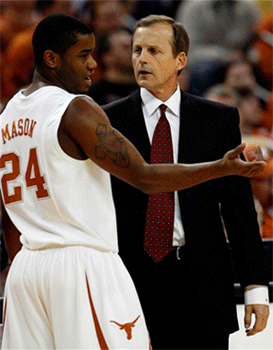
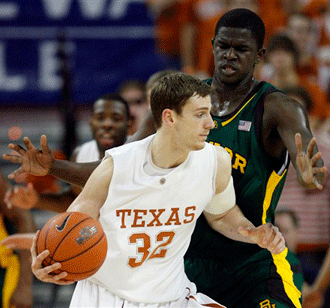
Justin Mason provides the glue for the Longhorns The most overlooked player on the Texas roster is probably Justin Mason, a glue guy who plays incredible defense and hustles all over the floor. His constant motor gets him a lot more rebounds than fans would expect from a guy his size, and he’s often able to match up with bigger guys. Mason is not a high-scoring threat, but does have three-point range and will pick up quite a few trash buckets inside after those hustle rebounds. Damion James has become a breakout star in his second season on the Forty Acres, as the departure of Kevin Durant allowed DaMo to move to his more natural position on the wing. While Texas needs his presence on the glass, James is a hell of an outsider shooter that often knocks down the long-range Js without even nicking the iron. Don’t be confused by the fact that Damion hangs out on the perimeter a lot — he still gets his share of rebounds, and is a threat for a double-double every night. His dual-threat game is also key for the Longhorns, as it pulls big defenders out of the paint and opens up the penetration game for Augustin and Mason. The other starting big for Rick Barnes is Connor Atchley, a skinny white kid who has really grown in his third season. Atchley has gained a lot of confidence this season, and it has resulted in more points and a ton of blocks. Like James, Atchley can knock it down from outside and spends a lot of time on the perimeter setting screens for the guards. He often finds himself open on the pick-and-pop, so opponents can’t always choose to double following the screen. The biggest knock on Atchley is likely his penchant for picking up early fouls, which leads to limited minutes in the first half. Off the bench, Texas has almost no depth at the guard position. Occasionally Barnes will run a more traditional lineup with only two guards in an effort to get Mason or Abrams some rest, but Augustin is often on the floor for 39 or 40 minutes a night. J.D. Lewis is a senior JuCo transfer who was known for his long-range ability, but hasn’t really shown it yet at Texas. Harrison Smith was a three-star recruit who has languished on the pine for the whole season. Fans shouldn’t expect to see either of these players except in blowout situations or to eat up fouls if the Horns find themselves down late.
Gary Johnson could be the X-factor for Texas In the post, the Longhorns have many more players to choose from. Freshman Gary Johnson missed half the season with a heart condition, but has really grown in Big 12 play to become an inside threat. Although he’s a tad undersized to bang down low, Johnson will often take on the bigger players in the post and fight on the glass. Early in the season, the biggest knock on Johnson was his inability to hit from the line, but his free throw shooting has improved drastically over the last few weeks. Against Oklahoma State in the Big 12 Quarterfinals, Gary went down with an injury that has been described as either a muscle strain or an ankle problem. He missed the next two games, but could be available for this weekend’s contests. Without Johnson for those two games, Barnes turned to his other young post reserves, tapping Alexis Wangmene for a bunch of minutes. Wangmene has a ridiculous wingspan and occasionally showcases some really nice post moves, but is still pretty raw. He plays really solid defense when he remembers to hold his position, but if he finds himself behind the play will often pick up unnecessary fouls. Freshman Clint Chapman hails from Oregon and is another unpolished freshman. He’s still got stone hands, but hustles his tail off and has shown some improvement in his defense over the last few weeks. If Texas is relying on Chapman for significant minutes during the tournament, they will likely be in trouble. But to give the key bigs a quick breather, Clint is a serviceable option. The biggest guy on the Longhorn roster is Dexter Pittman, who was once about 100 pounds bigger. If he ever sees the court, you’ll hear the story ad nauseum from the announcers, but the Cliff Notes version is that Strength and Conditioning Coach Todd Wright put Dex on a strict diet and exercise regimen to get him down to his svelte playing weight. Pittman is a solid rebounder and is an absolute force in the paint on the offensive end, but his poor defensive play means that he often doesn’t earn many minutes.
Connor Atchley must control his fouls during the tourney The weaknesses As mentioned earlier, Atchley has a problem with picking up early fouls. But that disease sometimes spreads to James, as well, and it cripples the interior game for Texas. In response, Barnes often goes to a zone defense to protect his bigs from foul trouble, and last week’s Kansas game shows how poorly that can turn out for Texas. The Longhorn guards are very short and already give up a few inches to most opposing backcourts, but the zone defense really exposes Texas on the perimeter. The Longhorns have also shown some trouble from the free throw line this season, particularly late in games. Missed free throws played a huge role in the loss to Wisconsin back in December, and late-game misses allowed Baylor to nearly rally in the final few minutes against Texas in Waco. Augustin and Abrams are usually safe bets from the line for the Longhorns, but even they have sometimes struggled late in the game. If a game is close in the end — and when doesn’t that happen in the tournament? — this could be Texas’ undoing. Teams with solid bigs are going to present a problem for the Longhorns as well, which is why I’m crossing my fingers for Marquette to advance to the Sweet Sixteen. The Longhorns did well against UCLA by packing the lane with a zone that controlled Kevin Love. Fortunately, the Bruins were content to shoot over it and were unable to hit their long-range shots. But an opponent with quality inside play and one or two sharpshooters could be an absolute nightmare for Texas. |